📌 Part of the guide: Packing a Go Bag: Checklist, Documents, and Family Plan
The Emergency Preparedness Test helps you discover how well your household is prepared for everyday disruptions, such as a power outage. You answer 20 questions with yes or no, count your yes answers, and see in the evaluation where you stand and what you should tackle first.
How the Emergency Preparedness Test Works
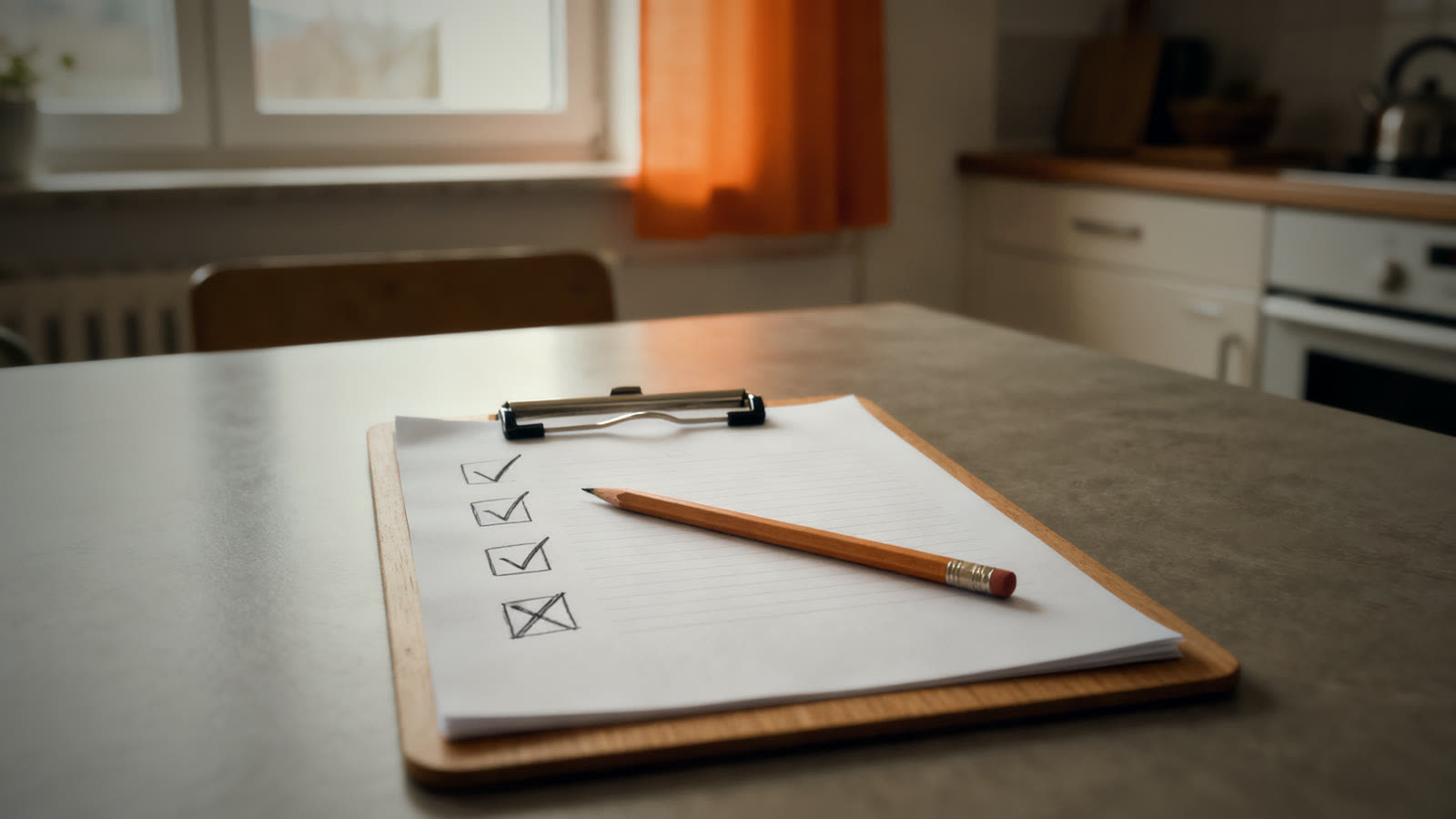
Take a piece of paper and some quiet time. Go through the questions one by one and answer honestly. A “yes” counts only if the thing is actually done, not if you’re “planning to” do it. For each yes, you note down one point.
The point isn’t to collect as many points as possible. The Emergency Preparedness Test is meant to show you where the gaps are so you can address them strategically. Almost every household has gaps, and that’s no cause for concern. What matters is that you know them and close them step by step.
The recommendations of the Federal Office of Civil Protection and Disaster Assistance (BBK—Germany’s Federal Office of Civil Protection and Disaster Assistance) serve as the benchmark. It recommends being able to provide for yourself for up to ten days. Even emergency supplies for at least three days help considerably. The EU Preparedness Union strategy calls on the population to maintain essential supplies for at least 72 hours in emergencies. How both figures fit together is explained in our article 72 Hours or 10 Days?
The test is divided into three parts. Part 1 covers questions 1 through 7, Part 2 questions 8 through 14, and Part 3 questions 15 through 20. After each part, you count your yes answers and write down the number. At the end, you add everything up.
Part 1: Water, Supplies, and Cooking (Questions 1–7)
The first part focuses on the essentials of everyday life: drinking, eating, and the ability to prepare both. Answer each question with yes or no.
- Do you have emergency supplies at home for at least three days for all people in your household?
- Have you set the goal of supporting yourself for up to ten days, and are you on track to achieve it?
- Have you planned drinking water for all people and calculated the amount per person per day?
- Have you considered special needs, such as for children, elderly people, or dietary restrictions?
- Does your stockpile contain a varied selection, such as grain products, vegetables, fruit, dairy products, eggs, meat, fish, and fats and oils?
- Can you prepare a meal during a power outage, or do you have food in your supplies that also tastes good cold?
- Do you regularly check the best-by dates of your supplies?
Background to the Questions
For water, the nutritional preparedness supply calculator assumes about 1.5 liters per day for drinking. Add 0.5 liters for cooking, for a total of about 2 liters. For seniors aged 65 and older, it recommends 2 liters; for children up to 12 years old, about 1 liter of fluid per day. You’ll find the detailed considerations in How Much Drinking Water Do I Need in an Emergency?
For food, the calculator assumes 2,200 kilocalories per person per day. It can be adjusted for a period of 1 to 28 days. The recommendations are general and should be adapted to your individual nutritional needs as necessary. For concrete guidance, see The 10-Day Emergency Stockpile According to BBK Recommendations.
Question 6 concerns preparation. Pay attention to safety: grills, gas stoves, or camping stoves don’t belong in enclosed spaces without adequate ventilation. You’ll find ideas in Cooking Without Electricity: Safe Options and Emergency Supplies Without Cooking. For Question 7, Best-By Dates Expired on Canned Goods: How to Check Correctly will help you.
Now count your yes answers from Part 1 and write down the number. A maximum of 7 points is possible.
Part 2: Power, Heat, and Information (Questions 8–14)
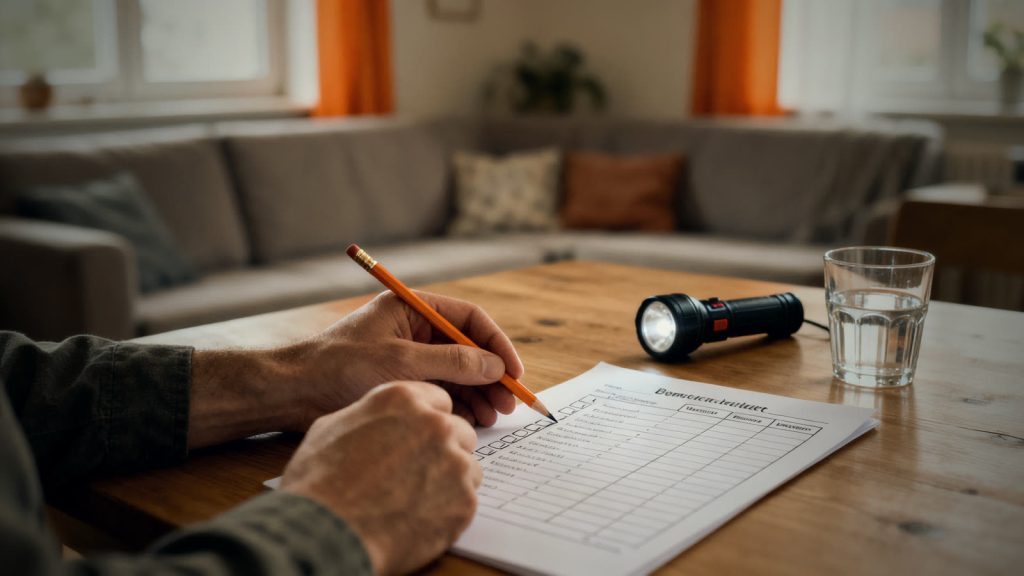
The second part of the emergency preparedness quiz tests whether you can still act effectively in darkness, in the cold, and without the internet. Here too, only what you’ve already completed counts.
- Do you have flashlights or headlamps readily available, and do you know where they are?
- Do you have spare batteries or charged rechargeable batteries for your lights and important devices?
- Can you charge your phone without a wall outlet?
- Do you have a radio that works without mains power, such as a hand-crank radio?
- Have you installed the NINA warning app on your smartphone?
- Have you thought about how to safely deal with cold if your heating fails, without resorting to dangerous makeshift solutions?
- Do your smoke detectors work, and have you tested them recently?
Why these points matter
The BBK (Germany’s Federal Office for Civil Protection and Disaster Assistance) shows in its guide the impacts of daily disruptions, for example due to a power outage, and provides measures to prepare for it. What can all fail in such a case is described in What Fails During a Power Outage? For the first few hours, Power Outage: How to Act in the First 24 Hours helps you.
For questions 8 to 10: How to Choose the Right Flashlight and Headlamp and How to Store Batteries and Rechargeable Batteries Safely show you how to plan for light and power effectively. Since storage also involves safety, these articles are worth a closer look.
For questions 11 and 12: The BBK provides the NINA warning app to alert the population to hazards. A radio without mains power complements it if mobile networks or the internet are not working. Learn more in Public Warnings: NINA, Cell Broadcast, and Sirens and The Hand-Crank Radio.
For question 13: Not every tip from the internet is safe. Improvised emergency heaters can release carbon monoxide or cause a fire. Learn why some makeshift solutions are dangerous in Carbon Monoxide: The Hidden Danger with Emergency Heating. Keeping Your Home Warm When Your Heating Fails describes safe approaches. For fire safety in question 14, refer to Fire Safety at Home.
Count your “yes” answers from Part 2 again. A maximum of 7 points is also possible here.
Part 3: Health, Documents, and Plan (Questions 15–20)
The third part covers everything that doesn’t sit on a supply shelf: health, documents, money, and household arrangements.
- Do you have a first aid kit and home medicine cabinet, and do you know what’s in them?
- Have you taken a first aid course or similar training, and would you like to refresh your knowledge if needed?
- Have you organized your important documents and stored them in an easily accessible place?
- Have you thought about how you would manage if card payments don’t work, for example by keeping a cash reserve?
- Do you have an emergency contact list and an agreed-upon meeting place for your family?
- Have you and your household discussed what to do if you have to evacuate your home?
These questions are less visible than a well-stocked supply shelf, but often crucial in an emergency. You’ll find practical guidance in Home Medicine Cabinet for Emergencies, First Aid Refresher, and The Document Folder.
For Question 18, see Emergency Cash Reserve. For Questions 19 and 20, you’ll find help in Emergency Contact List and Family Meeting Point and Evacuation: What to Do If You Have to Leave Your Home.
Count your “yes” answers from Part 3. A maximum of 6 points is possible here.
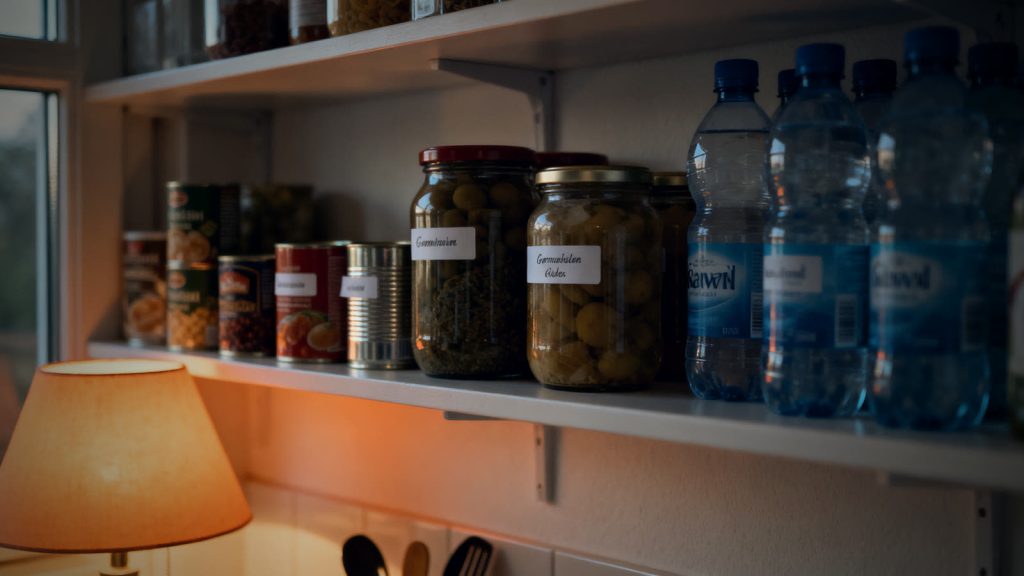
Evaluation: How to Read Your Result
Now add up your points from all three parts. Your total will be between 0 and 20. There are no fixed score thresholds, because every household has different circumstances. The following categories are a guide for you personally, not an official assessment.
- Mostly “No”: You’re just starting out. That’s a good starting point, because even small steps make a big difference. Begin with drinking water and a supply for at least three days.
- Mixed answers: You have a foundation. Now it’s about closing gaps, for example in power, information, or documents.
- Mostly “Yes”: You’re well prepared. Make sure to maintain your readiness, and check your supplies, equipment, and documents regularly.
More important than your total score are your “no” answers. Each one is a concrete task to work on. Safety-critical items like working smoke detectors (Question 14) and safe handling of cold weather (Question 13) should be addressed first, regardless of your overall result.
Regardless of your result: A household is never “finished” with its preparation. Emergency preparedness is an ongoing routine, not a one-time project. Your result from the emergency preparedness test is therefore a snapshot you can work with.
Frequently Asked Questions
How do I prepare for a crisis when starting from scratch?
Start with drinking water and supplies for at least three days. According to the BBK (Germany’s Federal Office of Civil Protection and Disaster Assistance), that helps a lot. Then you expand step by step toward the goal of ten days. A structured process is provided by Prepared in 30 Days.
How many days should my supplies cover?
The BBK recommends being able to provide for yourself for ten days if possible. The EU strategy calls for maintaining essential supplies for at least 72 hours. So you can start with three days and expand from there.
How many calories and water do I need per person?
The supply calculator of food supply preparedness counts on 2,200 kilocalories per person and day as well as about 2 liters of liquid, of which 1.5 liters for drinking and 0.5 liters for cooking. For children up to 12 years, it recommends about 1 liter per day. Adjust the quantities to your personal situation.
How often should I repeat the crisis preparedness test?
There is no fixed requirement. It makes sense to repeat the crisis preparedness test regularly, especially after changes in your household, such as new family members or a move. You can also check supplies and equipment on fixed dates, as described in Check Emergency Supplies: Fixed Routine During Daylight Saving Time.
Your next steps after the crisis preparedness test
The test only becomes useful when you take action. Therefore, proceed as follows:
- Write down your result with the date and post the list visibly, for example on the refrigerator.
- Mark all “no” answers and sort them: security first, then water and supplies, then everything else.
- Set fixed dates in your calendar for the most important items.
- Discuss the result with everyone in your household and distribute tasks.
- Repeat the test at a later date and compare the results.
If you work your way through step by step, you don’t need a big push all at once. The European Commission and the High Representative jointly presented the EU Preparedness Union Strategy on March 26, 2025. It includes 30 key actions, including an EU Preparedness Day and the inclusion of emergency preparedness in curricula. With your crisis preparedness test, you have already taken the first step.
Sources and Further Information
General information, no substitute for individual advice from authorities, emergency services or medical professionals. In an emergency in Europe: 112.