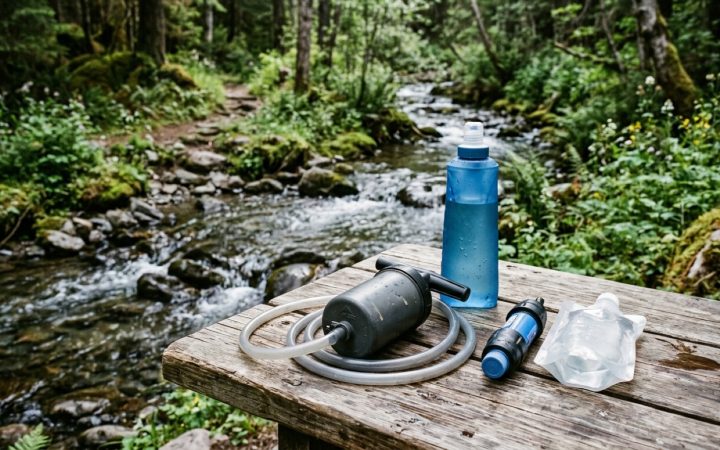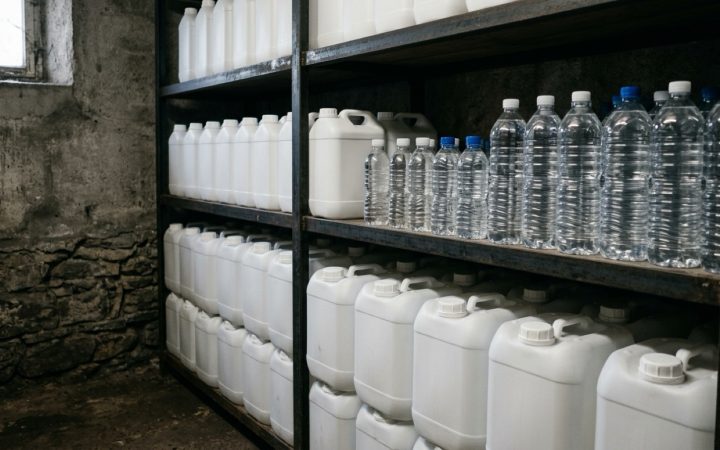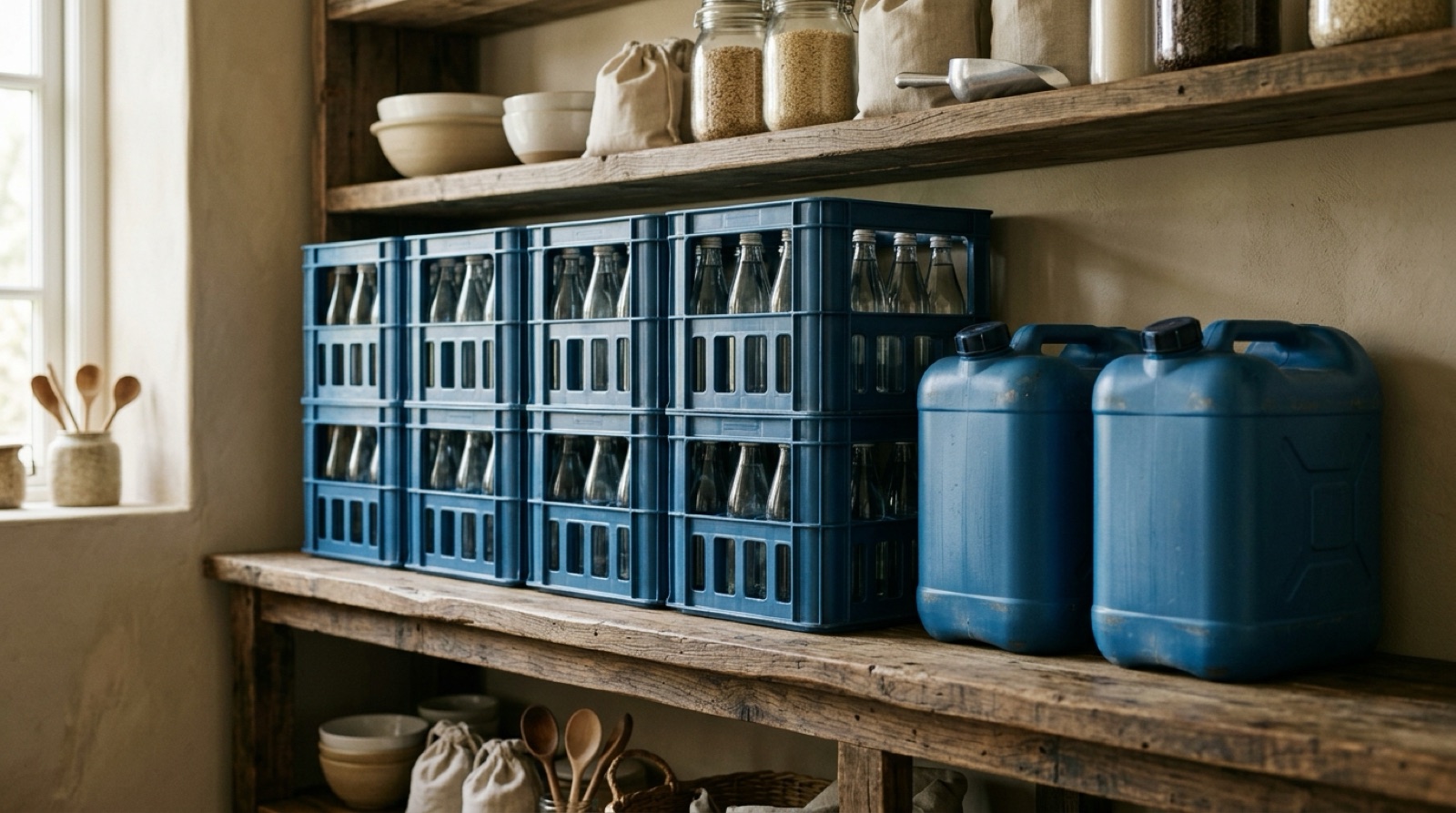
When we talk to people about emergency preparedness, we always ask what runs out first. The answer is almost always “food.” Actually, it’s water. Germany’s Federal Office of Civil Protection and Disaster Assistance (BBK) puts it bluntly: a person can survive for roughly three weeks without food, but only about four days without fluids. That’s why drinking water tops the list at LAGEBEREIT. The good news: the right amount is easy to calculate, and building up a supply doesn’t cost much money or time.
The basic formula: 2 liters per person per day
The BBK recommends that every household be able to be self-sufficient for up to ten days. For water, there’s a simple calculation:
- 1.5 liters per person per day for drinking
- 0.5 liters per person per day for cooking
- totaling 2 liters per person per day
Over ten days, that comes to 20 liters per person. A household with two adults and two children would need around 80 liters. That may sound like a lot, but depending on bottle size, it’s only about seven to nine cases of mineral water. If you’d rather start small: according to the BBK, even a three-day emergency water supply already makes a noticeable difference.
In basic training, you quickly learn: if you wait until you’re thirsty, you’ve already waited too long to drink. In an emergency, that’s doubly true, since stress and physical exertion increase your fluid needs, often without you noticing.
When you should plan for more
The 2-liter rule is a minimum for adults under normal conditions. In certain situations, you should plan more generously:
- Heat: In high temperatures, the BBK recommends drinking at least 1.5 to 2 liters a day — for drinking alone. If a power outage hits during a heat wave, plan for significantly more.
- Physical labor: Cleaning up after a storm, hauling sandbags, or fetching water all increase your fluid needs.
- Children and infants: Baby formula requires water of impeccable quality. It’s best to check infant water needs with a pediatrician or midwife.
- Older adults and people who are ill: They often feel thirst less intensely. If you have a pre-existing condition — for example, if your fluid intake is medically restricted — check with your doctor.
- Pets: Dogs and cats need water too. How much depends heavily on the type of animal, its size, and its food. When in doubt, ask your veterinarian.
What about washing and the toilet?
The 20 liters per person covers only drinking and cooking. It’s not enough for personal hygiene, dishwashing, or flushing the toilet. For that, though, you don’t need drinking-quality water. Many households also fill the bathtub, buckets, and pots with tap water as soon as a disruption is announced. This utility water is meant for hygiene and flushing, not drinking. We have separate articles on hygiene without running water and on emergency toilets.
For comparison: even the government’s emergency drinking water supply via emergency wells, which the BBK describes for a defense scenario, is planned at 15 liters per person per day. That shows how quickly your needs go beyond just drinking.
What your supply can be made up of
You don’t need to buy special water. Three approaches have proven effective, and you can combine them:
- Store-bought mineral or table water: The simplest option. According to the Food Supply Portal run by Germany’s Federal Office for Agriculture and Food, mineral water in its original sealed bottle, stored cool, dark, and dry, keeps almost indefinitely. Still water is also suitable for cooking.
- Self-filled tap water: Cheaper, but requires more upkeep. Use clean, food-grade canisters and refresh the water regularly. More on this in our article “Storing Drinking Water Correctly.”
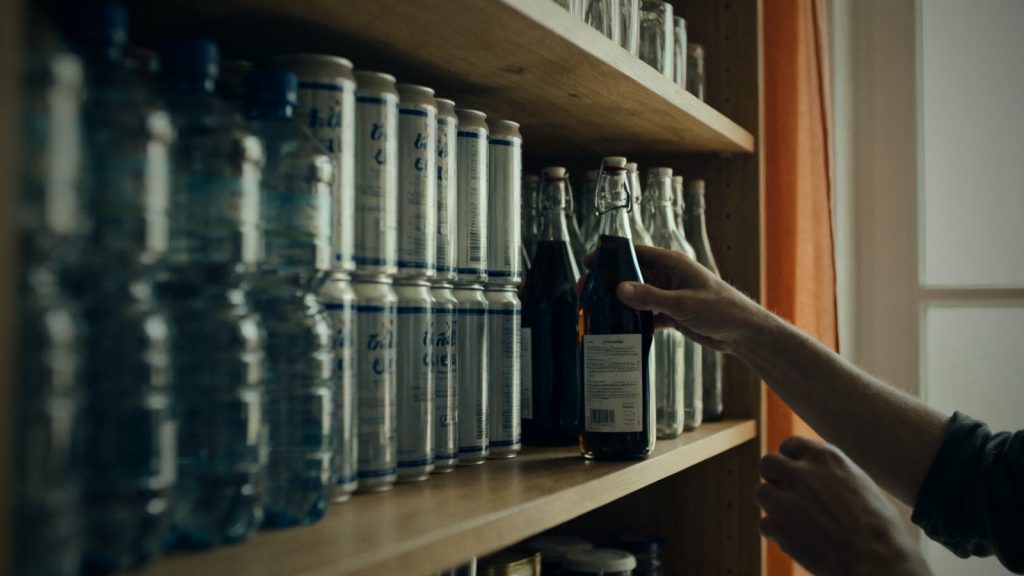
- Juices and other drinks as a supplement: They count toward your fluid intake but don’t replace water for cooking.
How to calculate the right amount for your household
Take five minutes and a piece of paper:
- Count the people in your household.
- Multiply by 20 liters (5.3 gallons) per person (ten days).
- Add extra for heat waves, infants, or people who need care.
- Include water needs for pets.
- Subtract beverages you already have on hand – build up the rest step by step.
A handy tool is the supply calculator at ernaehrungsvorsorge.de. Enter the number of people and the number of days you want to plan for, and it calculates not only food but also the amount of water you’ll need.
Where to store your water supply
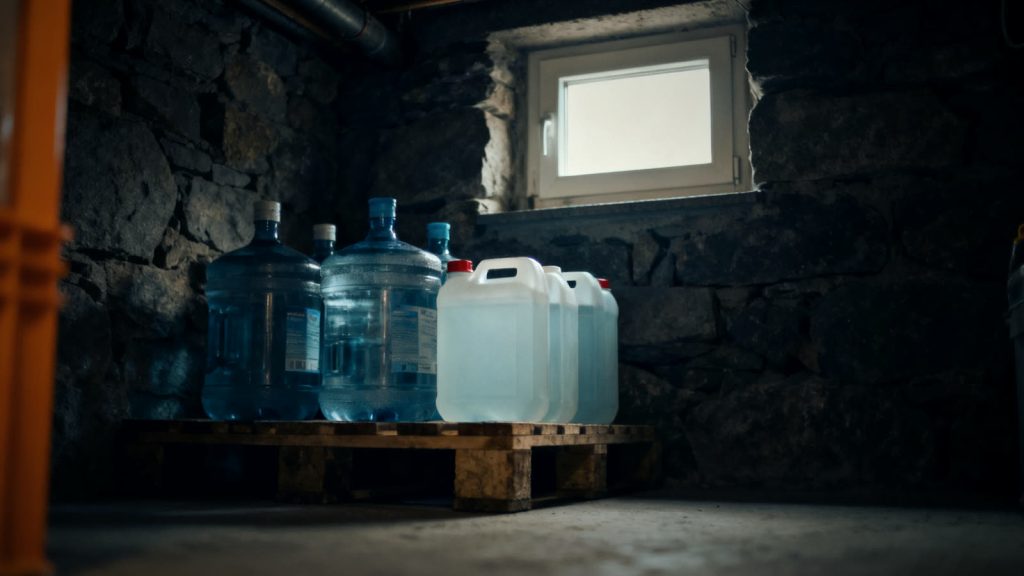
Water is heavy: 20 liters weighs 20 kilograms (about 44 pounds). Store it where you can reach it without hauling it far, and spread larger quantities across multiple spots, such as the basement, a storage room, and the kitchen. A cool, dark place preserves quality best. If you live in a flood-prone area, keep part of your supply on a higher floor instead of in the basement.
Common mistakes
- Only calculating for yourself: Partners, kids, guests, and pets all need to be factored into the calculation.
- Forgetting about the supply: Set a fixed date, like when the clocks change, to check expiration dates and containers.
- Mixing utility water and drinking water: Label containers clearly so no one drinks from the wrong one.
Water preparedness isn’t rocket science. A few cases in the basement and a clear calculation will get you very far – and give you exactly what matters most in an emergency: peace of mind.
In short: Plan for 2 liters (about half a gallon) per person per day, meaning 20 liters (5.3 gallons) for ten days. Add more for heat waves, infants, people who need care, and pets. Water for hygiene and the toilet comes on top of that and doesn’t need to be drinking water.
Compare suitable gear
| Produktbild bei AmazonCompactplasteo Wasserkanister 10 l | Produktbild bei AmazonProven Classichünersdorff Wasserkanister 12 l | Produktbild bei AmazonLarge Supplyhünersdorff Wasserkanister 22 l | |
|---|---|---|---|
| Rating | at least 4.3 out of 5 starswith 500+ customer reviews (our selection criterion)See current reviews* | at least 4.3 out of 5 starswith 500+ customer reviews (our selection criterion)See current reviews* | at least 4.3 out of 5 starswith 500+ customer reviews (our selection criterion)See current reviews* |
| Features |
|
|
|
| Pros |
|
|
|
| Cons |
|
|
|
| View on Amazon* | View on Amazon* | View on Amazon* |
Selected by manufacturer data and customer reviews (at least 4.3 stars with 500+ reviews). We only show exact star ratings when they come from Amazon the same day. As of 04.10.2026. Not tested by us. Current prices and reviews are on Amazon. *Ad · paid link
Conclusion: our product picks
Water Canisters with Spigot Compared
For home storage, 22-liter canisters are the most efficient option – one per person covers the BBK's recommended 20 liters. If you need to carry it, go with several 10- or 12-liter canisters. Store canisters in a cool, dark place and rotate the water regularly.
Links marked with * are advertising links. As an Amazon Associate I earn from qualifying purchases.
Sources and further information
- BBK (Germany’s Federal Office of Civil Protection and Disaster Assistance) – Stocking up on food and water
- BBK – Recommended precautions during heat waves (press release 2025)
- BBK – Measures for securing the water supply
- BLE (Germany’s Federal Office for Agriculture and Food) – Food preparedness: recommendations and tips
- BLE – Supply calculator
General information, no substitute for individual advice from authorities, emergency services or medical professionals. In an emergency in Europe: 112.