📌 Part of the guide: Building Your Emergency Supply Kit: A 4-Step Guide to 10 Days of Readiness
If the best-by date has expired, canned goods are not automatically spoiled. Undamaged, unopened cans can often be safely consumed years after the printed date when stored properly—that is, in a dry location and at temperatures below 19°C. What matters is that the packaging remains intact and the smell, appearance, and taste are as expected.
This question comes up sooner or later, especially when building an emergency food supply: A can on your shelf has been past the date for months, and you’re wondering whether you can still open it. In this article, you’ll learn what the best-by date actually means, which cans you should discard, and how to organize your supply so you have to make these decisions less often.
What the Best-By Date Really Means
The best-by date is the date up to which the manufacturer guarantees that an unopened food item will retain its specific properties when stored properly. These include smell, taste, and nutritional value. So it’s a manufacturer’s quality guarantee, not a statement that the product becomes unsafe the day after the date.
Manufacturers determine the best-by date themselves, in good faith, based on testing, studies, or expert assessment. The date describes how long a packaged food can be stored and consumed while maintaining its typical properties. “At least” is the key word here.
Retailers are also permitted to sell products after the best-by date has expired. However, retailers must carefully verify that the food is still in good condition and must inform customers accordingly. So an expired best-by date is not a ban, but a reason to check.
The Difference Between Use-By Date and Best-By Date
There is a clear distinction between use-by date and best-by date. The use-by date appears on highly perishable foods like ground meat or smoked fish. After it expires, bacteria pose a health risk. Such foods can no longer be sold after that date, and you should not eat them either.
- Best-by date (“best by”): Manufacturer’s quality guarantee. After this date, inspect the product; when stored properly, it can often still be safely consumed.
- Use-by date (“use by”): For highly perishable foods. After this date, the product must not be consumed.
If you don’t confuse the two, you avoid both unnecessary waste and real risks. So make sure to check which of the two dates appears on each product.
Best-By Date Expired on Canned Goods: How Long Do Cans Last?
The Verbraucherzentrale (Germany’s consumer advocacy center) states that undamaged, unopened canned goods can often still be eaten for years after the best-by date has passed. However, it does not provide a specific timeframe. Therefore, there is no reliable rule of thumb here along the lines of “two years is always safe.” Anyone who promises you something like this cannot back it up.
Two things are therefore decisive: the condition of the can and storage. The Verbraucherzentrale recommends storing unopened canned goods at basement temperature—that is, below 19°C—and keeping them dry to prevent corrosion or damage. An undamaged can stored this way is a good candidate for inspection after the date has passed.
For your emergency supplies, this means: The date is a reference point for planning, not a switch that flips at midnight. You can inspect canned goods after the date passes and use them if everything checks out. However, you should also not blindly rely on this and never check your supplies for years.
Three Things to Check: Packaging, Smell, Taste
The German Federal Office of Consumer Protection and Food Safety (BVL) lists three criteria: If the packaging is intact, the food smells as it normally does, and it tastes normal when you take a sample taste, it can be consumed beyond the best-by date. This results in a simple checklist:
- Inspect the packaging: Is the can intact?
- When you open it, smell and look: Does the appearance and smell seem normal?
- Taste test: Does it taste normal?
If you notice anything unusual with the packaging or smell, the decision is made. Then skip the taste test and dispose of the product.

Swollen Cans and Deep Dents: These Canned Goods Don’t Belong on Your Plate
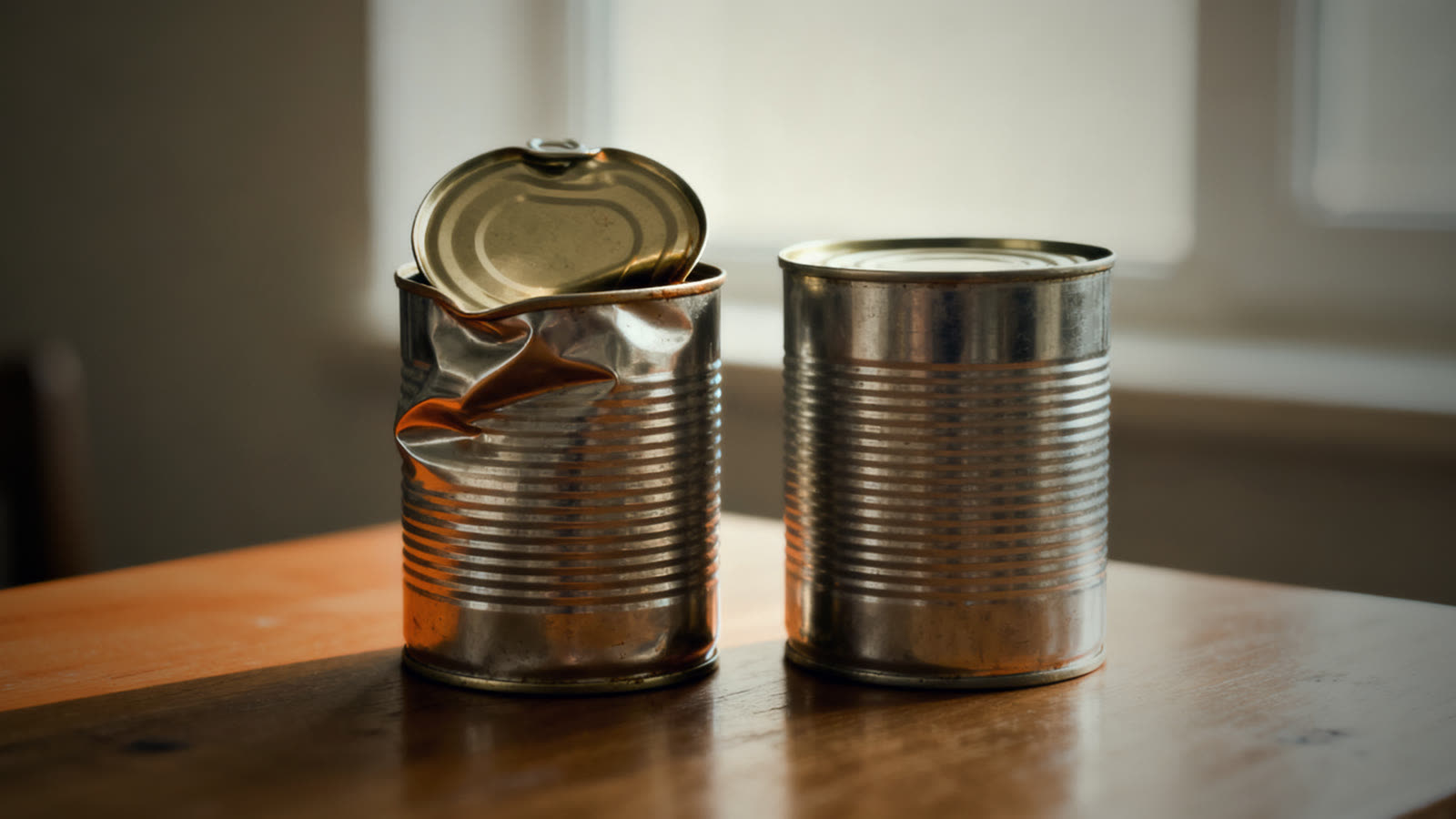
The packaging is the first and most important criterion. The Verbraucherzentrale recommends discarding severely dented or swollen cans immediately. There is nothing to weigh here. Do not put such a can back on the shelf “for later”—remove it at once.
Severe Creases and Dents
Mechanical damage also counts. You should avoid cans with severe creases or dents, because contaminants from the can may have leached into the product. If you are unsure whether damage is still harmless, it is better to discard it. A can is quickly replaced relative to the risks.
Storage also plays a role. The Verbraucherzentrale emphasizes that canned goods must be stored in a dry place so they do not corrode or become damaged. A dry storage location thus protects not only the contents but also the can itself.
Quick Check for the Can
- Can not swollen or severely dented
- No severe creases or dents
- Can was stored in a dry place
- Nothing unusual in smell or appearance when opening
See, Smell, Taste: The Sensory Test
For foods with an expired best-by date, the consumer center recommends trusting your own senses: sight, smell, and taste. After the best-by date has passed, products are often still perfectly safe to consume if stored properly. What matters is the order: first you check the packaging, appearance, and smell. Only if everything looks normal there should you taste the product.
Warning Signs When to Stop
For foods with expired best-by dates, the consumer center lists these warning signs. If you encounter any of them, you should not eat the product:
- visible mold
- unpleasant smell
- sour taste
- tingling on the tongue
For canned goods in particular, deviations in appearance, smell, or taste indicate spoilage. If the contents look different than usual or smell off, don’t taste further – dispose of it instead. A taste test is only appropriate if the packaging, appearance, and smell are unremarkable.
Keep in mind: The sensory test is a recommendation from the consumer center for foods with expired best-by dates. It does not apply to products with expired use-by dates. And an uneasy feeling is sufficient reason to throw out a product.
Store Properly and Rotate Your Stock
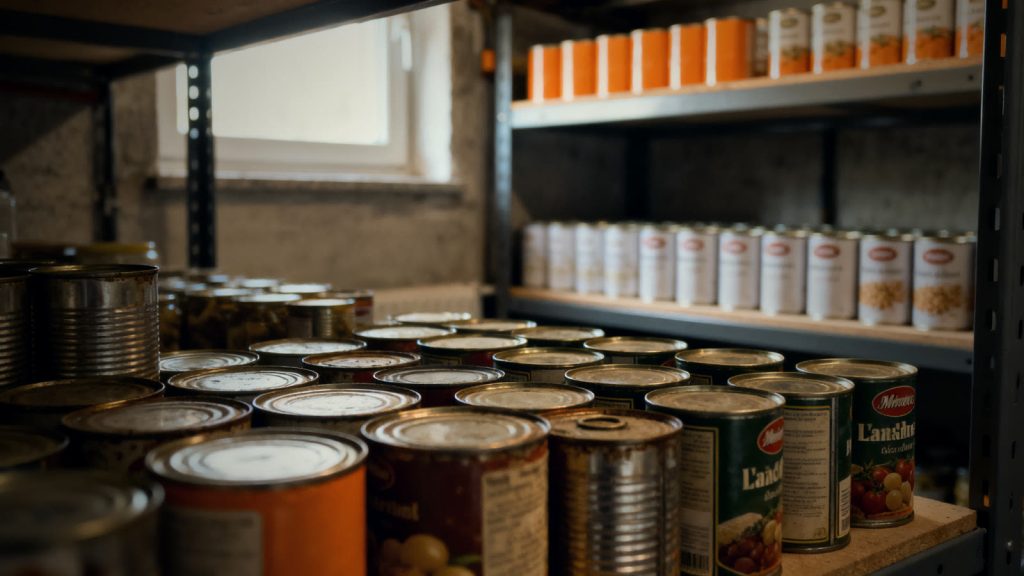
The consumer center recommends storing unopened canned goods at cellar temperature, meaning below 19 °C. They should also definitely be kept dry. A cool, dry room is therefore the right place for your canned food supply.
Especially in a rental apartment, a cellar is not always available. How to store supplies in a small space is explained in our article on Preparedness in a Small Rental Apartment with Limited Space. The core question remains the same: Where in your apartment is it cool and dry enough?
Handling Opened Canned Goods Properly
Once the can is open, the rules change. The consumer center recommends transferring the remainder into a food-safe container with a lid, for example made of glass, stainless steel, or plastic. The sources consulted do not provide specific timeframes for how long the contents will keep. Therefore, consume the remainder promptly and continue to check appearance, smell, and taste.
Rotate Your Stock So Less Expires
The easiest approach is if canned goods don’t stay beyond their date in the first place. This is where the principle of using supplies in daily life and replacing what is consumed comes in handy. How this works is described in our article on Stock Rotation: The \”Living Inventory\” Principle.
In practice, this means: new cans go in the back, older ones in the front. This way you automatically reach for the can with the earlier date first. A shelf where date and order are visible at a glance saves you many checks and prevents something from being forgotten in the back corner.
- Sort older items to the front, new ones to the back
- Orient the date forward so you can read it without rearranging
- Use cans approaching expiration consciously in your next meals
- Check your supply regularly and remove anything unusual
How to turn regular checking into a fixed habit is covered in our article Check Your Emergency Supply: Fixed Routine for Daylight Saving Time. Those who want to keep track of what should be in their emergency supply will find a good foundation in the 10-Day Emergency Supply Overview by BBK (Germany’s Federal Office of Civil Protection).
Frequently Asked Questions
Can I Still Eat Canned Food After the Best-Before Date?
Often yes. The Verbraucherzentrale (German consumer organization) states that undamaged, unopened cans can often be consumed years after the best-before date. The requirement is an intact package, as well as normal odor, normal appearance, and normal taste. The Verbraucherzentrale does not specify a fixed timeframe.
What Should I Do with a Swollen Canned Can?
According to the Verbraucherzentrale, you should dispose of severely dented or swollen cans immediately. Do not put them back on the shelf and do not use them anymore.
What’s the Difference Between Best-Before Date and Use-By Date?
The best-before date is the manufacturer’s quality guarantee; after that, you can check whether the product is still okay. The use-by date appears on perishable foods such as ground beef or smoked fish. After its expiration, there is a health hazard due to germs, which is why such products should no longer be consumed.
Can a Retailer Sell Products After the Best-Before Date Has Expired?
Yes, retailers may continue to sell products after the best-before date has expired. However, they must carefully check whether the food is still in perfect condition and point this out. Selling products after the use-by date has expired is prohibited.
When Should I Discard a Can with Dents?
In case of a sharp crease or dents. According to the Verbraucherzentrale, contaminants may have transferred from the can into the product. You should avoid such cans. If you’re uncertain, discarding them is the more cautious choice.
Your Next Steps
You don’t have to overhaul your entire pantry right away. With a few simple steps, you can gain clarity and approach an expired best-before date with ease:
- Set a fixed date and calmly review your pantry shelves.
- Check each can for swelling, sharp creases, and dents. Dispose of swollen or severely dented cans immediately.
- Move older items to the front, newer items to the back, and arrange the dates facing forward.
- Use cans that will soon reach their best-before date in your upcoming meals.
- Check your storage location: cool (below 19°C) and dry.
- If the best-before date has expired: first check the packaging, appearance, and odor, then taste a small sample. If you notice mold, unpleasant odor, sour taste, or a tingling sensation on your tongue, stop eating.
If you’re also wondering which foods are particularly suitable for long-term storage, our article on foods with long shelf life can help. This way, your pantry stock becomes more reliable piece by piece, without you having to constantly monitor it.
Sources and Further Information
General information, no substitute for individual advice from authorities, emergency services or medical professionals. In an emergency in Europe: 112.