📌 Part of the guide: Building Your Emergency Supply Kit: A 4-Step Guide to 10 Days of Readiness
A well-planned emergency supply for babies and toddlers secures age-appropriate food, boiled drinking water, hygiene supplies, and a tailored home medicine kit for ideally ten days. Because infants and young children cannot simply fall back on regular adult supplies when stores are closed or during a power outage, you need to factor in their special needs separately from the very start. With a few targeted adjustments, you can build a reliable buffer step by step that grows along with your everyday life.
Emergency Supply for Babies and Toddlers: Why Ten Days Make All the Difference
The Bundesamt für Bevölkerungsschutz und Katastrophenhilfe (BBK, Germany’s Federal Office of Civil Protection and Disaster Assistance) recommends that every household keep a BBK-recommended 10-day emergency supply of food and beverages. If that timeframe seems too big at first, even a three-day supply is a very helpful first step. Especially with young children at home, such a buffer immediately takes the time pressure off in an emergency.
Adults can easily get by for a few days on simple canned goods, crispbread, or rolled oats. An infant in their first year of life, however, strictly depends on breast milk or commercially manufactured infant formula as well as germ-free water. If the power goes out or supermarkets and drugstores remain closed after a severe storm, these products cannot be replaced with improvised home remedies.
There is also a practical factor that many parents underestimate when planning: babies and toddlers develop rapidly. What your child eats today or the diaper size they wear often no longer fits just a few months later. That is why a static emergency supply for babies and toddlers, stored away in the basement once and then forgotten, does not work in everyday family life.
The solution is a supply that is firmly integrated into your everyday grocery shopping and kitchen routine. When you apply the principle of regularly rotating your working pantry, you continuously use up the oldest packages in daily life and place newly bought items at the back of the shelf. This keeps baby formula, jars of baby food, and hygiene supplies fresh at all times and precisely matched to your child’s current age.
Emergency Baby Food Supply: Breast Milk, Infant Formula, and Solid Foods
What your emergency food supply for a baby or toddler actually looks like depends primarily on your child’s age and whether they are breastfed or bottle-fed. During the first twelve months of life, clear nutritional guidelines apply that also provide reliable guidance for emergency preparedness.
Breastfeeding as a Reliable Food Source in the First Six Months
According to Verbraucherzentrale NRW (the Consumer Advice Center of North Rhine-Westphalia), breast milk is the best nutrition for infants during the first six months of life. From an emergency preparedness perspective as well, breastfeeding offers major practical advantages: breast milk is hygienically safe, always at the right temperature, easy for your baby to digest, and immediately available without any preparation.
If you exclusively breastfeed, you do not rely on electricity, cooking facilities, or extra water to mix formula powder to feed your baby. However, this makes it all the more important to factor yourself into your emergency supply planning. Your body needs sufficient fluids and calories, so your own drinking water and emergency food supply must be reliably covered.
Stocking Up on Infant Formula: What Matters for Bottle-Feeding
If you do not breastfeed or only partially breastfeed, commercially manufactured starter infant formula—meaning Pre or Stage 1 formula—is suitable from birth through the entire first year of life. It can be fed entirely on demand according to your baby’s individual needs. Another assessment from Verbraucherzentrale NRW is particularly helpful for your stockpiling: from an expert perspective, switching later to follow-on formula such as Stage 2 or Stage 3 milk is not necessary.
Infants can easily stay on Pre or Stage 1 starter formula throughout their entire first year. Planning Pre formula into your baby’s emergency supply significantly simplifies your stockpiling. You do not need to calculate a switch to different varieties in advance—instead, you simply keep several sealed packages of the familiar starter formula your baby already drinks every day.
Keep an important safety rule from Verbraucherzentrale NRW in mind: infant milk must never be mixed at home from unprocessed cow’s milk or other raw ingredients. Likewise, buying breast milk online is strongly discouraged due to significant hygiene risks. In an emergency, rely exclusively on factory-sealed, commercially tested infant formula from your own supply.
Planning for Solid Foods from the 5th to 7th Month of Life
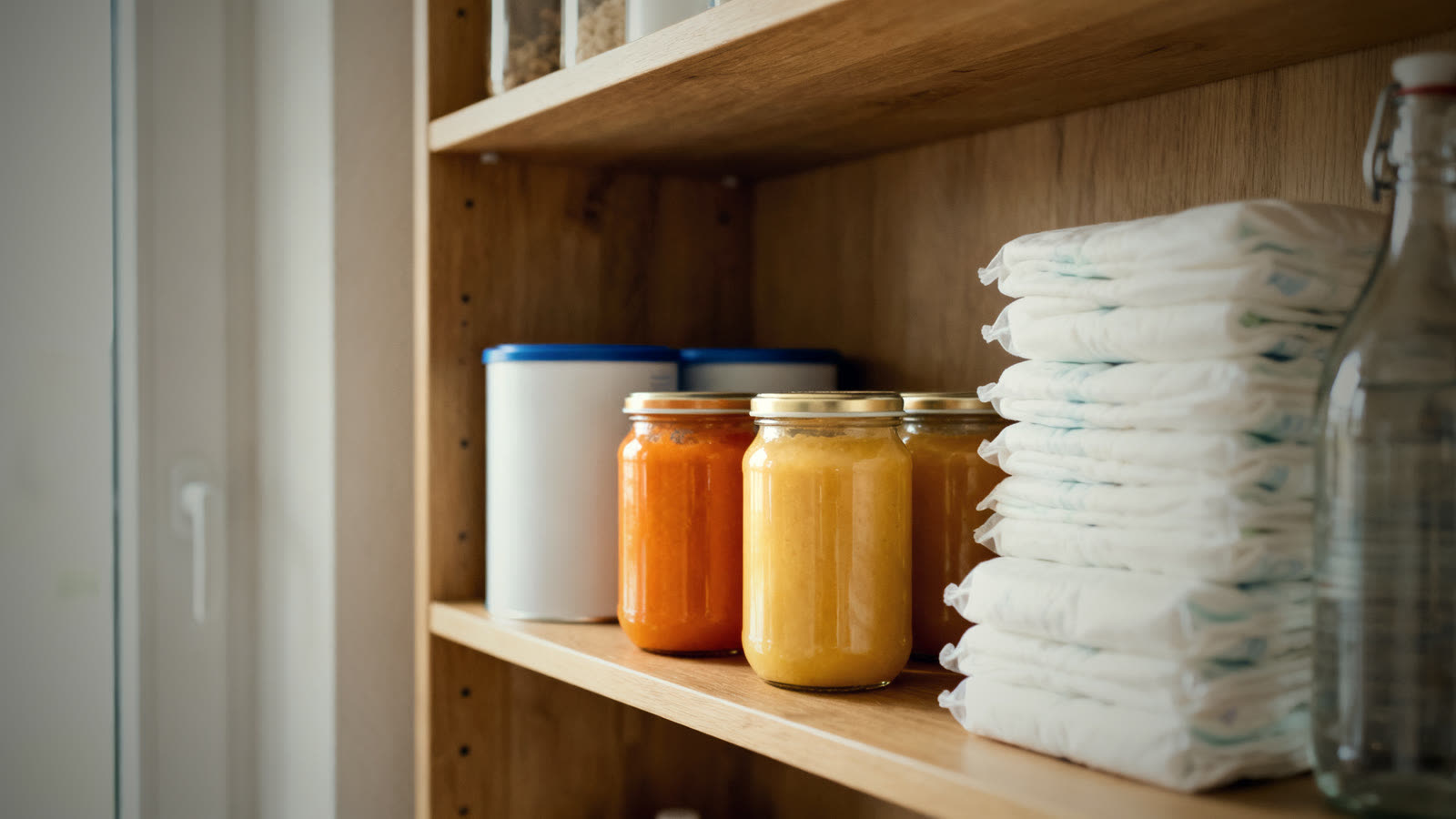
Introducing solid foods is recommended no earlier than the start of the fifth month of life and no later than the start of the seventh month of life. Once your baby is used to purees, gradually expand your emergency supply with shelf-stable baby food products such as jars of vegetable, potato-and-meat, or fruit-and-cereal purees, as well as dry instant baby cereal flakes.
Only include varieties in your baby’s emergency supply that your child has already tried in everyday life and tolerates well. An emergency situation such as a multi-day power outage is not the right time to experiment with unfamiliar ingredients. Since unopened jarred baby food can be stored at room temperature, it is very easy to keep a ten-day supply stocked on your pantry shelf.
Safely Preparing Baby Formula During a Power Outage and Planning Water Supplies
Powdered formula alone is not enough for a baby and toddler emergency supply. To safely prepare baby formula during a power outage or a disruption to the drinking water supply, you need enough suitable water, a way to heat it without electricity, and a consistent hygiene routine in the kitchen.
Calculating Drinking Water Needs for Infant Formula
For emergency preparedness, the BBK (Germany’s Federal Office of Civil Protection) generally calculates two liters of fluid per person per day, with about half a liter allocated for cooking. At the same time, the BBK explicitly advises factoring in additional individual needs, such as preparing baby formula, when calculating your emergency drinking water supply.
If you are planning for a bottle-fed infant, you need water not only for mixing feedings, but also for cleaning bottles and nipples afterward. Store this water in sealed bottles in a cool, dark place. The Verbraucherzentrale NRW (North Rhine-Westphalia Consumer Advice Center) advises against using standard household water filters to prepare baby formula, as germs and bacteria can multiply rapidly inside the filters.
Proper Temperature, Dosage, and Hygiene When Mixing Formula
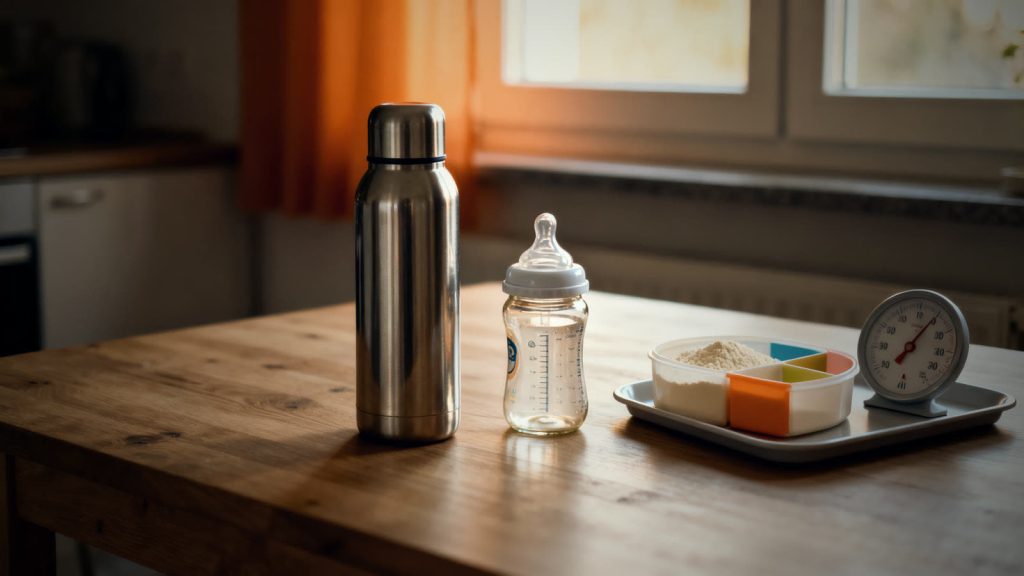
During the first few months of life, an infant’s immune system is still very sensitive. For this reason, water used to prepare infant formula should be boiled and then cooled to a drinking temperature of 30 to a maximum of 40 degrees Celsius before mixing in the powder. A simple kitchen thermometer helps you reliably monitor this temperature range.
When measuring the formula powder, follow the manufacturer’s instructions on the package precisely and always use level scoops with the included measuring scoop. The Verbraucherzentrale NRW warns against altering the mixing ratio: too much powder puts strain on the baby’s kidneys and fluid balance, while too little powder leads to insufficient nutrients.
The rule for how long a prepared bottle keeps is just as strict: formula must always be prepared fresh immediately before each feeding. Because germs multiply rapidly, leftover milk must never be stored or reheated later, and must be discarded immediately after feeding.
Practical Approach Without Stove Power: Thermos and Separate Storage
When an electric stove stays cold during a power outage, you need a safe alternative for boiling water, such as the options we cover in our guide on cooking without power and safe alternatives. To avoid having to start up a camp stove for every single nighttime feeding, a tried-and-tested method recommended by the Bundeszentrum für Ernährung (BZfE, Germany’s Federal Center for Nutrition) for on the go works well.
Because powdered infant formula is not sterile, you must not keep mixed milk warm in advance. Instead, boil a larger amount of water once, let it cool slightly, and pour the warm water into a clean, well-insulated thermos. Store the pre-measured dry formula powder separately in a dry formula dispenser, and mix the water and powder in the bottle only right before feeding.
Emergency Supply for Toddlers: Gradually Transitioning to Family Meals
Once your child turns one, your emergency supply planning changes noticeably. As the Bundeszentrum für Ernährung (BZfE, Germany’s Federal Center for Nutrition) and the Bundesanstalt für Landwirtschaft und Ernährung (BLE, Germany’s Federal Office for Agriculture and Food) explain, toddlers from ages one to three increasingly join in on regular meals at the family table.
As a result, after their first birthday, you can gradually integrate your baby and toddler emergency supply into your general family supply. Instead of specialized infant products, the focus shifts to kid-friendly, shelf-stable staples that the whole family will enjoy and that provide quick energy in an emergency.
According to the BZfE and BLE, shelf-stable basic ingredients such as pasta, rice, rolled oats, and gently processed canned vegetables and fruit are particularly well suited. Rolled oats, for example, can also be mixed with a shelf-stable liquid or fruit puree to make a nutritious meal without any cooking if you want to conserve cooking fuel.
To make sure you don’t overlook anything when putting your supplies together, this checklist will help you with the transition from infant to toddler:
- For infants in their 1st year: Sufficient Pre or Stage 1 infant formula (if not exclusively breastfed), extra drinking water for boiling, as well as a clean thermos and formula powder dispensers.
- From 5 to 7 months of age: Shelf-stable jarred baby food (vegetable, meat, and fruit purees) as well as dry infant cereals in varieties your baby already safely tolerates.
- For toddlers (ages 1 to 3): Kid-friendly staples such as fine rolled oats, short pasta, rice, and mild canned vegetables and fruit as part of your family supply.
- Preparation and equipment: Plenty of clean baby bottles, appropriately sized bottle nipples, spoons, and a safe way to heat water and food without grid power.
Hygiene, First-Aid Kit, and Important Documents for Children
A well-planned emergency supply for a baby or toddler doesn’t stop at food and drink. Just as important are practical routines at the changing table, an age-appropriate first-aid kit, and keeping important documents secure in case you have to leave your home at short notice.
Emergency Hygiene at the Changing Table
During a prolonged power outage, water pressure in the pipes may drop or trash collection may be temporarily suspended. For hygiene without running water, the BBK (Germany’s Federal Office of Civil Protection) recommends items including soap, wet wipes, disinfectant, and sturdy trash bags.
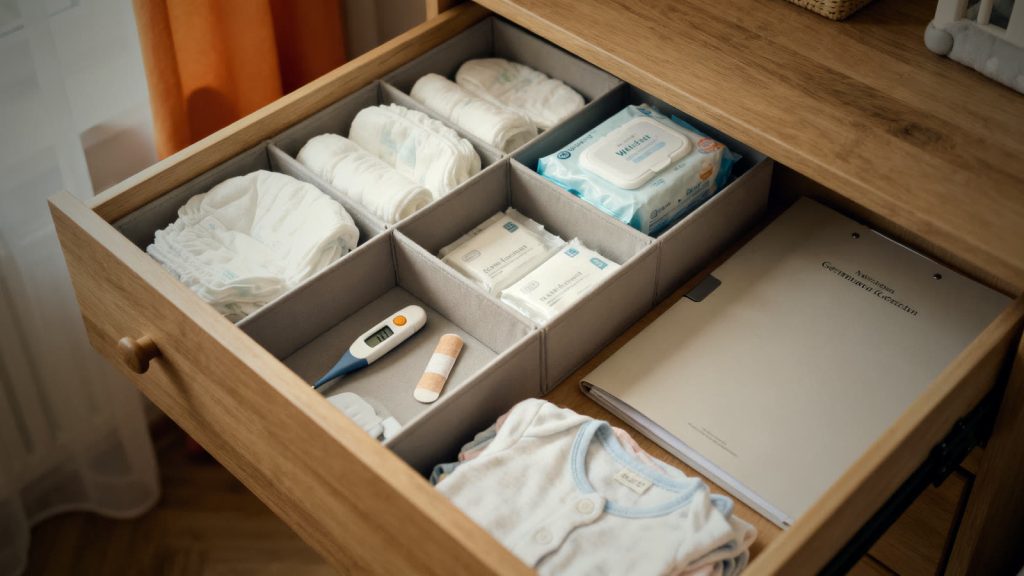
When you have a child in diapers at home, these items are essential. Alongside a ten-day supply of diapers in their current size, plan for plenty of skin-friendly wet wipes and tear-resistant, tightly sealable trash bags. This allows you to store used diapers and other hygiene waste odor-free and hygienically until regular waste collection resumes.
Expanding Your First-Aid Kit for Babies and Toddlers
Young children often come down with a fever or stomach issues at the worst possible times. According to the BBK, a recommended emergency first-aid kit includes personal medications, pain relievers and fever reducers, a working fever thermometer, electrolytes to replace fluids during diarrhea, wound disinfectant, and bandages and dressings.
Electrolyte solutions are an especially important part of a first-aid kit for infants and toddlers, as small bodies quickly lose fluids and salts during diarrhea. Discuss the right selection and age-appropriate dosage form of fever reducers or electrolytes at your next regular visit to your pediatrician’s office or pharmacy, and check expiration dates regularly.
Preparing a Document Folder and SOS Capsule
In some situations—such as a fire, a flood, or a bomb disposal in your neighborhood—your emergency supplies stay on the shelf because rapid evacuation is necessary. For a children’s go bag, the BBK recommends an SOS capsule or neck pouch containing the child’s name, date of birth, and address.
In addition, the BBK advises keeping important documents—such as the vaccination record, the yellow child health checkup booklet, and the birth certificate—ready to grab in a central document folder. Also pack a small supply of your baby’s usual infant formula, drinking water, and diapers in your go bag so your child is taken care of right away while on the move.
Frequently Asked Questions
How much Pre infant formula should I store as an emergency supply for my baby?
If you follow the BBK’s recommendation, plan your supply for ten days if possible—though even three days is a good start. Since infants drink Pre or Stage 1 formula according to their individual needs, simply track in everyday life how many days one package lasts you, and set aside the corresponding number of unopened packages as a dedicated reserve.
Can I use a water filter for baby formula during a power outage?
Verbraucherzentrale NRW (North Rhine-Westphalia Consumer Advice Center) strongly advises against using standard household water filters to prepare baby formula, because germs and bacteria can multiply rapidly inside the filters. Instead, use bottled water or boil tap water and let it cool to 30 to a maximum of 40 degrees Celsius before mixing in the formula powder.
Can I keep prepared infant formula warm for later?
No. According to Verbraucherzentrale NRW and the BZfE (Germany’s Federal Center for Nutrition), powdered infant formula is not sterile and must always be prepared fresh immediately before each feeding. Germs multiply very quickly in warm milk, which is why any leftovers must be discarded right away. Instead, keep only the boiled water warm in a thermos and mix in the powder right before feeding.
Do I need to buy follow-on formula for my emergency supply during the first year?
No—according to Verbraucherzentrale NRW, experts say switching to Stage 2 or Stage 3 follow-on formula is not necessary. Commercially produced infant starter formula (Pre or Stage 1 formula) is suitable from birth throughout the entire first year of life. This makes managing your supply much easier, since you can stick to a single familiar variety.
Your Roadmap: Building Your Child’s Emergency Supply Step by Step
You don’t need to buy your entire emergency supply for your baby or toddler in a single afternoon. Take a structured approach and build your reserve step by step:
- Start with three days: During your next weekly grocery trip, stock your shelves with enough infant formula, baby food jars, drinking water, and diapers to get through three days without shopping.
- Expand to ten days: Over your next few shopping trips, gradually build your supply up to the ten days recommended by the BBK (Germany’s Federal Office of Civil Protection) and incorporate all products into your everyday kitchen rotation.
- Test preparing food without power: Check that you have a clean thermos, a formula dispenser for dry milk powder, a thermometer, and a safe way to cook without grid power ready at home.
- Round out hygiene and health supplies: Add wet wipes, heavy-duty trash bags, a fever thermometer, electrolytes, and age-appropriate remedies to your home medicine cabinet, and place your child’s health checkup booklet and vaccination record in your document folder.
Also set a quick calendar reminder every few months to adjust diaper sizes, clothes in your go bag, and the transition from baby food to kid-friendly staples like pasta, rice, and oats to match your child’s current stage of development.
Sources and Further Information
- Emergency Preparedness Guide and Checklist – Bundesamt für Bevölkerungsschutz und Katastrophenhilfe (BBK)
- Infant Nutrition: From Breast Milk to Baby Food – Verbraucherzentrale NRW (North Rhine-Westphalia Consumer Advice Center)
- Baby Food for Non-Breastfed or Partially Breastfed Infants – Verbraucherzentrale NRW
- Infant Nutrition and Formula Preparation – Bundeszentrum für Ernährung (BZfE, Germany’s Federal Center for Nutrition)
- Emergency Food Preparedness and Toddler Nutrition – Bundeszentrum für Ernährung (BZfE) / BLE (Germany’s Federal Office for Agriculture and Food)
General information, no substitute for individual advice from authorities, emergency services or medical professionals. In an emergency in Europe: 112.