Flooding, a house fire, a gas leak on your street, or the defusing of a World War II bomb: there are situations where you have to leave your home quickly – sometimes with only a few minutes’ notice. In moments like that, there’s no time to calmly think through what you need. That’s exactly what an emergency go bag is for, often also called a bug-out bag. It sounds dramatic, but it’s nothing more than a well-packed bag that’s ready and waiting. If you’ve ever taken kids on a vacation, you know: a well-packed bag is half the battle.
The Basic Principle
The BBK (Germany’s Federal Office of Civil Protection and Disaster Assistance) recommends taking no more for each family member than fits in a single backpack. A backpack is more practical than a suitcase because you keep both hands free – for children, a pet, or to steady yourself. The backpack should get you through one to two days, until you reach a safe place, such as relatives’ home or an emergency shelter. It’s not expedition gear for weeks in the wilderness.
The Basic Checklist Based on BBK Recommendations
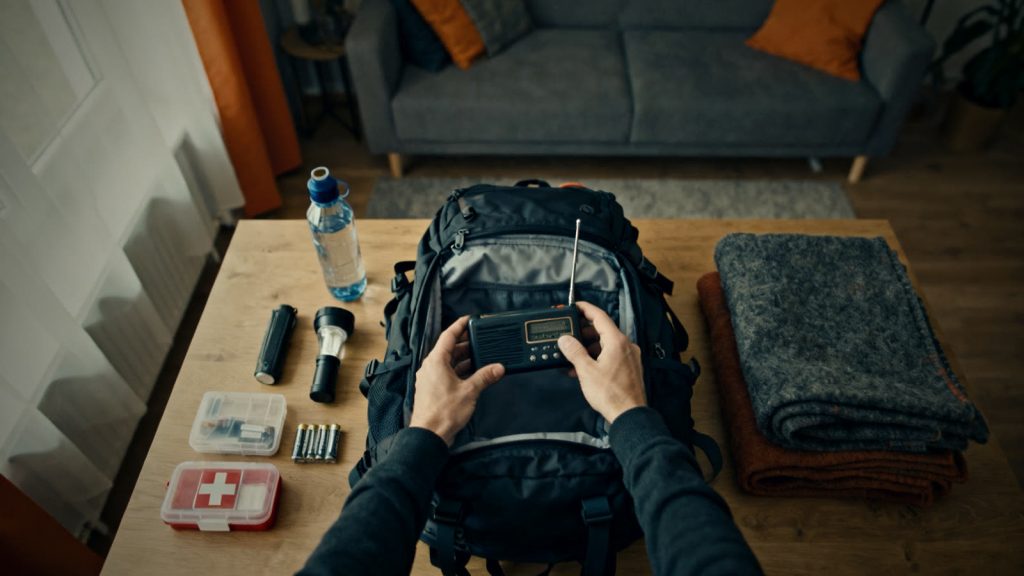
The BBK lists the following items for an emergency go bag. We’ve sorted them into groups and added tips from our own experience.
Health
- Personal medications: A small supply of the medications you take regularly, plus a list of active ingredients. How much you can keep on hand and how to store it is best clarified with your doctor or pharmacy.
- First aid supplies: A compact kit with adhesive bandages, dressings, disposable gloves, and an emergency blanket.
- Respirator mask: The BBK lists it for protection against viruses, bacteria, and hazardous substances, such as in smoke or dust.
Food and Water
- Two days’ worth of food in dustproof packaging: for example, granola bars, nuts, dried fruit, crispbread, and ready-made meals that can be eaten cold.
- Water bottle: filled and shatterproof. A small water filter is a useful addition.
- Dishes, cutlery, can opener, and pocketknife. A note on knife laws: A small pocketknife is generally not a problem, but check the rules of the Waffengesetz (German Weapons Act), for example regarding carrying certain knives in public.
Light, Information, Communication
- Battery-powered radio with spare batteries – or a hand-crank radio.
- Flashlight with spare batteries. A headlamp has the advantage of keeping your hands free.
- Camera or phone with a camera: for example, to document damage. A charging cable and a charged power bank belong in the bag too.
Clothing and Protection
- Clothing for several days with weather protection, meaning at least a rain jacket.
- Headwear and work gloves: against sun and cold, and for clearing debris or branches.
- Sleeping bag or blanket.
Hygiene and Documents
- Hygiene items for several days: toothbrush, toothpaste, soap, toilet paper, feminine hygiene products, wet wipes.
- Document folder with copies of your most important papers.
What You Pack Only in an Emergency
Some things you need in daily life, so you can’t leave them in the backpack permanently. Here the BBK lists, among other things, your ID card or passport, cash and bank cards, health insurance card, vaccination record, house and car keys, and your phone. Our tip: Write these items on a slip of paper and tape it to the inside of the backpack’s top flap. Under stress, people forget exactly the obvious things. In basic training, we used checklists for good reason – they think for you when your head is full.
How to pack your go bag the right way
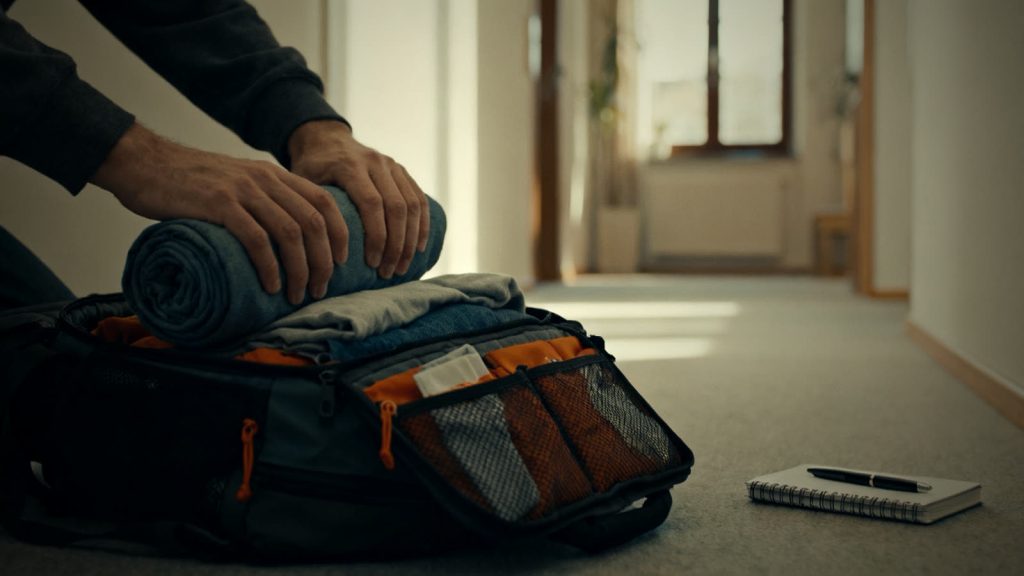
- Heavy items close to your back and high up: Keep water and food close to your body, and put lightweight items like a sleeping bag at the bottom.
- Quick-grab items on the outside: Put your flashlight, first aid kit, rain jacket, and document folder in the top pocket or side pockets.
- Waterproof everything: Pack clothing and papers in dry bags or freezer bags. A wet sleeping bag hardly keeps you warm.
- Check the weight: Put the backpack on and walk around the block. If it’s a struggle after fifteen minutes, it’s too heavy. In that case, it’s better to leave some things out.
Where to keep your go bag – and when to check it
Store your emergency bag where you’ll pass by on your way out anyway, such as in the coat closet or hallway. The basement is a poor choice because it can be the first place affected by flooding.
Check the contents at least once a year: Are the food and medications still good? Does the clothing still fit, especially for children? Are the batteries fully charged? A good fixed date is the switch to daylight saving or standard time – that way, you can swap in clothing that suits the season at the same time.
In short: Pack one backpack for each family member that covers one to two days – following the basic list from the BBK (Germany’s Federal Office of Civil Protection and Disaster Assistance). Write down on a slip of paper what else needs to go in at the last minute in an emergency, such as your ID, keys, and phone. Check the contents once a year and keep the backpack within easy reach in the hallway.
Suitable gear compared
| Produktbild bei AmazonLightweightBseash 40 l | Produktbild bei AmazonRuggedMardingtop 40 l (taktisch) | Produktbild bei AmazonComfortTerra Peak Flex 40 | |
|---|---|---|---|
| Rating | at least 4.3 out of 5 starswith 500+ customer reviews (our selection criterion)See current reviews* | at least 4.3 out of 5 starswith 500+ customer reviews (our selection criterion)See current reviews* | at least 4.3 out of 5 starswith 500+ customer reviews (our selection criterion)See current reviews* |
| Features |
|
|
|
| Pros |
|
|
|
| Cons |
|
|
|
| View on Amazon* | View on Amazon* | View on Amazon* |
Selected by manufacturer data and customer reviews (at least 4.3 stars with 500+ reviews). We only show exact star ratings when they come from Amazon the same day. As of 04.10.2026. Not tested by us. Current prices and reviews are on Amazon. *Ad · paid link
Conclusion: our product picks
Backpacks (40 L) Compared
As a bug-out bag, we recommend the rugged Mardingtop – additional pouches can be attached. If you want to save weight, go with the Bseash with its rain cover. The Terra Peak is the most comfortable to carry over longer distances.
Links marked with * are advertising links. As an Amazon Associate I earn from qualifying purchases.
Sources and further information
General information, no substitute for individual advice from authorities, emergency services or medical professionals. In an emergency in Europe: 112.