📌 Part of the guide: Packing a Go Bag: Checklist, Documents, and Family Plan
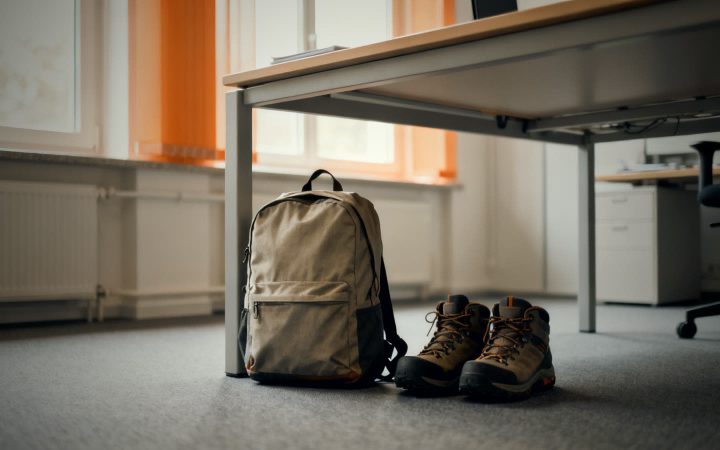
Buying a pre-packed go bag can be a good start if you’re short on time. However, a ready-made kit never contains your personal items like medication, ID, or keys. So you can’t avoid adding your own essentials and checking everything yourself.
Supermarkets and discount stores occasionally offer a pre-packed emergency backpack on sale. It’s tempting: grab it, buy it, done. In this article, we take a realistic look at what a ready-made kit can and cannot do, and how to make the right decision for yourself. We intentionally leave out brand names and prices, as we don’t have reliable test data for them.
What “Pre-Packed” Actually Means
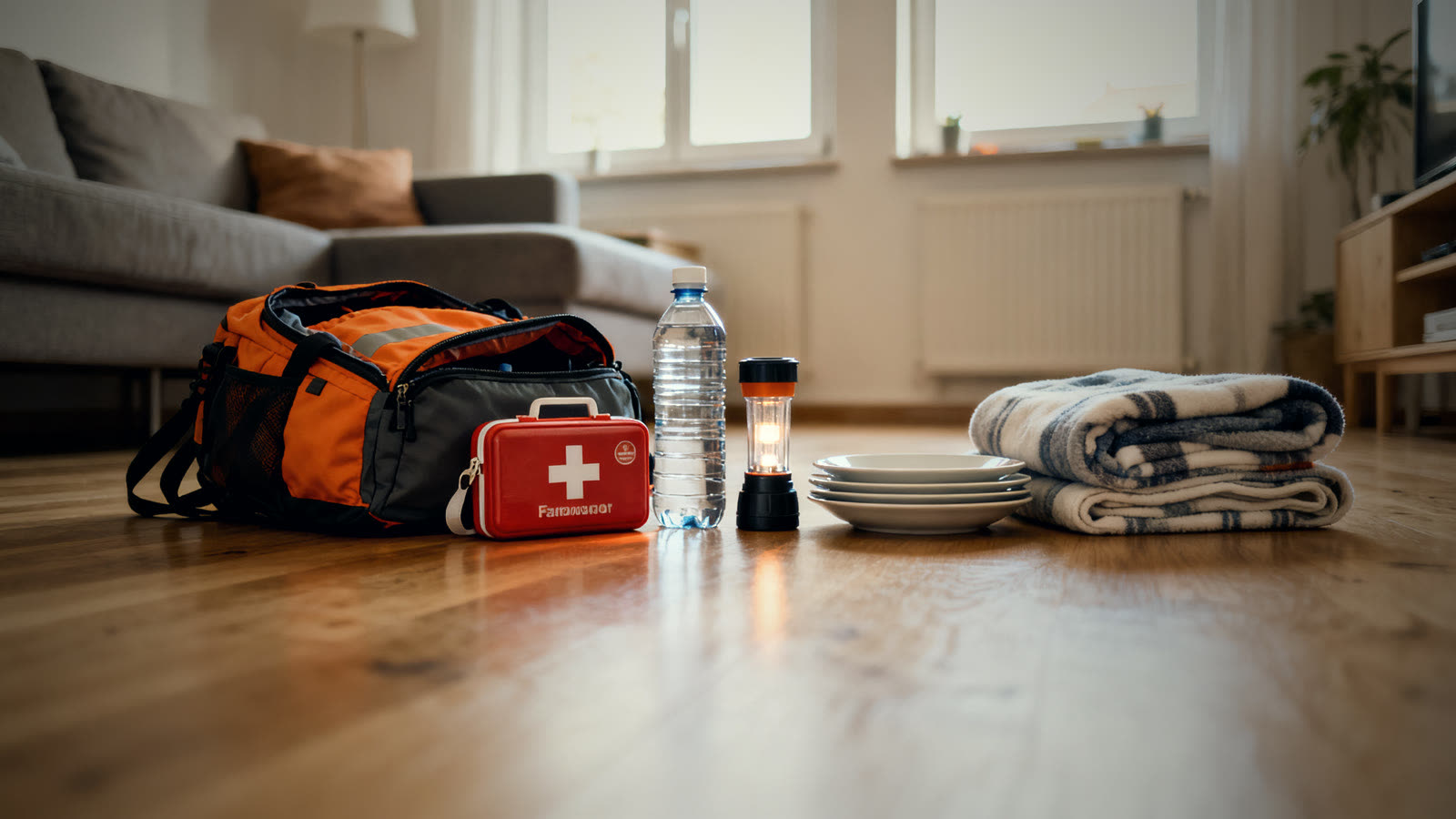
Emergency backpacks are available empty or pre-packed. You either get just the bag or backpack itself, or a fully stocked emergency kit with first aid supplies, tools, and emergency gear. When you buy “pre-packed,” you’re getting a pre-selected bundle put together by someone else.
The crucial question is what standard was used to put that bundle together. A good neutral benchmark is the emergency luggage checklist from the Bundesamt für Bevölkerungsschutz und Katastrophenhilfe (BBK, Germany’s Federal Office of Civil Protection and Disaster Assistance). It outlines what makes sense to take along during a rapid evacuation. You can use it to compare any offer, whether at a discount store, a supermarket, or online.
Buying a Pre-Packed Go Bag: Benefits and Limitations
A ready-made kit has real benefits, as well as clear limitations. You should know both before you head to the checkout.
The Case for Buying One
- Time savings: You don’t have to gather dozens of individual items.
- A basic foundation: Much of what belongs in a kit—such as first aid supplies, tools, and emergency gear—is already assembled.
- Low barrier to entry: If you haven’t prepared anything yet, it helps you actually get started.
That last point is especially important. An imperfect go bag sitting ready in the hallway is better than a perfect plan that never gets put into action.
The Case Against It
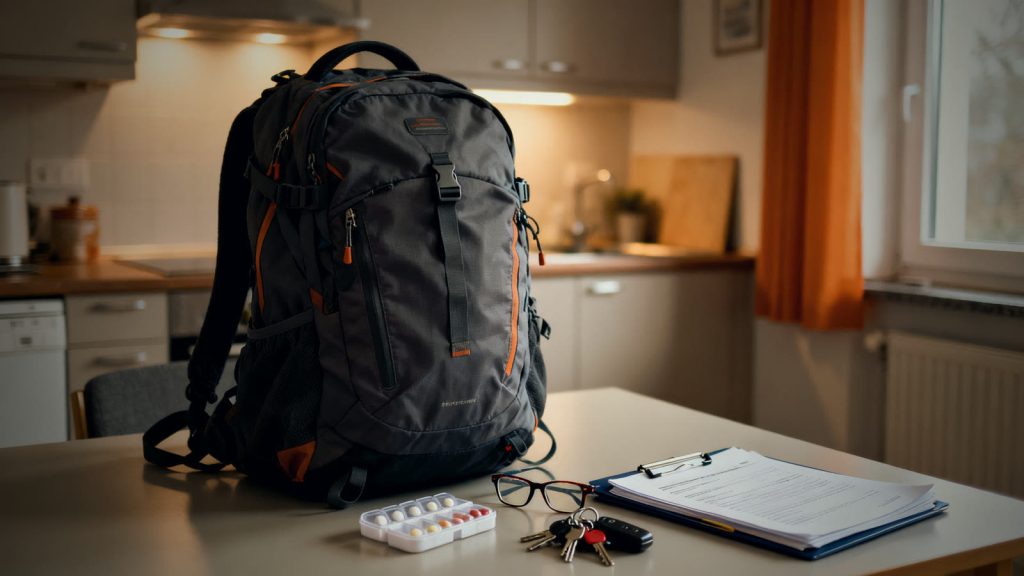
A ready-made kit doesn’t know you. It cannot include personal medications—you have to add those yourself. The same applies to your ID, cash, payment cards, health insurance card, vaccination record, keys, and cell phone. These items are missing from every pre-packed kit, and in an emergency, they are often the most important ones.
On top of that, with a pre-packed bundle, you don’t automatically know what’s inside, how to use it, or where it’s stored. If you’ve never unpacked your backpack, it’s hard to find the right item under stress. When you pack it yourself, you get to know every single item.
Emergency Backpack Contents: What the BBK (Germany’s Federal Office of Civil Protection) Recommends
The BBK checklist is a solid benchmark for any emergency kit. It covers several areas, which we summarize here. You can find a more detailed step-by-step guide in our basic go-bag checklist.
Food and Water
The BBK lists two days’ worth of food in dustproof packaging. This is paired with a water bottle, as well as a mess kit, utensils, and a can opener. With a pre-packed kit, check whether all of these items are included or only some of them.
Health and Hygiene
Health items include personal medications, first aid supplies, hygiene supplies for several days, and an FFP2 respirator mask. Our article What Belongs in a First Aid Kit? explains what a good first aid kit should contain. For everything specific to you, the emergency home medicine cabinet serves as a helpful starting point.
Clothing and Weather Protection
The BBK recommends dressing in layers, along with weatherproof outerwear such as a rain jacket or raincoat, weather-resistant shoes or rubber boots, work gloves, and headwear. Clothing is generally not included in a pre-packed kit, and it has to match your size and the season. You can read about how the layering system works in Layering Clothing: How to Dress Properly in Cold Weather.
Electronics, Sleeping Gear, and Documents
Additional items listed by the BBK include a battery-powered radio with spare batteries, a flashlight with spare batteries, a sleeping bag or blanket, a document folder, and a camera or smartphone. For background on radios and lighting, see our article on the hand-crank radio and our overview Choosing the Right Flashlight and Headlamp.
Emergency Backpacks at Netto, Edeka, and Other Retailers: What to Look For
If you find an emergency backpack at Netto, Edeka, or another retailer, it pays to compare calmly instead of making an impulse buy. We do not have verified information on specific products, prices, or defects of such offers, so we do not evaluate them here. However, you can check any kit yourself using a simple method.
- Read the contents list: Does the packaging state exactly what is inside? A kit without a clear, itemized list is hard to evaluate.
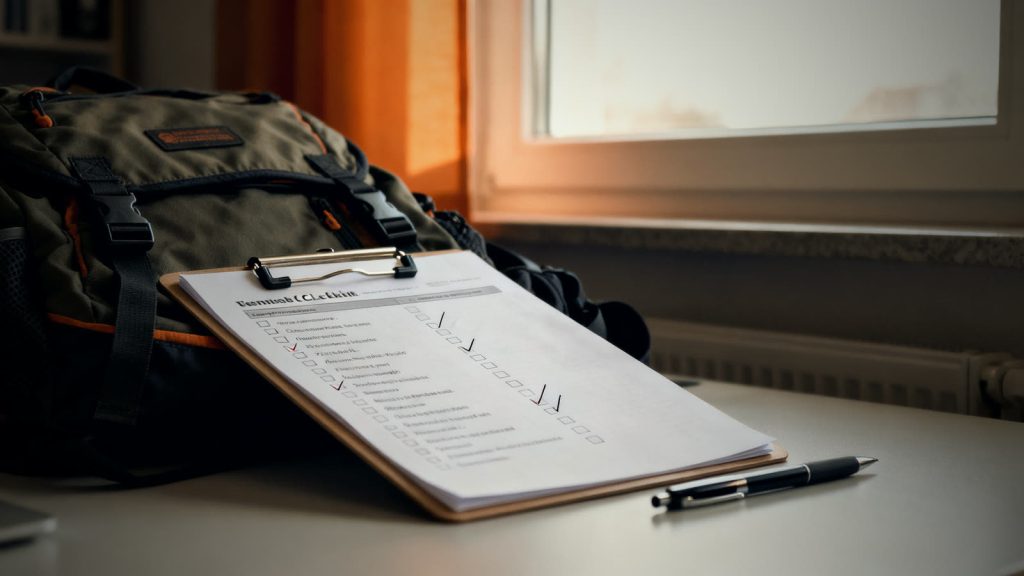
- Cross-check with the BBK checklist: Check off what is included and mark what is missing.
- Inspect the packaging and shelf life: Look for expiration dates on consumables and food items.
- Check the backpack itself: Does it fit your height, feel comfortable to carry, and close securely?
- Unpack and get familiar with it: After buying, unpack everything once, look over every item, and repack it deliberately.
Our article Choosing the Right Backpack for an Emergency explains how to pick a suitable pack. Especially with pre-packed kits, the backpack itself should not be the compromise, since you may have to carry it for a long time in an emergency.
Best Emergency Go Bag: Is There a Test Winner?
Many people look for a test winner to make the decision for them. Honesty matters here: the guide from Stiftung Warentest (Germany’s independent consumer testing organization) on emergency go bags is not a product test. It explains how to pack your own bag based on recommendations from the BBK (Germany’s Federal Office of Civil Protection) and does not provide test results, prices, brands, or flaws for pre-packed backpacks.
So if a website presents a “test winner” for pre-packed emergency go bags, it pays to take a critical look: who conducted the test, what criteria were used, and how up to date are the results? Based on our available sources, we cannot name a test winner for you. A more reliable approach is to compare a kit against the BBK checklist and add your own personal items.
Packing Your Own Go Bag: When It’s the Better Choice
Packing your own is especially worthwhile if you have specific needs: regular medications, glasses, children, caregiving needs, or a pet. A pre-packed emergency kit does not cover those needs. For children, you can find ideas in our article Emergency Go Bag for Children.
Another advantage: you decide what quality you want for your flashlight, radio, or sleeping bag. And in the end, you know exactly where everything is packed. On the other hand, it takes more time upfront. Set aside an afternoon, go through the BBK checklist, and use items you already have around the house. Chances are you already own much of what you need.
The Middle Ground: A Pre-Packed Kit as a Foundation
You don’t have to choose strictly one or the other. Many people do well with a middle ground: start with a pre-packed kit as a foundation, then selectively add what’s missing and remove what you don’t need. That way, you save time and still end up with a go bag that fits your needs.
Follow this order: first, compare the kit’s contents against the BBK checklist; next, fill in any gaps; then add your personal items; and finally, check the weight.
What You Always Need to Add Yourself
No matter which option you choose, there are essentials that no pre-packed kit can include. In an emergency, you should also take:
- ID card
- Cash and bank cards
- Health insurance card
- Vaccination record
- Keys and cell phone
- Personal medications
Many of these items are things you already carry with you every day or keep in fixed spots. It helps to have one dedicated place where everything is stored together, such as an emergency document folder. You can learn how to keep important papers safe in our article The Emergency Document Folder. For cash planning, see Emergency Cash Reserve.
Don’t forget what matters in everyday life, too: if you wear glasses, pack a spare pair if you have one. Personal items like these are exactly why a pre-packed kit can never be the end of your preparedness.
A Go Bag Is Not the Same as an Emergency Supply
A common misconception is that once your backpack is packed, you’re “all set.” That isn’t true. The BBK recommends being able to sustain yourself for ten days if possible. Even a three-day emergency supply helps significantly. An emergency go bag does not replace this household supply. It is meant for situations where you have to leave your home quickly, allowing you to grab everything essential in one go.
Plan for both: a go bag for evacuation and an emergency supply for home. To see how to build your supply step by step, read The 10-Day Emergency Supply Based on BBK Recommendations. And for what to keep in mind during an evacuation, see Evacuation: What to Do When You Have to Leave Your Home.
Frequently Asked Questions
Is it worth buying a pre-packed go bag?
As a starting point, it can be worth it because you save time and get a basic foundation. However, you will always need to add personal medications, documents, cash, and keys yourself. Comparing a kit against the checklist from the BBK (Germany’s Federal Office of Civil Protection) shows you how complete it is.
What should be in a go bag?
According to the BBK, this includes food for two days, a water bottle, a mess kit, utensils, a can opener, first-aid supplies, hygiene items, an FFP2 mask, weatherproof clothing, a radio, a flashlight, spare batteries, a sleeping bag or blanket, and a document folder.
Is there a top-rated pre-packed go bag?
Based on our sources, none can be named. The guide from Stiftung Warentest (Germany’s independent consumer testing organization) is not a product test and does not list test results for pre-packed backpacks. For that reason, evaluate available kits yourself against the BBK checklist.
Does a go bag replace an emergency supply?
No. The BBK recommends being able to stay self-sufficient for ten days if possible, and notes that even a three-day supply is a significant help. The go bag complements your emergency supply, but does not replace it.
How heavy should the backpack be?
The BBK does not give a specific figure, but advises taking no more per family member than fits into one backpack. What matters is that you can carry it for an extended period.
What to do next
- Download the BBK emergency go-bag checklist or use our basic checklist and print it out.
- Decide on your approach: pack everything yourself or use a pre-packed kit as a base.
- Compare the contents item by item and check off what you already have.
- Add personal items: medications, documents, cash, keys, and your phone.
- Test the weight with a short walk around the block.
- Choose a dedicated storage spot and check the backpack regularly.
Once you have taken care of this without rushing, you will be much better prepared for a rapid evacuation. For a broader look at how to approach preparedness, see the plan Prepared in 30 Days.
Sources and Further Information
General information, no substitute for individual advice from authorities, emergency services or medical professionals. In an emergency in Europe: 112.