When the power goes out, light is the first thing you need. A reliable light source takes the uncertainty out of the dark right away. Even so, in many households the only thing in the drawer is an old flashlight with leaked batteries. Yet good lighting is affordable, energy-efficient, and long-lasting today – if you know what to look for.
Flashlight, headlamp, or lantern?
Each type of light has its own job, and ideally they complement each other:
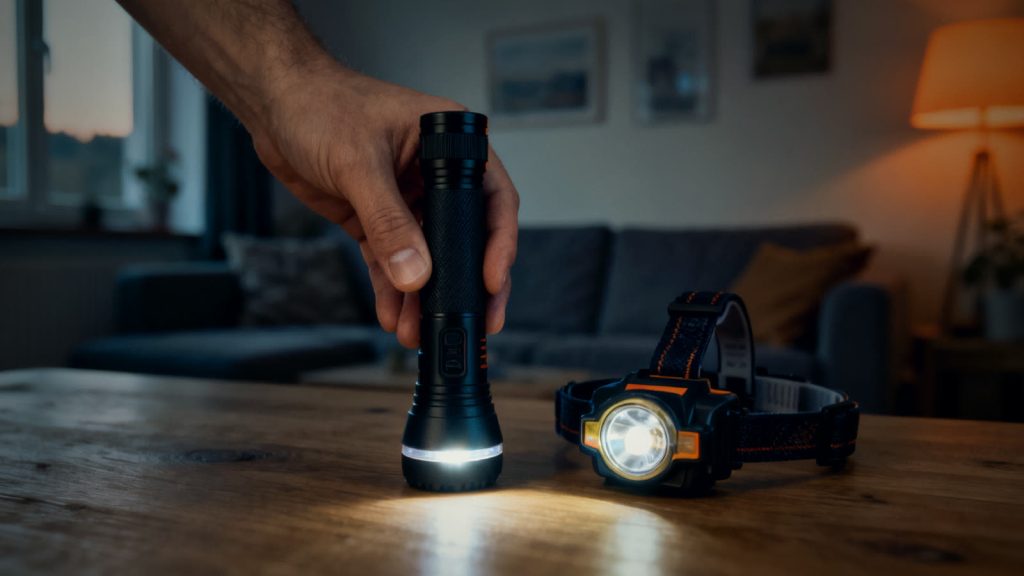
- Headlamp: Our clear number one for emergencies. You have both hands free – for cooking, packing, climbing stairs, giving first aid, or holding a child. In basic military training, it’s standard gear for good reason.
- Flashlight: Ideal for lighting up a specific spot far away, such as in a stairwell, in the basement, or outdoors. It’s also easy to hand off to someone else.
- Lantern: Lights up an entire room evenly and provides calm, pleasant light at the dinner table or in a warm room.
For one household, we recommend: one headlamp per person, at least one powerful flashlight, and one lantern for the shared room.
Understanding the key specs
Many reputable manufacturers state their values according to the ANSI/PLATO FL1 standard. This makes lights from different brands comparable.
Luminous flux in lumens
Lumens describe how much light the lamp emits in total. More isn’t automatically better. For most tasks around the house, a low or medium setting is enough, and it lasts much longer. High lumen values often apply only for a short time, after which the light steps down to avoid overheating.
Beam distance in meters
It shows how far the beam reaches. Indoors it hardly matters, but outdoors it’s important.
Runtime
Under FL1, runtime is measured as the time until brightness drops to ten percent of the starting value. Pay attention to how long the light lasts on the low and medium settings – that’s the key figure during a power outage.
IPX rating
The number after IPX describes protection against water. IPX4 means protection against splashing water, so rain. IPX7 withstands brief immersion. IPX8 stands for protection during continuous immersion under conditions specified by the manufacturer. For an emergency, it should be at least IPX4.
Rechargeable or disposable batteries?
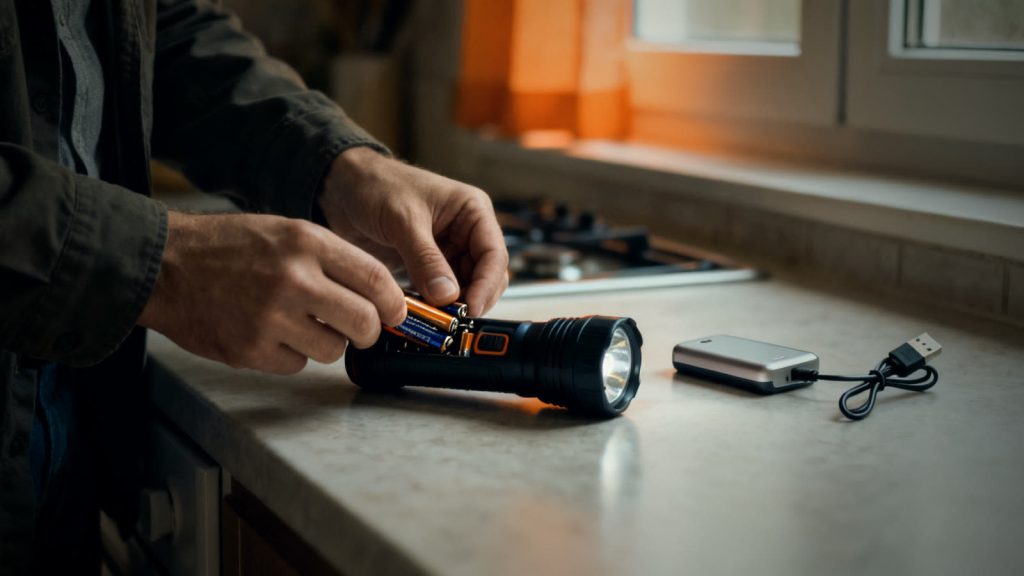
This is one of the most important decisions. Lights with a built-in rechargeable battery and a USB-C charging port are convenient and can be recharged from a power bank or portable power station. The downside: if the battery is empty and there’s no power, that’s it. Lights that use standard AA or AAA batteries can be kept running at any time with spare batteries from your supplies.
The best solution for preparedness is so-called hybrid lights. They run on a rechargeable battery that comes with the light, but in an emergency they also accept standard off-the-shelf batteries. If you choose a light with a replaceable rechargeable battery such as an 18650 or 21700, you should keep at least one charged spare battery with it. Very important: stick to one or two battery sizes in your household if possible, so you don’t have to stock up on a separate supply for each light.
Useful Features
- Red light: Preserves your night vision and doesn’t dazzle others – handy when kids are asleep.
- Low moonlight mode: Saves energy and is enough to find your way around a room.
- Lockout mode: Prevents the flashlight from switching on by accident in your backpack and draining the battery.
- Battery level indicator: Shows when it’s time to recharge.
- Simple operation: In the dark and under stress, the flashlight has to turn on with one button and without any thinking. Complicated click combinations are a disadvantage in an emergency.
Storage and Maintenance
The best flashlight is useless if you can’t find it in the dark. Keep them in fixed places: one next to your bed, one in the hallway, one in your go bag. When the clocks change in spring and fall, check that all your flashlights work and are charged. Battery-powered flashlights that go unused for a long time are best stored without the batteries inserted or with lockout mode activated – leaking batteries can destroy the contacts.
Why Not Cheap Flashlights?
Quality pays off with flashlights. Established manufacturers state realistic specifications, build durable housings, and offer warranties and replacement parts. Many no-name flashlights advertise unrealistic lumen figures and don’t deliver what they promise in continuous use. A good headlamp will serve you for many years – while camping, doing yard work, and, of course, in an emergency.
One last safety note: never look directly into a powerful LED beam, and never shine it in anyone’s face. With kids in particular, it’s worth explaining this briefly before they excitedly run around the house with the flashlight during a power outage. Giving each child their own small flashlight, by the way, takes a lot of the fear out of the dark.
In short: One headlamp per person is the most important light source in an emergency. Pay attention to runtime and ingress protection rating rather than maximum lumens. Hybrid flashlights that can run on both rechargeable and standard batteries are ideal for emergency preparedness.
Recommended Gear Compared
| Produktbild bei AmazonBattery-PoweredLedlenser H3.2 | Produktbild bei AmazonTwo-PackBlukar Stirnlampe (2er-Set) | Produktbild bei AmazonHigh-PerformanceLedlenser H8R | |
|---|---|---|---|
| Rating | at least 4.3 out of 5 starswith 500+ customer reviews (our selection criterion)See current reviews* | at least 4.3 out of 5 starswith 500+ customer reviews (our selection criterion)See current reviews* | at least 4.3 out of 5 starswith 500+ customer reviews (our selection criterion)See current reviews* |
| Features |
|
|
|
| Pros |
|
|
|
| Cons |
|
|
|
| View on Amazon* | View on Amazon* | View on Amazon* |
Selected by manufacturer data and customer reviews (at least 4.3 stars with 500+ reviews). We only show exact star ratings when they come from Amazon the same day. As of 04.10.2026. Not tested by us. Current prices and reviews are on Amazon. *Ad · paid link
Conclusion: our product picks
Headlamps Compared
For emergency supplies, we recommend a battery-powered lamp like the Ledlenser H3.2 – batteries can be stored, while rechargeable batteries can't always be charged. For families, the Blukar two-pack is practical. If you're often outdoors, go with the Ledlenser H8R.
Links marked with * are advertising links. As an Amazon Associate I earn from qualifying purchases.
Sources and Further Information
- BBK (Germany’s Federal Office of Civil Protection and Disaster Assistance) – Preparing for and Responding to a Power Outage
- BBK – Guide to Emergency Preparedness and Acting Correctly in Emergency Situations
- Umweltbundesamt (German Environment Agency) – Using Batteries and Rechargeable Batteries Properly
General information, no substitute for individual advice from authorities, emergency services or medical professionals. In an emergency in Europe: 112.