📌 Part of the guide: Preparing for a Power Outage: Light, Heat, Communication
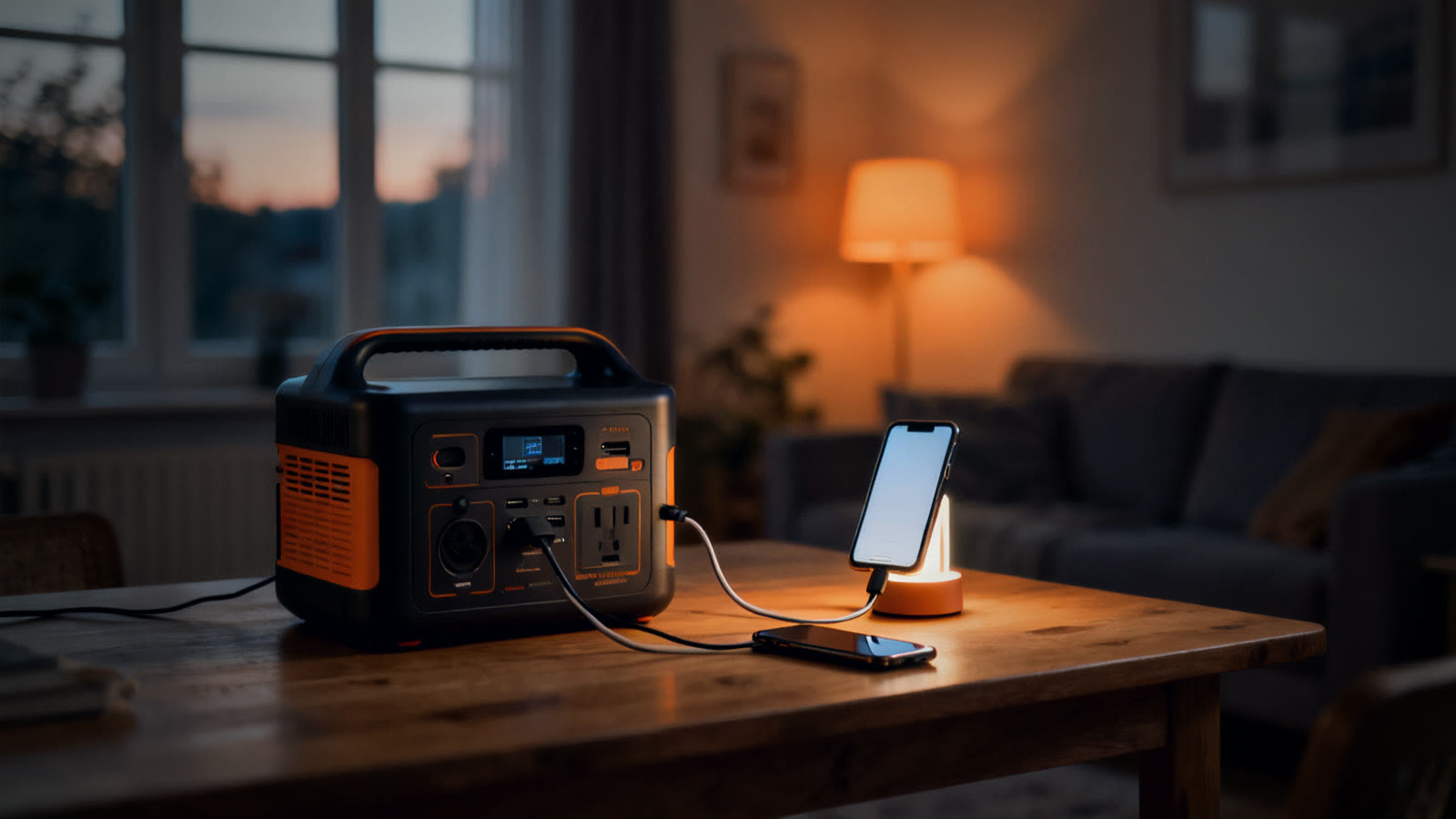
If you want to buy a portable power station, first pay attention to three things: a capacity in watt-hours that matches your actual needs, enough continuous output in watts, and the right ports for your devices. Everything else – battery type, UPS function, weight – you can decide afterward. A test winner won’t help you much if it doesn’t fit your needs.
What a Power Station Should Do During a Power Outage
The BBK (Germany’s Federal Office of Civil Protection and Disaster Assistance) lists accidents, construction defects, severe weather such as storms, floods, or snow, sabotage, and cyberattacks on utility systems as causes of power outages. According to the BBK, outages are usually fixed within a few hours. In larger events, however, they can last for days. This is exactly the range you should keep in mind when planning.
A power station is a sensible building block for this, but it is not a substitute for the rest of your emergency preparedness. It keeps communication, lighting, and small devices running. It is not a power plant that heats your entire house. If you separate the two clearly from the start, you buy more deliberately and avoid disappointment.
The BBK advises keeping devices and spare batteries charged and having solar chargers or power banks on hand. This also includes a battery-powered or hand-crank radio and some cash, because ATMs don’t work during a power outage. A power station complements this list when you need more energy than a power bank can deliver. Whether that applies to you is covered in the article Power Station or Power Bank – Which Do I Need?
Which Devices Do You Actually Want to Power?
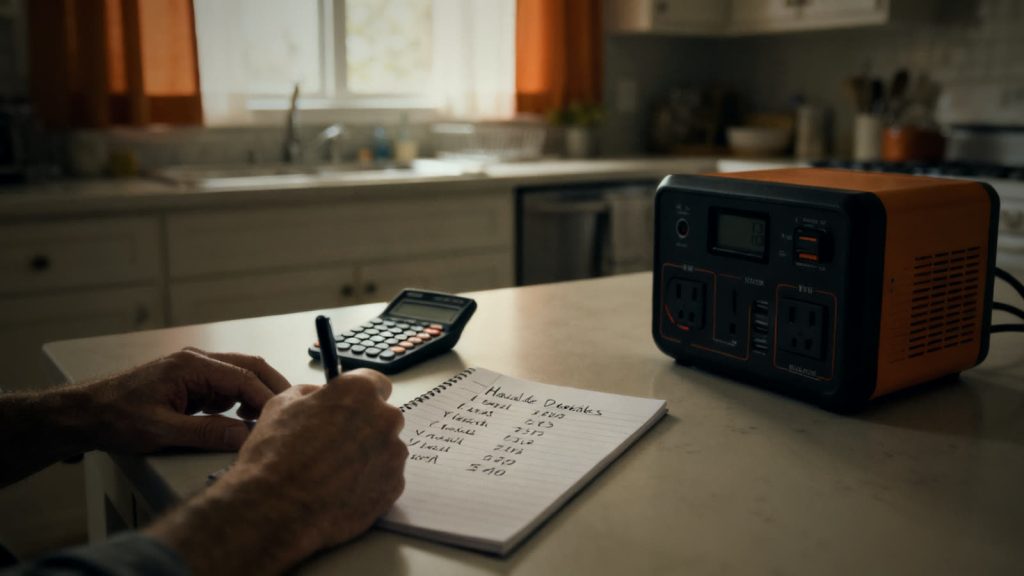
The BBK brochure “Stromausfall – Vorsorge und Selbsthilfe” (Power Outage – Preparedness and Self-Help) describes the consequences for refrigerators, heating, and communication. It helps you set your priorities. Before you buy, write down what the power station should supply. Typical candidates are:
- Smartphones and power banks, so you stay reachable
- Lamps and a radio
- a router or a laptop, if you need one
- medical or care-related devices, if applicable
- the refrigerator for short periods, if needed
This list is the basis for your purchase. The shorter it is, the smaller and cheaper the unit can be.
Calculating Capacity: Watt-Hours Instead of Guesswork
The capacity of a power station is given in watt-hours (Wh). It tells you how much energy is stored in the battery. To calculate the capacity you need, multiply a device’s power in watts by the time in hours it should run. The result is the energy requirement in watt-hours. This applies to every device you want to run.
A simple example for illustration: A device rated at 50 watts that runs for 4 hours needs 200 watt-hours. For multiple devices, add the values together. Plan the runtime realistically, not for continuous operation around the clock. You can find a detailed guide with a table in the article Calculating Your Power Needs in an Emergency.
Why the Stated Capacity Is Never Fully Usable
The rated capacity is listed on the data sheet, but in everyday use you can usually draw a little less. Energy is lost when converting direct current to 230-volt alternating current, and the electronics need power themselves. How large this loss is for a given model cannot be stated across the board. So build in a buffer and buy a bit more capacity than the bare calculation gives you.
How Big Are Typical Units?
For orientation: The power stations tested by Stiftung Warentest (German consumer testing foundation) had capacities from 400 to 644 watt-hours. This is the class where many portable units fall. For charging phones, running lights, and listening to a radio over several days, this range is often enough for you. If you want to run high-consumption devices for hours, however, you’ll need significantly more. In that case, calculate instead of guessing.
Buying a Power Station: What to Look for in Terms of Output
Besides capacity, continuous output in watts matters. It determines how many devices can run at the same time. Add up the wattage of all the devices you want to run simultaneously and compare the total with the continuous output. In the Stiftung Warentest (German consumer testing foundation) test, the maximum continuous output of the devices ranged from 300 to 700 watts.
Also pay attention to the peak output. Devices with a motor, such as a refrigerator, briefly draw more power when starting up than during continuous operation. Whether a power station can handle this is stated in the data sheet. If this information is missing, that is a warning sign.
Check the Specifications, Don’t Just Trust Them
According to test.de, not all devices deliver the output they promise. One power station in the test shut off after 30 minutes, even though it was supposed to sustain the stated output. For you, this means: read independent tests, compare data sheets, and test your device yourself after buying it, ideally with the load you would need in an actual emergency. Test runs like this belong in any emergency preparedness plan anyway.
Heat-generating appliances such as fan heaters, electric kettles, or stovetops are generally poor candidates for a power station, because they draw a lot of power and drain the battery quickly. There are better ways to keep your home warm, which we describe in the article How to Keep Your Home Warm When the Heating Fails.
LiFePO4 Power Station: Which Battery Is Right?
When it comes to cell chemistry, you will often come across the term LiFePO4, short for lithium iron phosphate. Many manufacturers advertise a LiFePO4 power station as durable and robust. You should always take specific figures for charge cycles or service life from the data sheet of the particular model rather than adopting them across the board. Equivalent claims do not apply to every device.
For emergency preparedness, one point is especially important: the power station often sits in a closet for months and has to work when an emergency hits. So when buying, ask yourself how the battery handles long-term storage and how you are supposed to maintain it. The manufacturer’s instructions on charge level and storage are decisive here. You can find general basics in the article How to Store Batteries and Rechargeable Batteries Properly.
What Else to Look at When Choosing a Battery Type
- Manufacturer information on cell chemistry, storage, and operating temperature
- Weight relative to capacity
- Warranty terms and availability of customer service
- Information on overheating and overcharge protection
If you mostly use the device at home, weight matters less than it does for someone who wants to transport it.
The UPS Function: Power Without Interruption
Some models offer a UPS function, meaning an uninterruptible power supply. In this case, the power station sits between the wall outlet and the device and automatically takes over during a power outage. This is useful for devices that shouldn’t simply shut off, such as a router, a computer, or a medical device.
With a power station’s UPS function, check exactly how it works. The switchover time is crucial, as is the question of whether the device may stay plugged into the grid permanently. Not every switchover is fast enough for sensitive devices. Rely only on the manufacturer’s specifications, and test the function once at your leisure by pulling the power plug.
If you don’t need the function, a device without a UPS function may save you money. But if medical devices or communication equipment depend on it, it is a sensible criterion. For medically relevant devices, you should also discuss the backup solution with your doctor or the device manufacturer.
Ports, Weight, and Safety
Take a look at which ports you really need. The power stations tested by Stiftung Warentest (Germany’s consumer testing foundation) have standard household outlets (230 V), 12 V car sockets, and USB ports, including USB-C. That is a good minimum setup. Count how many devices you want to connect at the same time, and make sure there are enough ports.
Weight matters more in everyday use than many people think. The tested units weighed 4 to 8 kilograms. Portability and the position of the handles were also part of the rating. If you have to bring the power station up from the basement or lift it into the car, it should be easy to grip. Capacity and weight are related: more energy usually means more mass.
Safe Handling
Stiftung Warentest tested charging and discharging, among other things, and also rated safety and handling. That shows what you can look for yourself: clear displays, an easy-to-read charge level, simple operation, and a manual you can still understand under stress. Operate the unit according to the manufacturer’s instructions, don’t cover it, and store it in a dry place.
One clear advantage over combustion generators: a power station produces no exhaust fumes. The BBK (Germany’s Federal Office of Civil Protection and Disaster Assistance) brochure warns about the exhaust hazards of emergency generators when they are used improperly in enclosed spaces. You can read more in the article Emergency generator for the home: practical, permitted, safe? If you also cook with gas, use a camping stove or grill only outdoors. For gas appliances, the BBK recommends a carbon monoxide detector.
Charging Before and During an Emergency: Grid, Car, Solar
A power station is only as good as its charge level. So charge it fully after you buy it, and check the level regularly. A fixed routine helps, for example when the clocks change. The article Checking your emergency supplies: a fixed routine at daylight saving time changes fits well here.
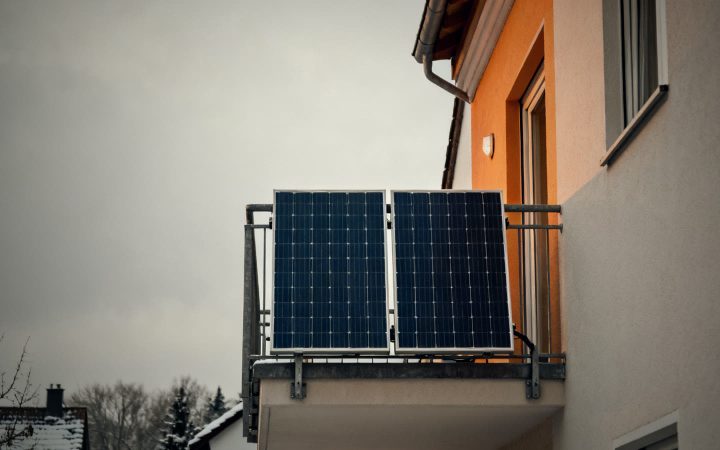
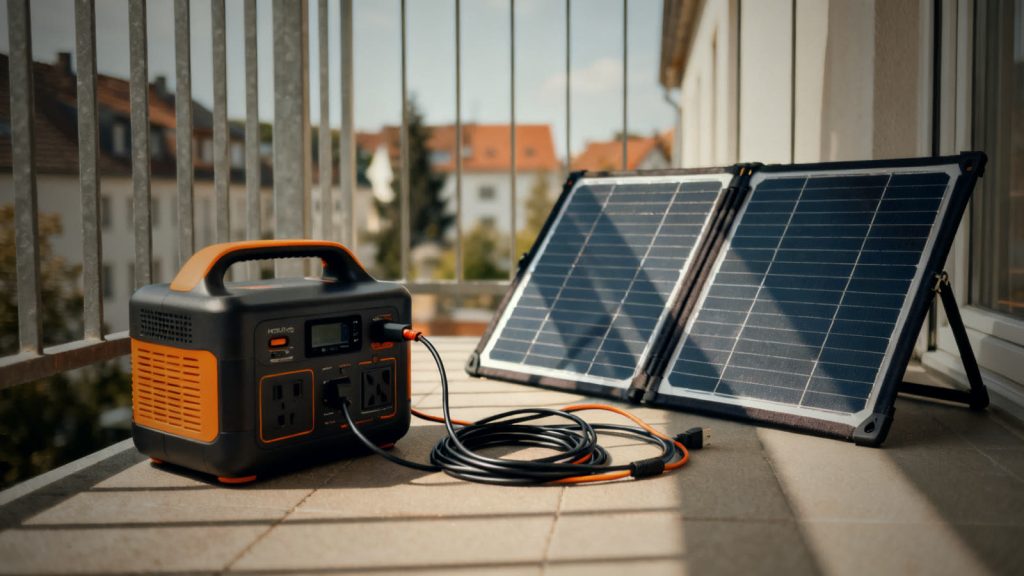
If the outage lasts longer, a second charging source helps. The BBK explicitly lists solar chargers as part of preparedness. When buying, check which charging methods your model supports and whether the power station and solar panel are compatible. The article Solar panels for beginners gives you a starting point. Balcony solar system during a power outage: what really works explains how far a balcony solar system can help during an outage.
Also look at charging time and charging power. A unit that fills up very slowly is less practical during multi-day outages if you want to recharge in between. The data sheet gives you the figures you need, and they are easy to compare against your own needs.
Frequently Asked Questions
What size power station do I need for a power outage?
That depends on your devices. Multiply power in watts by running time in hours, add up all the devices, and plan in a buffer. For phones, lighting, and a radio, a smaller size is often enough. For reference: the units tested by Stiftung Warentest ranged from 400 to 644 watt-hours.
What does LiFePO4 mean for a power station?
LiFePO4 stands for lithium iron phosphate and describes the cell chemistry of the battery. Manufacturers often advertise it as long-lasting. Specific figures such as cycle counts can only be found in the data sheet of the individual model. Compare them there instead of relying on the term alone.
Do I need a UPS function?
Only if devices need to keep running without interruption, such as a router or a computer. It isn’t necessary for charging phones and powering lights. If needed, check the switchover time in the manufacturer’s specifications and test the function yourself once.
Can I run a refrigerator with a power station?
Depending on the unit and its capacity, this is possible for a limited time. Check the continuous and peak power and calculate the running time. What happens to your food during an outage is covered in the article Freezer during a power outage: what keeps, what has to go?
Your Next Steps
- List which devices you really want to power during a power outage.
- Calculate your energy needs in watt-hours and your simultaneous power draw in watts.
- Compare spec sheets for capacity, continuous output, ports, weight, and battery type.
- Decide whether you need a UPS function.
- Read independent tests, since not every device delivers the output it promises.
- After purchase, charge the power station fully and do a test run.
- Plan for a second charging source, such as a solar panel, and check the charge level regularly.
To learn how to get through the first hours of an outage, read the article Power Outage: How to Act Correctly in the First 24 Hours.
Sources and Further Information
- Preparing for and Responding to a Power Outage – Bundesamt für Bevölkerungsschutz und Katastrophenhilfe (BBK, Germany’s Federal Office of Civil Protection and Disaster Assistance)
- Power Outage Preparedness and Self-Help – Bundesamt für Bevölkerungsschutz und Katastrophenhilfe (BBK)
- Power Stations Tested – Outlets for On the Go – Stiftung Warentest (Germany’s consumer testing foundation) (test.de)
General information, no substitute for individual advice from authorities, emergency services or medical professionals. In an emergency in Europe: 112.