Most power outages in Germany are over within a few minutes or hours. Still, it pays to have a clear plan in your head. The first few minutes decide whether you end up scrambling around for candles or handle the situation calmly and methodically. From our training, we know the basic principle: assess the situation first, then act. That’s exactly how you should approach this, too.
The First 15 Minutes: Assess the Situation
- Get some light: Do you have a flashlight or headlamp within reach? It should be kept in a fixed spot that everyone in the household knows – ideally one you can find even in the dark.
- Narrow down the cause: Is it only your apartment that’s dark? Then check the fuse box to see whether a circuit breaker or the RCD (residual-current device) has tripped. If the whole building or street is affected, the fault is in the grid.
- Report it: You report outages to your local grid operator, not to your electricity provider, as the Verbraucherzentrale (German consumer advice center) explains. The number is usually printed on the meter box or your electricity bill – write it down on paper ahead of time.
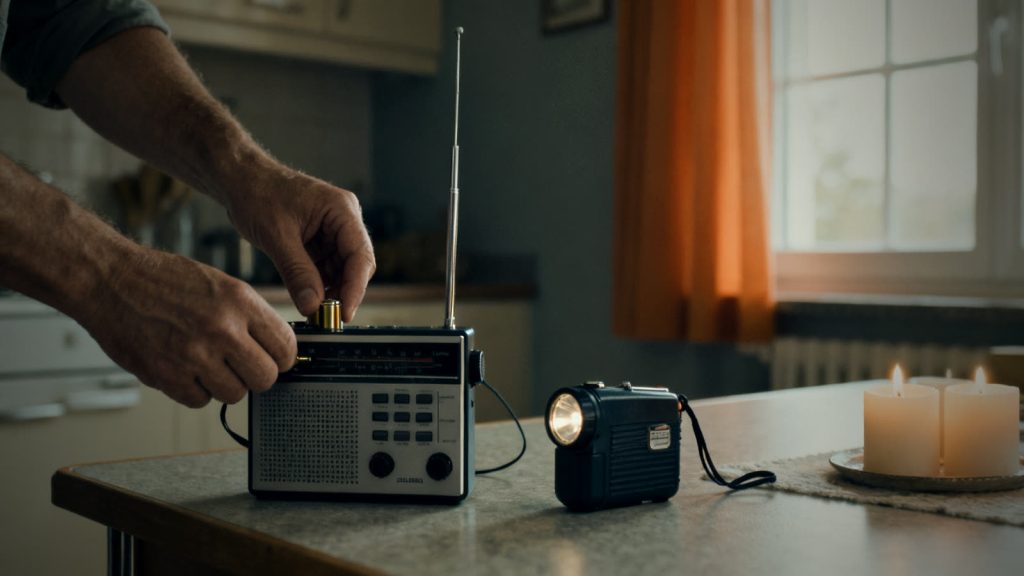
- Stay informed: A battery-powered or hand-crank radio picks up official announcements. If the mobile network is still working, the NINA warning app (the German government’s emergency alert app) and regional outage pages can keep you informed as well.
The First Hour: Secure Your Home
- Switch off appliances: Turn off sensitive devices such as computers and TVs and unplug them to protect them from power surges when the electricity comes back.
- Stove and iron: Switch off anything that could get hot unattended when the power returns. Leave a single lamp switched on – that way you’ll notice when the power is back.
- Keep the fridge and freezer closed: Every time you open them, cold air escapes. A full freezer stays cold longer than a half-empty one. How long your appliance holds out is often listed in the user manual as the storage time during a power failure.
- Look out for others: Are there elderly people, people who rely on medical devices, or families with babies in your building? A quick knock on the door can make a big difference.
If you rely on electrically powered medical devices at home, you should talk to your doctor or care service in advance about what to do during a power outage.
The First Few Hours: Save Power
Your smartphone is now your source of information, flashlight, and emergency phone all in one. Treat the battery accordingly:
- Turn on power-saving mode and lower the screen brightness.
- Close apps you don’t need, and skip streaming and long videos.
- Use a power bank, but wisely: it’s better to top up your phone every now and then than to let it run completely dead.
- Keep calls short. When many people are on the phone at the same time, short text messages often get through more reliably.
During longer outages, the mobile network can also go down after a while because the backup power supply of cell towers is limited. That’s why a battery-powered or hand-crank radio is essential.
The First Evening: Light, Food, Warmth
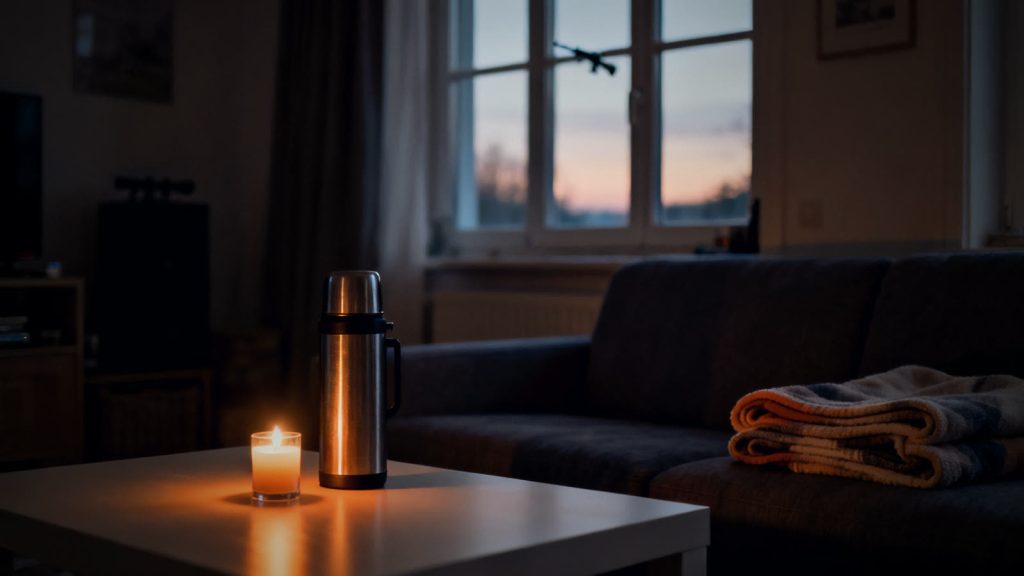
Rely on battery-powered light: LED lanterns light up an entire room, and headlamps keep your hands free. Candles are an option, but only with care: never leave them unattended, keep them well away from curtains, and ventilate the room regularly. Children should not handle open flames.
Eat the perishable food from your refrigerator first. Shelf-stable supplies that you can eat cold are worth their weight in gold right now. Cook with a camping stove or grill only outdoors – never in your home, basement, or garage. Carbon monoxide is invisible and odorless.
In winter, the rule is: choose one room as your warm room, close the doors, and use warm clothing and blankets. You’ll find more in our article on heating failure.
The First Night: Calm and Routine
Get everything ready for the night: a lamp by the bed, shoes within reach, and your phone charged or connected to a power bank. Agree in your household on who gets up when and checks that everything is okay. Children sleep better when the evening goes as normally as possible – a story by lantern light can even turn the disruption into a little adventure.
Emergency Calls and Help
The emergency number 112 is only for real emergencies: fires, medical emergencies, trapped people. Please don’t call to ask when the power will come back – it ties up the lines for people in danger. If your phone isn’t working, fire stations and police stations are places you can go for help. Many municipalities also plan emergency information points for longer outages; check with your local municipality in advance to find out where they are.
When the Power Comes Back
Switch appliances back on one at a time, not all at once. Check the contents of your refrigerator and freezer: anything that has thawed or looks questionable should go if in doubt. In winter, it’s worth checking your heating system and water pipes. And then: write down what you were missing and restock your supplies.
In short: First assess the situation, then act: check the fuse, report the outage to your grid operator, turn on the radio. Switch appliances off, keep refrigerators and freezers closed, save your phone battery. Cook and heat with an open flame only outdoors – never indoors.
Matching Gear Compared
| Produktbild bei AmazonTwo-pack with batteriesSUBOOS Campinglampe 2er-Set | Produktbild bei AmazonBrightest optionLepro Campinglampe 1500 Lumen | Produktbild bei AmazonWith battery & power bankPopoIron Campinglaterne 2er-Set | |
|---|---|---|---|
| Rating | at least 4.3 out of 5 starswith 500+ customer reviews (our selection criterion)See current reviews* | at least 4.3 out of 5 starswith 500+ customer reviews (our selection criterion)See current reviews* | at least 4.3 out of 5 starswith 500+ customer reviews (our selection criterion)See current reviews* |
| Features |
|
|
|
| Pros |
|
|
|
| Cons |
|
|
|
| View on Amazon* | View on Amazon* | View on Amazon* |
Selected by manufacturer data and customer reviews (at least 4.3 stars with 500+ reviews). We only show exact star ratings when they come from Amazon the same day. As of 04.10.2026. Not tested by us. Current prices and reviews are on Amazon. *Ad · paid link
| Produktbild bei AmazonBudget entry pointSolarbaby Notfall-Solarradio | Produktbild bei AmazonSolid middle groundActa Berg Kurbelradio | Produktbild bei AmazonLargest reserveROCAM Kurbelradio 12.000 mAh | |
|---|---|---|---|
| Rating | at least 4.3 out of 5 starswith 500+ customer reviews (our selection criterion)See current reviews* | at least 4.3 out of 5 starswith 500+ customer reviews (our selection criterion)See current reviews* | at least 4.3 out of 5 starswith 500+ customer reviews (our selection criterion)See current reviews* |
| Features |
|
|
|
| Pros |
|
|
|
| Cons |
|
|
|
| View on Amazon* | View on Amazon* | View on Amazon* |
Selected by manufacturer data and customer reviews (at least 4.3 stars with 500+ reviews). We only show exact star ratings when they come from Amazon the same day. As of 04.10.2026. Not tested by us. Current prices and reviews are on Amazon. *Ad · paid link
Conclusion: our product picks
Camping Lanterns Compared
For a power outage at home, the Lepro is the brightest, running on storable D batteries. If you want to light up two rooms, go with the SUBOOS two-pack – batteries are already included. The PopoIron pays off if you have a power station or solar panel on hand to recharge it.
Crank Radios Compared
For most households, the Acta Berg offers the best compromise between battery reserve and size. If you want to recharge your phone over several days, go for the ROCAM with 12,000 mAh. For a small emergency backpack, the Solarbaby is enough.
Links marked with * are advertising links. As an Amazon Associate I earn from qualifying purchases.
Sources and Further Information
- BBK (Germany’s Federal Office of Civil Protection and Disaster Assistance) – Preparing for and Responding to a Power Outage
- BBK – Power Outage: Preparedness and Self-Help
- Verbraucherzentrale (German consumer advice center) – What to Do During a Power Outage
- BfR (German Federal Institute for Risk Assessment) – Carbon Monoxide: An Invisible Danger
General information, no substitute for individual advice from authorities, emergency services or medical professionals. In an emergency in Europe: 112.