These days, we pay with a card or smartphone almost everywhere. That’s convenient – as long as power, network and payment systems are working. During a prolonged power outage, a large-scale IT disruption or a cell network outage, that suddenly stops working. The BBK (Germany’s Federal Office of Civil Protection and Disaster Assistance) explicitly advises keeping cash on hand, because ATMs also stop working during a power outage. A small cash reserve is therefore a simple but effective part of your emergency preparedness.
Why cash helps in a crisis
- Independent of technology: A bill needs neither electricity nor a network.
- Shopping stays possible: During disruptions, some stores can keep selling using backup power or by hand – often only for cash.
- Staying calm: If you know you can pay for a few days, you don’t have to be first in line at the ATM.
In a 2025 study covering several crises, the European Central Bank described cash as playing an important role as a fallback in such situations, with demand for it rising significantly in each crisis.
How much cash makes sense?
In Germany, authorities have set no fixed amount. Recommendations from neighboring countries can serve as a guideline: The Dutch central bank (De Nederlandsche Bank) recommends about 70 euros per adult and 30 euros per child for the first 72 hours. In other European countries, the amounts given are of a similar magnitude.
We recommend basing the amount on your household: What do you spend on food, medication, pet food and possibly fuel over a few days? That gives you a realistic figure. More isn’t necessarily better – keeping cash at home also comes with risks (see below).
The right denominations
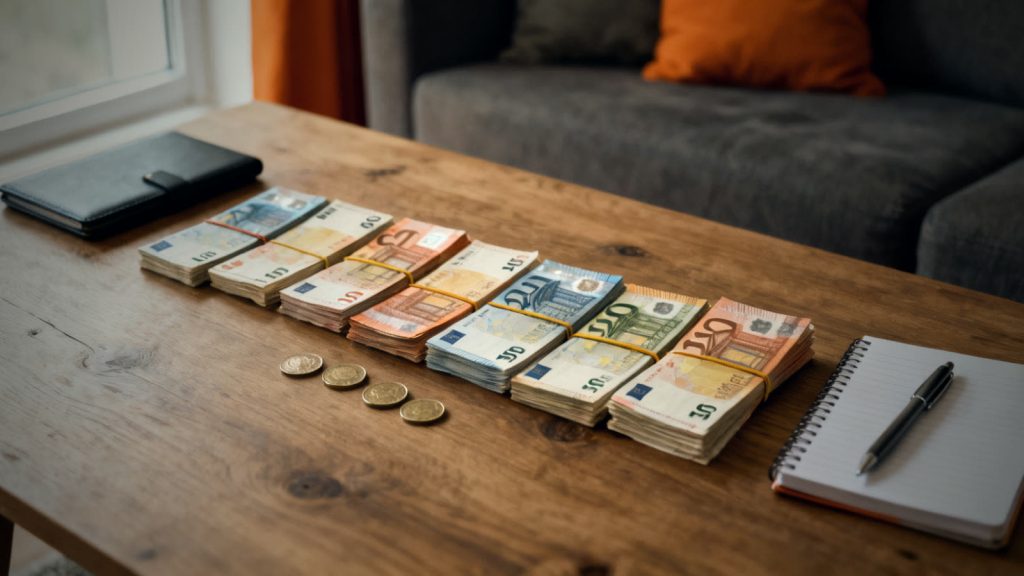
In a crisis, hardly anyone has change. Paying for a loaf of bread with a 100-euro bill then becomes difficult. So keep your reserve mostly in small bills (5, 10 and 20 euros) and some coins. Coins can also come in handy for vending machines, shopping carts or parking meters.
Store It Safely
Keeping cash at home isn’t a risk if you follow a few basic rules:
- Not in the usual spots: Under the mattress, in the sock drawer, or in the cookie tin is where everyone looks first.
- Split it up: Keep a small amount in your go bag and some at home in an inconspicuous spot. That way you won’t lose everything at once.
- Protect it from moisture: Store bills in a waterproof pouch or document sleeve.
- Discretion: Don’t tell people that you keep cash at home or where you keep it.
- Inform your family: The people in your household who need to access it in an emergency must know where it is.
What About Insurance?
Homeowner’s or renter’s insurance (Hausratversicherung) usually covers cash after a burglary only up to a limit. According to the German Insurance Association (Gesamtverband der Versicherer), these limits are often between 1,000 and 2,000 euros; higher amounts are usually only covered with a suitable safe and a separate agreement. Check your own policy – the terms vary.
Cash Belongs in Everyday Life – Not Just in the Emergency Kit
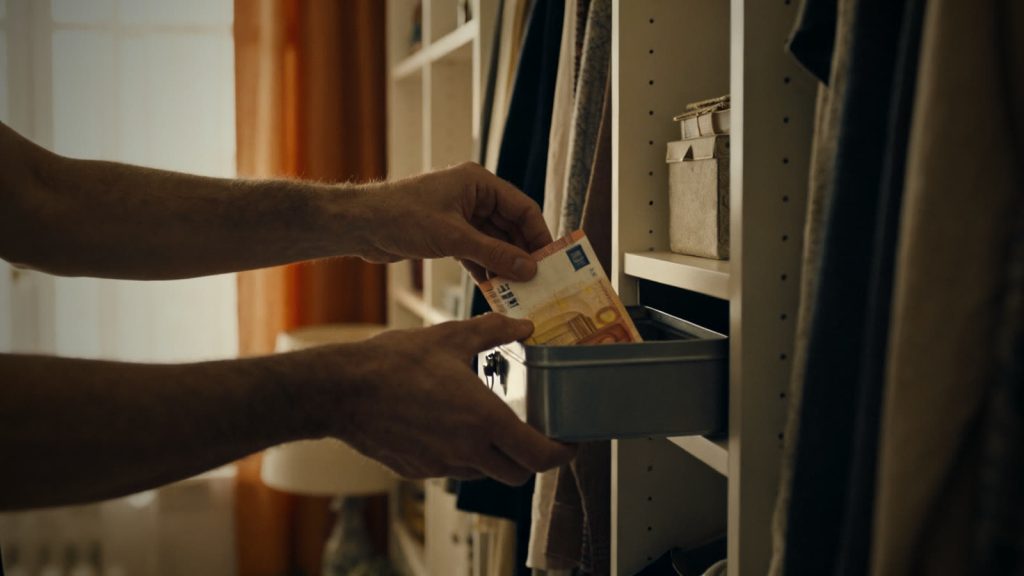
A reserve only helps if it’s there when you need it. A typical mistake: you set money aside and then “borrow” it for the weekend grocery run or a gift. Make it a rule to refill the reserve right away whenever you take something out. A fixed date in your calendar, for example together with checking your supplies, can help.
We know the principle from training: equipment that isn’t checked won’t be there when it counts. That applies to the flashlight just as much as to the envelope of cash.
Build Up Your Cash Reserve Gradually
You don’t have to set the amount aside all at once. For example, withdraw a few extra euros whenever you pay by card, where possible, or regularly put coins and small bills from your wallet into the envelope. That way the reserve grows on the side without noticeably straining your household budget. Many people find it helpful to write down the total and add a date. Then, at your next supply check, you’ll know right away whether everything is there.
Additional Tips
- Cash in your go bag: A small amount belongs in your go bag, together with your document folder.
- Cash in the car: A few bills in the glove compartment can help if you break down or if a gas station’s card reader is down.
- Emergency account numbers: Write down the card blocking number (in Germany, the emergency blocking hotline 116 116) and your bank’s contact details on paper.
- Access without a smartphone: If you only pay with your phone, also carry a physical card.
In short: During a power outage, neither card payments nor ATMs work – a cash reserve keeps you able to pay. As a guideline for the first three days, plan on about 70 euros per adult and 30 euros per child in small bills, adjusted to your household. Store it spread out, dry, and discreetly, and refill it right away after every withdrawal.
Matching Gear Compared
| Produktbild bei AmazonCompact for home useBURG-WÄCHTER Money 5020 | Produktbild bei AmazonPlenty of spaceWestcott Geldkassette groß | Produktbild bei AmazonWith coin-counting trayHMF Geldkassette 10015-02 | |
|---|---|---|---|
| Rating | at least 4.3 out of 5 starswith 500+ customer reviews (our selection criterion)See current reviews* | at least 4.3 out of 5 starswith 500+ customer reviews (our selection criterion)See current reviews* | at least 4.3 out of 5 starswith 500+ customer reviews (our selection criterion)See current reviews* |
| Features |
|
|
|
| Pros |
|
|
|
| Cons |
|
|
|
| View on Amazon* | View on Amazon* | View on Amazon* |
Selected by manufacturer data and customer reviews (at least 4.3 stars with 500+ reviews). We only show exact star ratings when they come from Amazon the same day. As of 04.10.2026. Not tested by us. Current prices and reviews are on Amazon. *Ad · paid link
Conclusion: our product picks
Cash Boxes Compared
For a cash reserve in a closet, the compact BURG-WÄCHTER Money 5020 is enough. Anyone wanting to store more bills, documents, or valuables should go with the larger Westcott. The HMF with a coin-counting tray is the top choice for anyone who regularly sorts and counts cash. A cash box protects against quick access but is no substitute for a safe.
Links marked with * are advertising links. As an Amazon Associate I earn from qualifying purchases.
Sources and further reading
- BBK (Germany’s Federal Office of Civil Protection and Disaster Assistance) – Preparing for and responding to a power outage
- ECB – Keep calm and carry cash: lessons on the unique role of physical currency across four crises (2025)
- De Nederlandsche Bank – Cash in your emergency kit
- GDV (German Insurance Association) – Keeping cash at home: is it covered by insurance?
- BBK – Go bag
General information, no substitute for individual advice from authorities, emergency services or medical professionals. In an emergency in Europe: 112.