Many people start their go bag with the backpack and immediately buy the biggest model they can find. That’s understandable, but it’s usually a mistake. A huge backpack tempts you to fill it completely – and then in an emergency you’re carrying a weight that slows you down after a short distance. The right emergency backpack fits you, your gear, and what you realistically plan to do with it. We’ll show you what matters.
Pack first, then buy
It sounds backwards, but it’s the best approach: first lay out everything that belongs in your go bag according to the basic checklist. The BBK (Germany’s Federal Office of Civil Protection and Disaster Assistance) recommends that you don’t take more for each family member than fits in one backpack. Once your items are laid out in front of you, you can see how much volume you really need. Often it’s less than you think. And you’ll quickly notice if you’ve planned for something twice.
The right volume
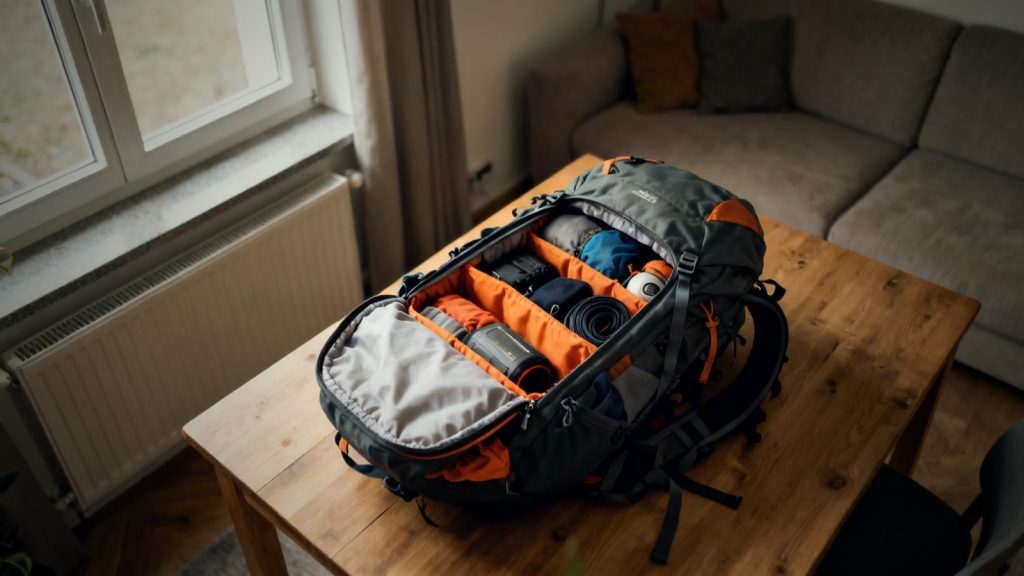
As a rough guideline for adults: for one to two days, a backpack of about 30 to 50 liters is usually enough. You can go smaller if you pack very compactly. You’ll need larger if you’re also carrying items for a child or want to bring a bulky sleeping bag. There are dedicated models for children that fit their torso length.
What matters isn’t just the number of liters, but whether your gear fits well and the weight stays manageable for you. A rule of thumb from hiking: a fully packed backpack shouldn’t noticeably throw you off balance, and it should still feel bearable after an hour of walking.
The carrying system: the most important point
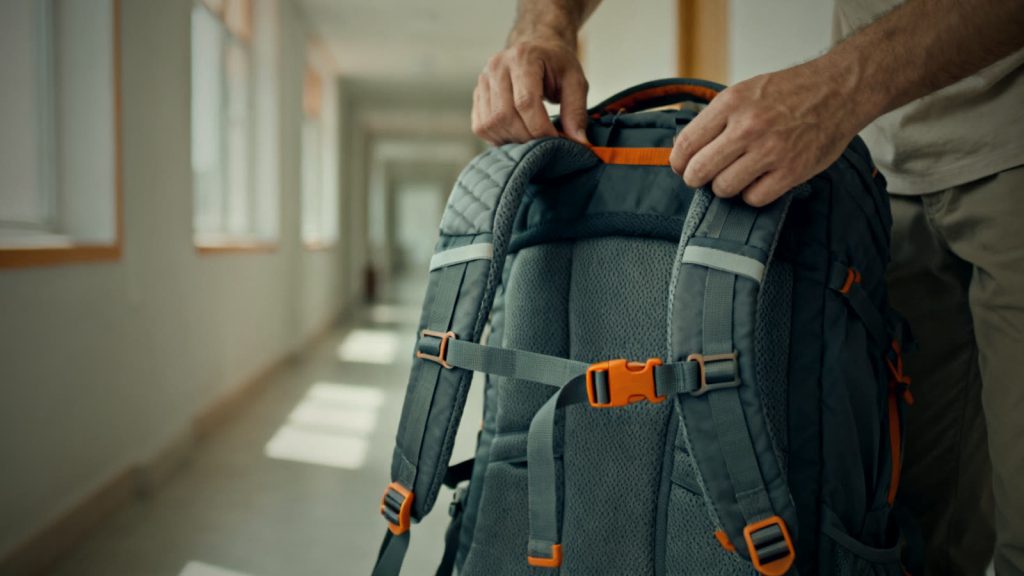
In basic training, every recruit quickly learns that weight alone isn’t what counts, but how it sits on your body. A good carrying system distributes the load so that a large part rests on your hips instead of your shoulders. Look for these features:
- Padded hip belt: From about 30 liters up, a proper hip belt is highly recommended. It should sit on your hip bones, not on your belly.
- Adjustable torso length: Many trekking backpacks can be adjusted to your torso length. This is especially handy if several people might use the backpack.
- Chest strap: It keeps the shoulder straps in position and takes pressure off your shoulders.
- Load lifter straps: Small straps at the top of the shoulder straps that you use to pull the backpack closer to your body.
- Back ventilation: A mesh back panel or ventilation channels help you sweat less.
Be sure to try the backpack on loaded. Good outdoor stores have sandbags or weights for this. Walk around with it for a few minutes and go up and down a flight of stairs.
Material and Construction
An emergency backpack often sits in the hallway for a long time, but it has to work right away when it matters. Here is what you should look for:
- Durable fabric: Dense nylon or polyester with a coating keeps out rain for a while and holds up to rough handling.
- Good zippers: They are often the weak point. High-quality name-brand zippers and clean workmanship pay off.
- Rain cover: Hardly any backpack is truly waterproof. A fitted rain cover or dry bags inside keep the contents dry.
- Inconspicuous color: A muted color is practical because it doesn’t show dirt as quickly. A bright backpack, on the other hand, can be helpful in poor visibility. Reflectors are a good idea in any case if you’re walking along roads in the dark.
Compartments and Access
A single large compartment is lightweight but impractical when you need to reach something at the very bottom. These features help:
- a lid pocket for small items such as a flashlight, tissues, and your emergency checklist,
- a front-access zipper or bottom compartment so you don’t have to unpack everything,
- side pockets for your water bottle,
- an internal compartment for your document folder, ideally close to your back.
Lots of external loops and pockets look adventurous, but they tempt you to hang things on the outside. Anything dangling outside can snag, get wet, or get lost.
Military Backpack or Hiking Backpack?
Military-style backpacks are popular, but they aren’t automatically better. For most households, a good hiking backpack from a well-known manufacturer is the better choice: a comfortable carrying system, lower empty weight, and an inconspicuous look. What matters most is that it fits you and that you can carry it a longer distance if necessary.
What About the Whole Family?
Every person who is able to carry a pack gets their own backpack, sized to their height and strength. Small children carry only a light backpack with a few personal items. The adults distribute the rest. Plan realistically: if you’re carrying a toddler, you can’t also haul a heavy backpack and two bags.
In short: Pack first, then buy the backpack that fits your gear – for one to two days, 30 to 50 liters is usually enough. A well-fitting carrying system with a hip belt matters more than any extra pocket. Try the backpack on fully loaded and protect the contents with a rain cover and dry bags.
Compare Recommended Gear
| Produktbild bei AmazonLightweightBseash 40 l | Produktbild bei AmazonRuggedMardingtop 40 l (taktisch) | Produktbild bei AmazonComfortTerra Peak Flex 40 | |
|---|---|---|---|
| Rating | at least 4.3 out of 5 starswith 500+ customer reviews (our selection criterion)See current reviews* | at least 4.3 out of 5 starswith 500+ customer reviews (our selection criterion)See current reviews* | at least 4.3 out of 5 starswith 500+ customer reviews (our selection criterion)See current reviews* |
| Features |
|
|
|
| Pros |
|
|
|
| Cons |
|
|
|
| View on Amazon* | View on Amazon* | View on Amazon* |
Selected by manufacturer data and customer reviews (at least 4.3 stars with 500+ reviews). We only show exact star ratings when they come from Amazon the same day. As of 04.10.2026. Not tested by us. Current prices and reviews are on Amazon. *Ad · paid link
Conclusion: our product picks
Backpacks (40 L) Compared
As a bug-out bag, we recommend the rugged Mardingtop – additional pouches can be attached. If you want to save weight, go with the Bseash with its rain cover. The Terra Peak is the most comfortable to carry over longer distances.
Links marked with * are advertising links. As an Amazon Associate I earn from qualifying purchases.
Sources and Further Information
General information, no substitute for individual advice from authorities, emergency services or medical professionals. In an emergency in Europe: 112.