Imagine it’s evening, the power is out, and your phone shows no signal. The TV stays dark, and the router isn’t blinking. Right now, you’d want to know what’s going on: Is it just your street or half the region? Are there instructions from the authorities? When can you expect things to improve? In a situation like this, the answer will most likely come through a channel many people have almost forgotten about: the radio.
The BBK (Germany’s Federal Office of Civil Protection and Disaster Assistance) explicitly recommends keeping a battery-powered radio or a hand-crank radio on hand so you can follow official announcements during a longer power outage. We go one step further and say: a device with a hand crank belongs in every household. We’ll explain why here.
Why the radio in particular?
Broadcasting is a robust way to reach many people at the same time. One transmitter sends out a signal, and every receiver within range picks it up – with no cellular network, no internet, and no servers that could become overloaded. That’s why authorities deliberately use radio stations in emergencies, especially the regional public broadcasting programs, to spread hazard warnings and safety instructions.
Your smartphone can do a lot, but it has two weak points: it needs power, and for most information it needs a working network. A radio only needs power – and a hand-crank radio can generate that itself.
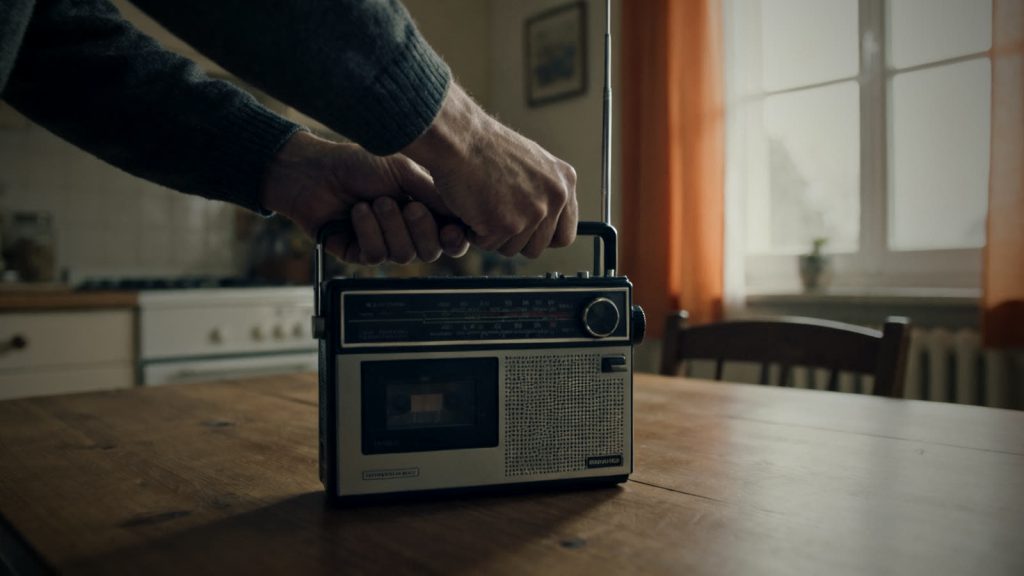
Crank, solar, battery: the power sources
Good emergency radios combine several power sources. That’s not a gimmick, it’s built-in redundancy:
- Hand crank (dynamo): You turn the crank, and the device charges its built-in battery. It always works, as long as you have strength in your arm. How long the radio plays after one minute of cranking depends heavily on the model and the volume – test this on your own device.
- Solar panel: Usually small and meant more for topping up over the course of the day. On a windowsill, it can slowly fill the battery.
- Batteries or rechargeable batteries: Many devices also take standard AA or AAA cells. That’s a big advantage, because you can draw on your battery stockpile.
- USB charging: Handy for everyday use, so you can keep the radio fully charged in the closet.
In basic training, we taught recruits never to rely on just one solution. The same goes for the radio: the more ways you have to get power, the better.
Reception: FM and DAB+
In Germany, most stations today broadcast both over FM and digitally via DAB+. An emergency radio should at least receive FM reliably. DAB+ is a plus because in many places it offers additional stations and clear reception, but it often uses a bit more power. Medium wave (AM) hardly plays a role in Germany anymore, since the major broadcasters have largely switched it off. Shortwave is more something for enthusiasts who also want to listen to international stations.
Important: Find out now which frequency your regional public broadcaster uses in your area. Write it on a slip of paper and stick it to the back of the radio. In an emergency, this saves you from having to search.
What to look for when buying a hand-crank radio
- Multiple power sources: A hand crank plus a battery compartment plus USB is ideal.
- Solid crank mechanism: The crank should feel sturdy and turn smoothly. Cheap cranks tend to break first.
- Readable display and real buttons: In the dark and with cold fingers, you don’t want to click through a menu.
- Flashlight: Many models have a built-in LED light. It’s no substitute for a proper flashlight, but it’s a useful backup.
- USB output: Some models can charge a phone via the crank. Don’t expect too much here: it takes a long time and gives you an emergency reserve rather than a full battery.
- Durability: Splash protection and a sturdy housing make sense if the device is also meant to go in your go bag.
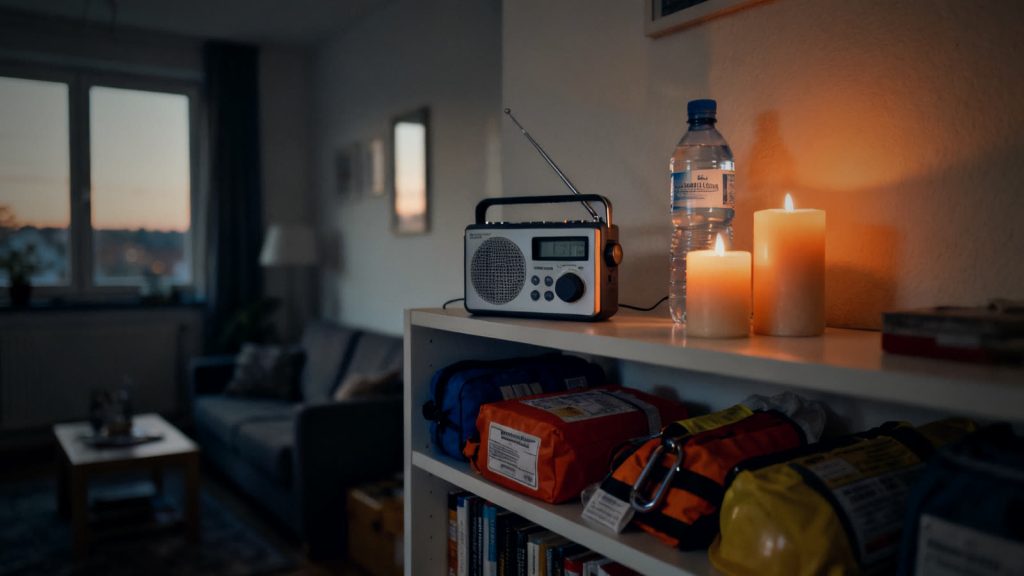
Getting your radio ready
An emergency radio that sits in the basement for years may be dead or broken when you need it. So:
- Charge the built-in battery regularly, for example whenever you check your supplies.
- Take the batteries out if the device is going to sit in storage for a longer time, so they don’t leak. Keep them in a bag next to it.
- Deliberately test the crank once a year, for example on Germany’s nationwide warning day (Warntag) in September.
- Show everyone in your household how the radio works, including the kids.
What you’ll hear in an emergency – and how to handle it
During a major incident, radio stations interrupt their regular programming for announcements. Listen closely and write down the key points: affected area, safety instructions, assistance points, time of the next update. Save energy by turning the radio on at news times and switching it off in between. And pass the information on to neighbors who may not have a radio. The BBK (Germany’s Federal Office of Civil Protection and Disaster Assistance) explicitly stresses how valuable it is to share official information.
A small device with a big impact
A hand-crank radio is no big purchase, takes up hardly any space, and with good care lasts many years. It is one of the few preparedness items that helps you in almost any situation: during a power outage, a storm, a flood, or simply when the network goes down. It takes away the feeling of sitting in the dark knowing nothing – and for peace of mind, that matters at least as much as water and food.
In short: A radio with a hand crank, a battery compartment, and FM reception is your most reliable source of information when power and networks fail. Write down the frequency of your local station and test the device once a year. Pass on the official information you hear to your neighbors.
Matching gear compared
| Produktbild bei AmazonBudget entry pointSolarbaby Notfall-Solarradio | Produktbild bei AmazonSolid middle groundActa Berg Kurbelradio | Produktbild bei AmazonLargest reserveROCAM Kurbelradio 12.000 mAh | |
|---|---|---|---|
| Rating | at least 4.3 out of 5 starswith 500+ customer reviews (our selection criterion)See current reviews* | at least 4.3 out of 5 starswith 500+ customer reviews (our selection criterion)See current reviews* | at least 4.3 out of 5 starswith 500+ customer reviews (our selection criterion)See current reviews* |
| Features |
|
|
|
| Pros |
|
|
|
| Cons |
|
|
|
| View on Amazon* | View on Amazon* | View on Amazon* |
Selected by manufacturer data and customer reviews (at least 4.3 stars with 500+ reviews). We only show exact star ratings when they come from Amazon the same day. As of 04.10.2026. Not tested by us. Current prices and reviews are on Amazon. *Ad · paid link
Conclusion: our product picks
Crank Radios Compared
For most households, the Acta Berg offers the best compromise between battery reserve and size. If you want to recharge your phone over several days, go for the ROCAM with 12,000 mAh. For a small emergency backpack, the Solarbaby is enough.
Links marked with * are advertising links. As an Amazon Associate I earn from qualifying purchases.
Sources and further information
General information, no substitute for individual advice from authorities, emergency services or medical professionals. In an emergency in Europe: 112.