A cold, an upset stomach, a splinter in your finger: in everyday life, you just pop into the pharmacy. During a prolonged power outage, in severe weather, or when you’re sick in bed yourself, that isn’t always possible. That’s exactly what a home medicine cabinet is for. It doesn’t replace a doctor, but it means you can treat minor ailments and injuries yourself for the time being – calmly and without a rush.
Here we show you what the BBK (Germany’s Federal Office of Civil Protection and Disaster Assistance) recommends, how to adapt the list to your household, and how to keep your first aid supplies in good shape over the long term.
The BBK Basic Equipment List
In its guide to emergency preparedness, the BBK lists a manageable set of basic supplies. It is deliberately kept lean and covers the most common everyday problems:
- Your personal prescription medications – the most important compartment of all
- Cold remedies as well as pain relievers and fever reducers
- Remedies for diarrhea, nausea, and vomiting
- Electrolytes to replace lost fluids
- Ointment or gel for insect bites and sunburn
- Fever thermometer and splinter tweezers
- Skin and wound disinfectant
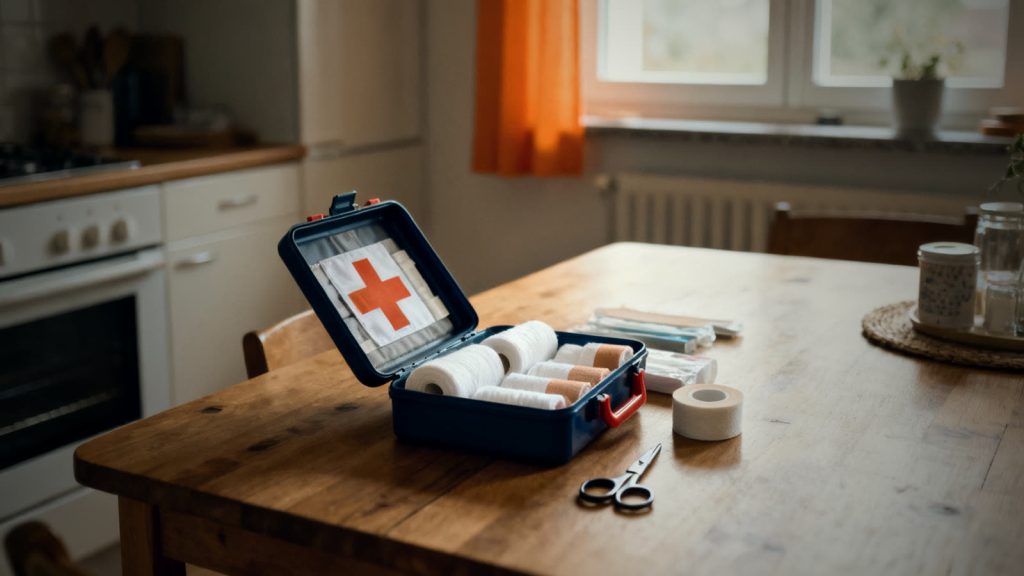
- Bandaging supplies, for example according to DIN 13164 (gauze pads, bandages, adhesive bandages, triangular bandage, bandage scissors)
Please check with your doctor or at the pharmacy which products are right for you and your family. Especially with children, pregnancy, pre-existing conditions, or if you regularly take other medications, not every over-the-counter product can be used safely. Get advice and write down the instructions.
Personal Medications: The Critical Compartment
If you need medication on an ongoing basis, you shouldn’t depend on your next prescription in a crisis. Talk to your doctor’s office about whether and how you can build up a small buffer. Not every medication is suitable for this, and some need to be refrigerated – that belongs in this conversation, too.
Also create a medication list: name of the product, active ingredient, strength, how often you take it, and who prescribed it. One copy goes in the first aid kit, one in your document folder, and one in your go bag. In an emergency, someone else can then quickly understand what you need.
Additions That Prove Their Worth in Everyday Life
Beyond the basic list, it’s worth taking a look at your household. Useful additions can include:
- Disposable gloves so you can treat other people’s wounds hygienically
- Cold packs that work without a freezer (instant cold packs)
- An emergency blanket
- A tick card or tick tweezers if you spend a lot of time outdoors
- A small flashlight so you can see what you’re holding even during a power outage
- Spare glasses or contact lenses along with care solution
In basic training, we learned a simple rule: equipment you can’t find is equipment you don’t have. That’s why organization matters more than quantity. Sort by topic – wounds, pain and fever, stomach and digestion, skin, personal items – and label the compartments or boxes.
Proper Storage
The bathroom is the classic spot for the medicine cabinet – and at the same time a poor one. Humidity and temperature swings damage many medications. The BBK (Germany’s Federal Office of Civil Protection and Disaster Assistance) recommends a dry room that isn’t too warm, and your first aid kit and home pharmacy should be lockable or at least out of reach of children. A cabinet in the hallway or bedroom is often the better choice.
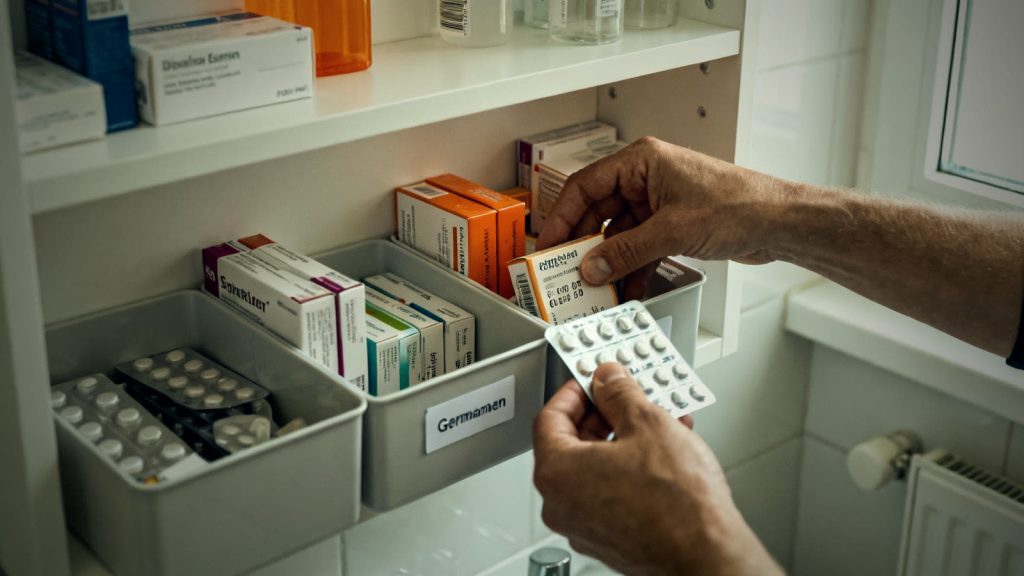
Whenever possible, keep medications in their original packaging with the package insert. That way you always have the expiration date, storage instructions, and usage information together. For syrups, drops, and ointments, write the date you opened them on the package – opened products often have a much shorter shelf life than unopened ones.
Checking Your Supplies: Twice a Year Is Enough
A home medicine cabinet isn’t a project you finish once and forget. Set a fixed date, for example when the clocks change in spring and fall. Then you can go through it in just a few minutes:
- Check expiration dates and sort out anything expired
- Restock what you’ve used up
- Update your medication list
- Test the thermometer battery
- Check sterile dressings for damaged packaging
Expired medications should never go down the toilet or the sink, because the active ingredients end up in the wastewater. The Umweltbundesamt (Germany’s Federal Environment Agency) points out that proper disposal is regulated differently from region to region – in many municipalities it goes in the household trash, in some places there are collection points, or pharmacies accept old medications. To find out what applies where you live, check with your local waste disposal service.
Your Home Medicine Cabinet as Part of Your Preparedness
Your home medicine cabinet doesn’t stand alone. It complements your drinking water and food supply, because with diarrhea or fever, the most important thing you need is enough to drink. And it complements your knowledge. The best bandaging material won’t help much if you don’t know how to apply a pressure bandage. A first aid course is therefore the most worthwhile investment besides the supplies themselves.
If you’re unsure whether a health complaint is something you can handle with your home medicine cabinet: when in doubt, seek medical advice. Outside of office hours, you can reach the medical on-call service at 116 117. In life-threatening situations, always call the emergency number 112.
In short: Your personal medications plus a medication list are the heart of your home medicine cabinet. Store everything in a dry, cool, childproof place – not in the bathroom. Check expiration dates twice a year, dispose of old items properly, and replace what’s missing.
Matching Equipment Compared
| Produktbild bei AmazonFor home useFLEXEO Erste-Hilfe-Koffer DIN 13157:2021 | Produktbild bei AmazonHome alternativeWERKSTEIN Erste-Hilfe-Kasten DIN 13157:2021 | Produktbild bei AmazonFor on the goFLEXEO Erste-Hilfe-Tasche „Discovery“ | |
|---|---|---|---|
| Rating | at least 4.3 out of 5 starswith 500+ customer reviews (our selection criterion)See current reviews* | at least 4.3 out of 5 starswith 500+ customer reviews (our selection criterion)See current reviews* | at least 4.3 out of 5 starswith 500+ customer reviews (our selection criterion)See current reviews* |
| Features |
|
|
|
| Pros |
|
|
|
| Cons |
|
|
|
| View on Amazon* | View on Amazon* | View on Amazon* |
Selected by manufacturer data and customer reviews (at least 4.3 stars with 500+ reviews). We only show exact star ratings when they come from Amazon the same day. As of 04.10.2026. Not tested by us. Current prices and reviews are on Amazon. *Ad · paid link
Conclusion: our product picks
First Aid Kits Compared
For home use, a kit meeting DIN 13157 belongs on the wall – both models meet the current standard. For emergency bags and outings, the FLEXEO bag is a good addition. A first aid course doesn't replace the supplies – in an emergency, always call 112.
Links marked with * are advertising links. As an Amazon Associate I earn from qualifying purchases.
Sources and Further Information
General information, no substitute for individual advice from authorities, emergency services or medical professionals. In an emergency in Europe: 112.