Ask around your circle of friends when they last took a first aid course. For many, the answer is: “For my driver’s license.” That could be ten, twenty, or thirty years ago. You can buy supplies, but you can’t buy knowledge. And it’s knowledge that makes the difference in the decisive moment – at a car accident, when someone collapses in the supermarket, or when something happens at home while the ambulance is still on its way.
Why Knowledge Fades
First aid is a skill, not a theory. Much like a foreign language, if you don’t practice it, you lose it. On top of that, recommendations change over time. The resuscitation guidelines are revised regularly, procedures have been simplified, and today laypeople are encouraged above all to do one thing: act quickly and decisively.
In basic training, we didn’t do medical training just once, but over and over – until the moves became second nature, even under stress. That’s exactly the point: in an emergency, you don’t think for long, you fall back on what you’ve practiced.
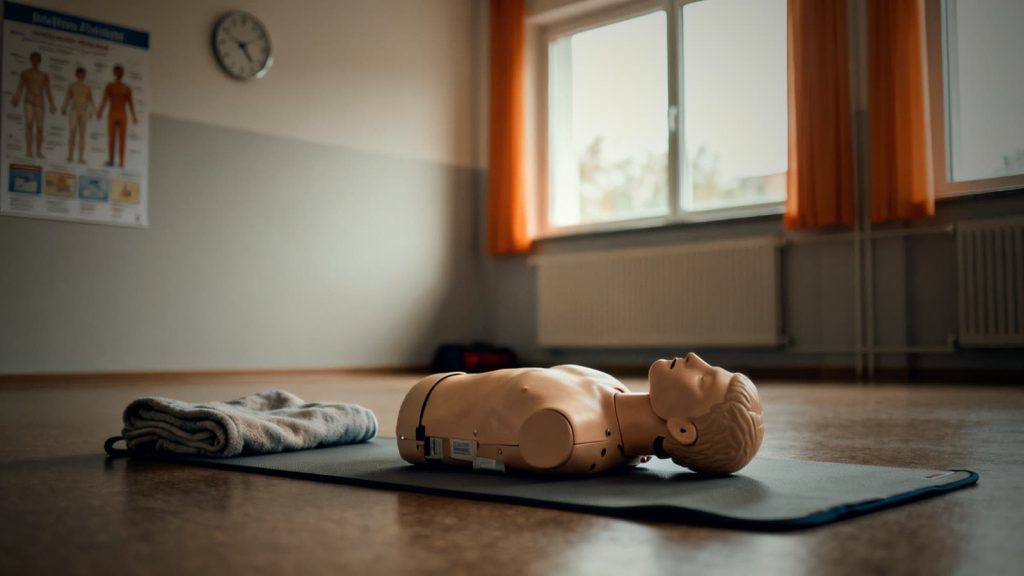
What You Learn in a First Aid Course
A standard course consists of 9 instructional units and fits into a single day. This is exactly the course that is also required for a driver’s license in Germany. Typical topics include:
- Protecting yourself and securing an accident scene
- Making an emergency call to 112 correctly and waiting for follow-up questions
- Recognizing unconsciousness and the recovery position
- CPR (cardiopulmonary resuscitation) and using an automated external defibrillator (AED)
- Stopping severe bleeding and applying a pressure bandage
- Treating wounds, burns, and broken bones
- Dealing with shock, and recognizing signs of a heart attack or stroke
- Caring for and calming those affected
The hands-on part is the heart of the course. You practice chest compressions on a manikin, apply bandages, and roll other participants into the recovery position. It feels unfamiliar at first – and that’s exactly why it’s so valuable.
How Often Should You Refresh Your First Aid Skills?
There is no refresher requirement for private individuals. However, the rules for workplace first aiders offer a good point of reference: according to the DGUV (German Social Accident Insurance), they must refresh their skills in a first aid training within two years. That interval is a sensible rule of thumb for you, too. If that seems too ambitious: a course every few years is far better than none at all.
The Fear of Doing Something Wrong
Many people hesitate in an emergency because they fear they’ll do more harm than good. The message from aid organizations is clear: the only real mistake is doing nothing. In the case of cardiac arrest, every minute counts until the ambulance arrives. A course takes away this uncertainty because you know what to do.
Good to know: In Germany, anyone who provides help in an emergency is covered by statutory accident insurance in case they are injured themselves. This is not a substitute for legal advice, but it should ease your worry that helping could work against you.
Specialized Courses for Particular Situations
In addition to the standard course, there are options tailored to specific circumstances:
- First aid for children – for parents, grandparents, and anyone who spends time with kids
- First aid for seniors or family caregivers
- Wilderness first aid for situations where emergency services take longer to arrive
- Short formats on CPR and AED use, often free or very inexpensive
Where to Find a First Aid Course
First aid courses are offered by the German Red Cross (DRK), the Workers’ Samaritan Federation (ASB), the Johanniter-Unfall-Hilfe (Johanniter Accident Assistance), the Malteser Hilfsdienst (Malteser Relief Service), and the DLRG (German Lifesaving Association), among others. You can search their websites for course dates near you. Many employers also train workplace first aiders, so feel free to ask whether you can sign up. In that case, the costs are usually covered by the Berufsgenossenschaft or Unfallkasse (German statutory accident insurance providers).
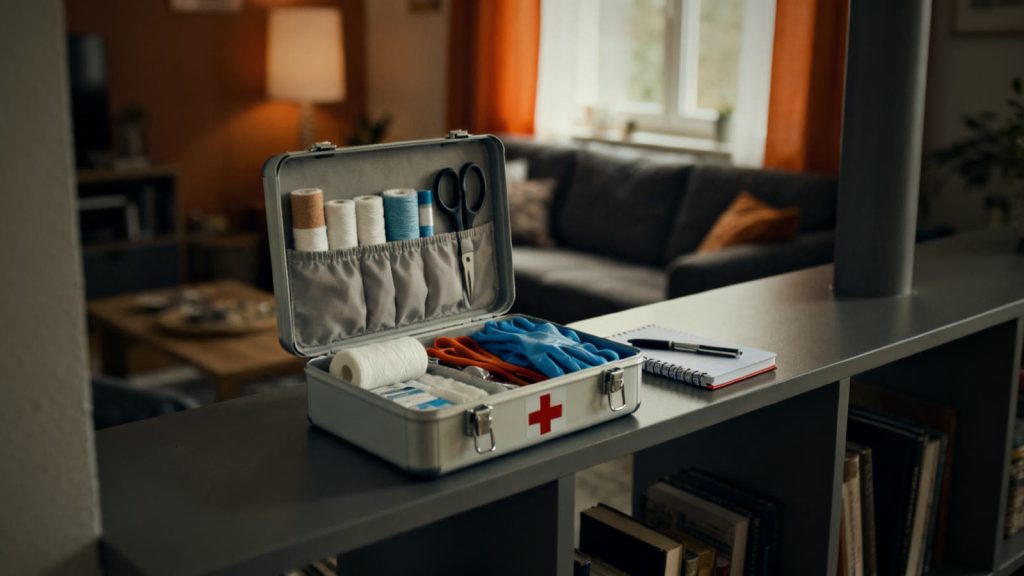
After the Course: Keep It Up
A course is a good start. To keep what you’ve learned fresh, a few small habits help:
- Take a close look at your first aid kit after the course and replace anything that’s missing.
- Make a mental note of where AEDs (automated external defibrillators) are located in your area, such as at train stations, supermarkets, and sports halls.
- Talk with your family about the most important steps: protecting yourself, calling emergency services, and helping.
- Add your next refresher date to your calendar right away.
A nice side effect: first aid knowledge is contagious. People who have taken a course often motivate partners, children, coworkers, or their sports club to follow suit. The more people around you who know what to do, the more likely it is that someone will help you quickly and correctly in an emergency, too.
In short: First aid skills fade if you don’t practice them. A one-day course with 9 teaching units gets you up to date, and refreshing your knowledge about every two years is a good rule of thumb. The only real mistake in an emergency is doing nothing.
Comparing the Right Gear
| Produktbild bei AmazonFor home useFLEXEO Erste-Hilfe-Koffer DIN 13157:2021 | Produktbild bei AmazonHome alternativeWERKSTEIN Erste-Hilfe-Kasten DIN 13157:2021 | Produktbild bei AmazonFor on the goFLEXEO Erste-Hilfe-Tasche „Discovery“ | |
|---|---|---|---|
| Rating | at least 4.3 out of 5 starswith 500+ customer reviews (our selection criterion)See current reviews* | at least 4.3 out of 5 starswith 500+ customer reviews (our selection criterion)See current reviews* | at least 4.3 out of 5 starswith 500+ customer reviews (our selection criterion)See current reviews* |
| Features |
|
|
|
| Pros |
|
|
|
| Cons |
|
|
|
| View on Amazon* | View on Amazon* | View on Amazon* |
Selected by manufacturer data and customer reviews (at least 4.3 stars with 500+ reviews). We only show exact star ratings when they come from Amazon the same day. As of 04.10.2026. Not tested by us. Current prices and reviews are on Amazon. *Ad · paid link
Conclusion: our product picks
First Aid Kits Compared
For home use, a kit meeting DIN 13157 belongs on the wall – both models meet the current standard. For emergency bags and outings, the FLEXEO bag is a good addition. A first aid course doesn't replace the supplies – in an emergency, always call 112.
Links marked with * are advertising links. As an Amazon Associate I earn from qualifying purchases.
Sources and Further Information
General information, no substitute for individual advice from authorities, emergency services or medical professionals. In an emergency in Europe: 112.