Many people want to prepare but don’t know where to start – so they keep putting it off. Yet preparedness works best the same way you build skills in basic training: in small, clear steps, a little every day. This plan spreads the most important tasks over 30 days. Most take 15 to 30 minutes. You don’t have to buy everything at once, and you can pause at any time. All that matters: get started.
Week 1: Overview and Information
- Day 1 – Take stock: Go through your kitchen, bathroom, and basement. What do you already have in terms of water, food, flashlights, batteries, and medications? Write it down.
- Day 2 – Assess your household: How many people, children, pets? Who needs medications or assistive devices? Are there any allergies?
- Day 3 – Receive warnings: Install the NINA warning app (Germany’s official emergency warning app) on all smartphones in your household, enable notifications, and save your location.
- Day 4 – Get informed: Read the guide “Vorsorgen für Krisen und Katastrophen” (Preparing for Crises and Disasters) from the BBK (Germany’s Federal Office of Civil Protection and Disaster Assistance) or download the checklists.
- Day 5 – Risks in your area: Do you live in a flood zone? Are there industrial facilities nearby? Frequent storms or heavy rain? These shape your priorities.
- Day 6 – Check your smoke detectors: Press the test button and check the batteries.
- Day 7 – Rest day: Let what you’ve learned sink in. Talk to your family or housemates about the plan.
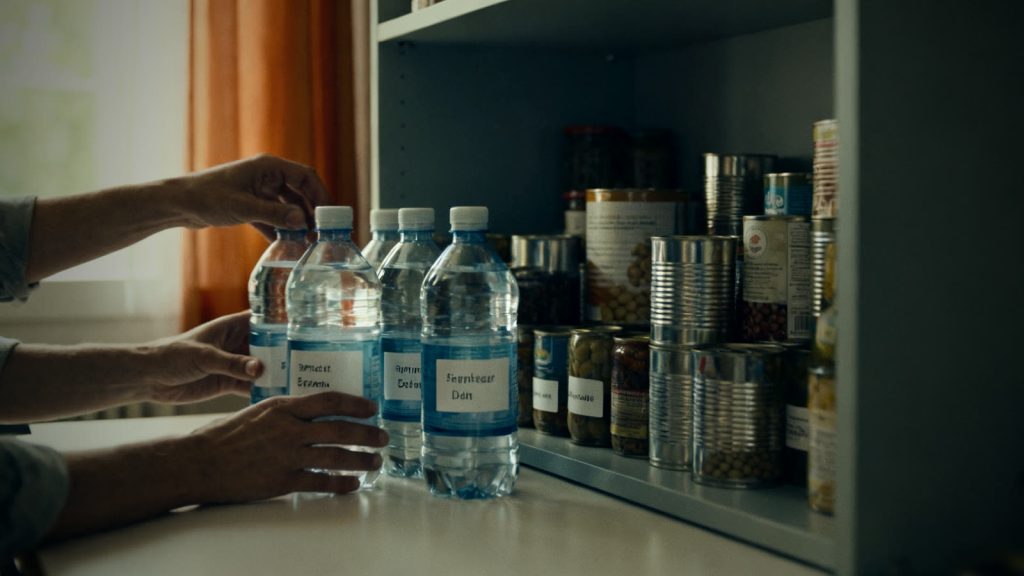
Week 2: Water and Food
- Day 8 – Calculate your needs: The BBK recommends a supply for ten days if possible, at least 1.5 liters of drinking fluids per person per day plus about 0.5 liters for cooking. For one person and ten days, that comes to around 20 liters. The supply calculator at ernaehrungsvorsorge.de helps with the math.
- Day 9 – Buy water: Start with a three-day supply. Store it in a dark, cool place.
- Day 10 – Plan your food: Write a list of foods you already enjoy eating that keep for a long time – ideally edible without cooking.
- Day 11 – First big shopping trip: Pick up part of the list. No panic buying – just targeted, step by step.
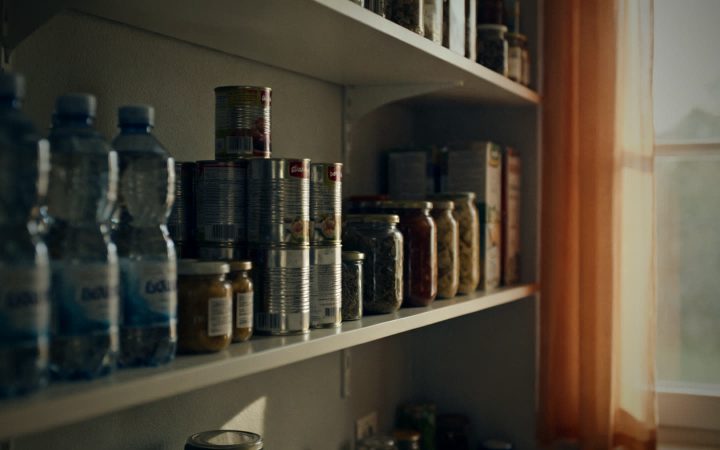
- Day 12 – Set up a storage space: Clear a shelf or cupboard and sort your supplies by shelf life – oldest in front.
- Day 13 – Cooking without power: Think about how you can get a hot meal without a stove. Important: Grills, gas heaters, and camping stoves without exhaust venting do not belong in enclosed spaces – risk of fatal carbon monoxide poisoning. If necessary, plan for cold meals.
- Day 14 – Pets: Add food, water, and any medications for your animals.
Week 3: Light, Power, Information, Health
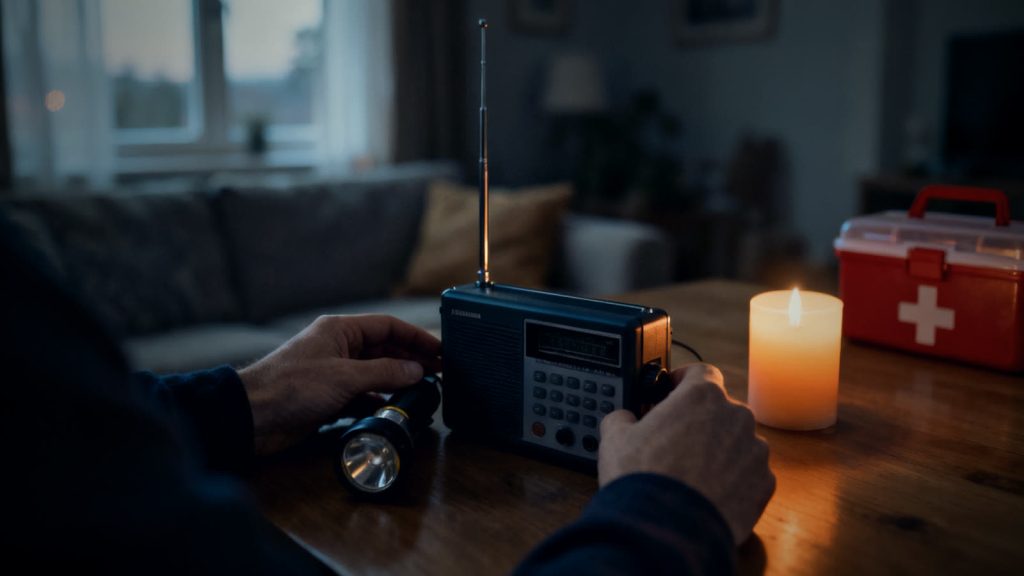
- Day 15 – Light: Get a flashlight or headlamp for each person, plus spare batteries. Use candles only under supervision.
- Day 16 – Radio: Get a battery-powered or hand-crank emergency radio and look up the stations in your area.
- Day 17 – Power for communication: Charge a power bank and decide on a fixed spot for it. Check whether a portable power station makes sense for you.
- Day 18 – Warmth: Keep blankets, sleeping bags, and warm clothing within easy reach in case the heating fails.
- Day 19 – First aid kit and medications: Check what you have, and ask your pharmacy how to dispose of anything expired. Talk to your doctor or pharmacist about your regular medications and how much of a reserve to keep.
- Day 20 – Hygiene: Toilet paper, soap, disinfectant, and sturdy trash bags for an emergency toilet.
- Day 21 – Cash: Build a small cash reserve in small bills. During a power outage, ATMs don’t work either.
Week 4: Go Bag, Agreements, Practice Run
- Day 22 – Document folder: Gather important documents as recommended by the BBK (Germany’s Federal Office of Civil Protection and Disaster Assistance) – some as originals, some as copies – and back them up digitally as well.
- Day 23 – Pack your go bag: One backpack per person with medications, first aid supplies, a radio, a flashlight, two days of food, a water bottle, a change of clothes, hygiene items, a sleeping bag or blanket, and the document folder.
- Day 24 – Contact list: Print important phone numbers on paper – for each bag and next to the phone.
- Day 25 – Meeting points: Choose one meeting point near your home and one outside your area. Clarify pickup rules for children.
- Day 26 – Neighbors: Introduce yourself to your neighbors and exchange phone numbers. Who needs help? Who can help?
- Day 27 – First aid: Sign up for a first aid course, for example with the DRK (German Red Cross), Johanniter, Malteser, or ASB (Workers’ Samaritan Federation), if your last one was a long time ago.
- Day 28 – Find the main shutoffs: Where are the fuse box, the main water shutoff valve, and, if you have one, the gas shutoff valve? All adults in the household should know.
- Day 29 – Practice run: One evening without power: lights off, radio on, food from your supplies. Write down what was missing or inconvenient.
- Day 30 – Review and calendar: Add any gaps to your shopping list. Set recurring dates in your calendar, for example twice a year, to check your supplies, batteries, and go bag.
What Comes After the 30 Days
Preparedness is not a state you reach, but a routine. Use up and replace your supplies regularly following the “rotating stockpile” principle. Gradually build up whatever was missing during your practice run. From experience, we can say: equipment that is never checked is often not ready when it matters. A recurring date in your calendar prevents that.
And most importantly: don’t let perfection paralyze you. If you have three days covered today, you’re better prepared than most people. Every step counts.
In short: Small daily steps make emergency preparedness manageable – from taking stock to a practice run in four weeks. Start with information, water, and food, then light, power, and health, and finally your go bag and agreements. After that, check and top up regularly.
Recommended Gear Compared
| Produktbild bei AmazonCompactplasteo Wasserkanister 10 l | Produktbild bei AmazonProven Classichünersdorff Wasserkanister 12 l | Produktbild bei AmazonLarge Supplyhünersdorff Wasserkanister 22 l | |
|---|---|---|---|
| Rating | at least 4.3 out of 5 starswith 500+ customer reviews (our selection criterion)See current reviews* | at least 4.3 out of 5 starswith 500+ customer reviews (our selection criterion)See current reviews* | at least 4.3 out of 5 starswith 500+ customer reviews (our selection criterion)See current reviews* |
| Features |
|
|
|
| Pros |
|
|
|
| Cons |
|
|
|
| View on Amazon* | View on Amazon* | View on Amazon* |
Selected by manufacturer data and customer reviews (at least 4.3 stars with 500+ reviews). We only show exact star ratings when they come from Amazon the same day. As of 04.10.2026. Not tested by us. Current prices and reviews are on Amazon. *Ad · paid link
| Produktbild bei AmazonBudget entry pointSolarbaby Notfall-Solarradio | Produktbild bei AmazonSolid middle groundActa Berg Kurbelradio | Produktbild bei AmazonLargest reserveROCAM Kurbelradio 12.000 mAh | |
|---|---|---|---|
| Rating | at least 4.3 out of 5 starswith 500+ customer reviews (our selection criterion)See current reviews* | at least 4.3 out of 5 starswith 500+ customer reviews (our selection criterion)See current reviews* | at least 4.3 out of 5 starswith 500+ customer reviews (our selection criterion)See current reviews* |
| Features |
|
|
|
| Pros |
|
|
|
| Cons |
|
|
|
| View on Amazon* | View on Amazon* | View on Amazon* |
Selected by manufacturer data and customer reviews (at least 4.3 stars with 500+ reviews). We only show exact star ratings when they come from Amazon the same day. As of 04.10.2026. Not tested by us. Current prices and reviews are on Amazon. *Ad · paid link
Conclusion: our product picks
Water Canisters with Spigot Compared
For home storage, 22-liter canisters are the most efficient option – one per person covers the BBK's recommended 20 liters. If you need to carry it, go with several 10- or 12-liter canisters. Store canisters in a cool, dark place and rotate the water regularly.
Crank Radios Compared
For most households, the Acta Berg offers the best compromise between battery reserve and size. If you want to recharge your phone over several days, go for the ROCAM with 12,000 mAh. For a small emergency backpack, the Solarbaby is enough.
Links marked with * are advertising links. As an Amazon Associate I earn from qualifying purchases.
Sources and further information
- BBK (Germany’s Federal Office of Civil Protection and Disaster Assistance) – Stockpiling Food and Water
- BBK – Checklists for Preparing for Crises and Disasters (PDF)
- BBK – Go Bag
- BBK – Always Within Reach: The Document Folder
- BBK – Preparing for and Responding to a Power Outage
- BZfE (Germany’s Federal Center for Nutrition) – Private Food Preparedness
General information, no substitute for individual advice from authorities, emergency services or medical professionals. In an emergency in Europe: 112.