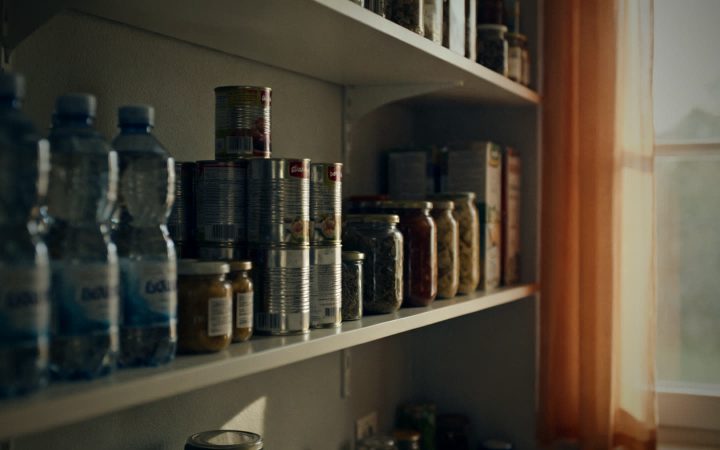
“I’d love to prepare, but where am I supposed to put all of it?” – we hear this a lot. In cities especially, many people live in small rented apartments with no basement, attic, or pantry. The BBK (Germany’s Federal Office of Civil Protection and Disaster Assistance) recommends building up a supply for ten days if possible, which can sound like it requires a warehouse. It doesn’t have to. With a few tricks, a solid basic emergency supply fits even into a studio or two-room apartment.
Starting small is perfectly fine
The BBK stresses that even a three-day supply is an important step. Start there and build it up bit by bit. Preparedness isn’t a weekend project, it’s a habit.
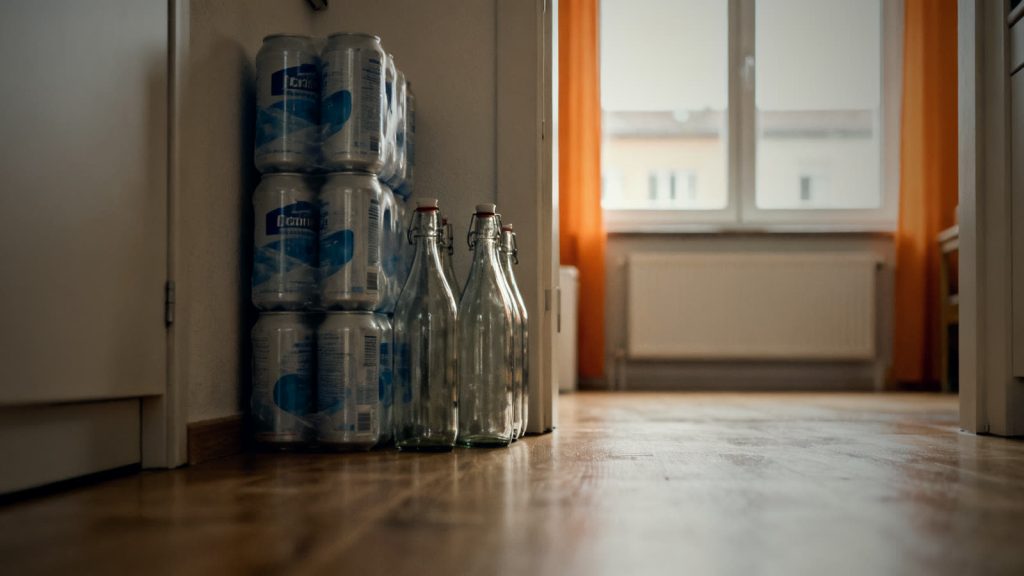
Water: the biggest space hog
For one adult, the BBK calculates at least 1.5 liters of drinking fluids per day, plus about 0.5 liters for cooking. For one person over ten days, that comes to roughly 20 liters – about three cases of mineral water or a few canisters.
Space-saving ideas:
- Flat beverage crates or six-packs under the bed – it’s usually dark and cool there.
- Collapsible water containers as a backup that you fill additionally when a warning is issued. They don’t replace your permanent supply, though, because there’s no time for that in a sudden outage.
- “Store” mineral water as part of everyday life: Simply buy one more case than you need and always drink the oldest one first.
Food: compact and well thought out
Choose energy-dense foods that take up little space and can be eaten without cooking if possible: nuts, dried fruit, oats, crispbread, canned ready meals, peanut butter, granola bars. Pasta and rice are compact, but they need water and energy for cooking.
The principle of a rotating pantry saves space: You buy things you already eat in slightly larger quantities and use them up regularly. That way, you don’t need a separate “emergency cupboard,” just a bit more organization in your existing cabinets.
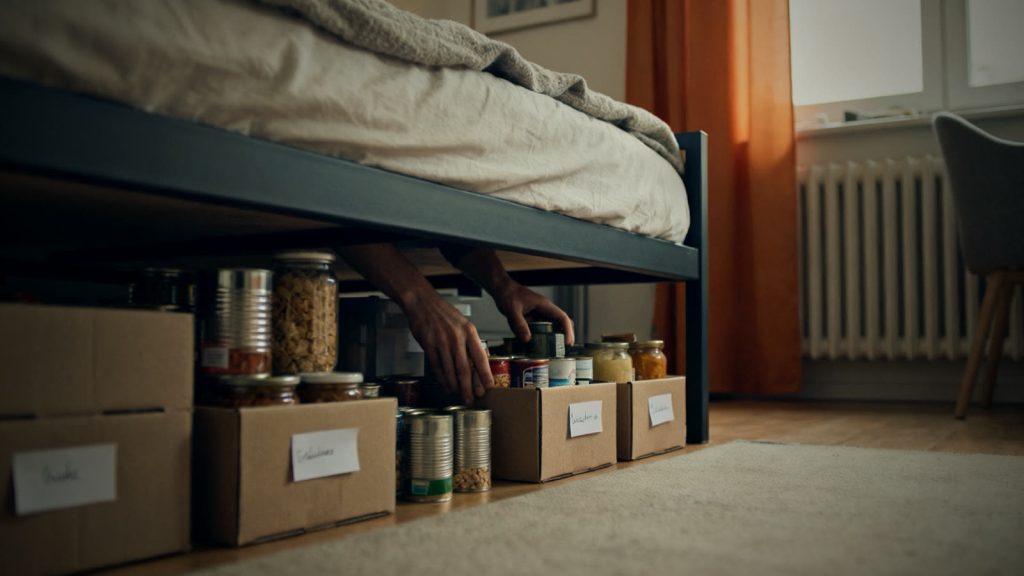
Using hidden storage space
- Under the bed: flat storage boxes with lids for canned food, water, and hygiene items.
- Top closet shelves: lighter items such as toilet paper, candle alternatives, spare batteries.
- Behind doors: hanging racks or shoe organizers for small items like flashlights, batteries, lighters, medications.
- Storage benches and stools with built-in storage – furniture that does double duty.
- The hallway: Your go bag belongs within easy reach near the door, for example in the coat closet.
Important: Store food in a dry, dark place that isn’t too warm if possible – so not right next to the radiator or in the sun by the window. The Ernährungsvorsorge portal (the German government’s food preparedness portal) of the Federal Office for Agriculture and Food (Bundesanstalt für Landwirtschaft und Ernährung) recommends about 59 to 68 °F (15 to 20 °C) for a pantry or food cupboard.
What to Keep in Mind When Living in a Rental Apartment
Fire Safety and House Rules
Fuels such as gas cartridges, denatured alcohol, or kerosene don’t belong in an apartment in large quantities. Store only what you really need, in a cool, well-ventilated place and out of children’s reach. Stairwells and hallways in your building are escape routes and must not be blocked. Smoke detectors are required in apartments in all German states – check that yours works.
Cooking and Heating Without Power
A camping stove can be useful, but only with care: gas appliances, grills, and heaters without exhaust venting have no place in enclosed spaces. Carbon monoxide poisoning is life-threatening. If you cook indoors at all, use only approved appliances, make sure there is good ventilation, never leave them unattended, and keep them away from anything flammable. Food that needs no cooking is the safer choice.
Power for the Essentials
A power bank for your smartphone and a small portable power station for lighting, a radio, and charging take up little space. A power station fits in a closet and can be kept charged from a wall outlet. Plug-in balcony solar systems are only partly suitable for emergencies, since most of them shut off automatically during a power outage.
Your Neighbors as a Resource
In apartment buildings with several households, there is one big advantage: people. Get to know your neighbors, exchange phone numbers, and agree on who can help whom. If you know that the elderly woman on the third floor depends on her medication, you can check on her in an emergency. In basic military training, you learn early on that a group that knows each other accomplishes more in difficult situations than a bunch of lone fighters.
A Mini Checklist for Small Apartments
- Water for at least three days, ideally ten
- Compact foods that can be eaten without cooking
- Flashlight or headlamp with spare batteries
- Battery-powered or hand-crank radio
- Power bank, ideally a small portable power station
- First aid kit and personal medications
- Cash in small bills
- Hygiene items and trash bags
- Document folder and go bag by the door
In short: Even a small space is enough for a sensible emergency supply if you use storage space under the bed, in closets, and behind doors. Start with three days and build up using the “rotating stockpile” principle. And keep fire safety in mind: no open flames or gas appliances without exhaust venting in your apartment.
Matching Gear Compared
| Produktbild bei AmazonCompactplasteo Wasserkanister 10 l | Produktbild bei AmazonProven Classichünersdorff Wasserkanister 12 l | Produktbild bei AmazonLarge Supplyhünersdorff Wasserkanister 22 l | |
|---|---|---|---|
| Rating | at least 4.3 out of 5 starswith 500+ customer reviews (our selection criterion)See current reviews* | at least 4.3 out of 5 starswith 500+ customer reviews (our selection criterion)See current reviews* | at least 4.3 out of 5 starswith 500+ customer reviews (our selection criterion)See current reviews* |
| Features |
|
|
|
| Pros |
|
|
|
| Cons |
|
|
|
| View on Amazon* | View on Amazon* | View on Amazon* |
Selected by manufacturer data and customer reviews (at least 4.3 stars with 500+ reviews). We only show exact star ratings when they come from Amazon the same day. As of 04.10.2026. Not tested by us. Current prices and reviews are on Amazon. *Ad · paid link
Conclusion: our product picks
Water Canisters with Spigot Compared
For home storage, 22-liter canisters are the most efficient option – one per person covers the BBK's recommended 20 liters. If you need to carry it, go with several 10- or 12-liter canisters. Store canisters in a cool, dark place and rotate the water regularly.
Links marked with * are advertising links. As an Amazon Associate I earn from qualifying purchases.
Sources and Further Information
General information, no substitute for individual advice from authorities, emergency services or medical professionals. In an emergency in Europe: 112.