Do you know the cell phone number of your partner, your parents, or your kids’ school by heart? Most of us don’t anymore. In everyday life that’s not a problem, because your phone remembers for you. But what if the battery is dead, the phone is broken or lost, or the network is overloaded? Then you’re left without your most important numbers. An emergency contact list and an agreed family meeting point are among the simplest and cheapest ways to prepare. They cost you one afternoon and a little paper.
Why paper?
The BBK (Germany’s Federal Office of Civil Protection and Disaster Assistance) explicitly recommends keeping important contacts in print or handwritten. Paper needs no power, no password, and no network. You can copy it, hand it out, and slip it into any pocket. In basic training, we drilled it into everyone: whatever has to work in an emergency should be as simple as possible. A slip of paper is simple.
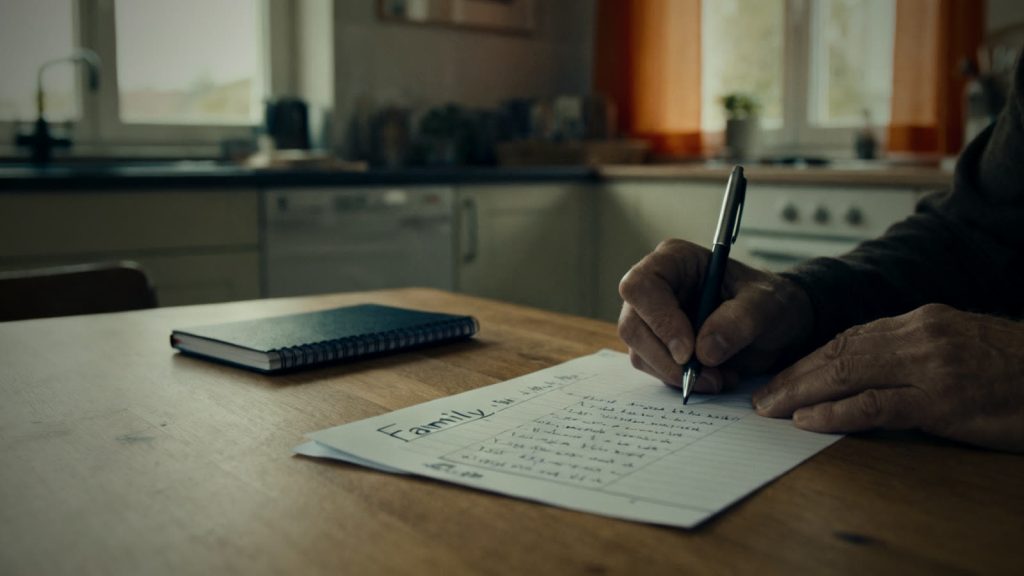
What belongs on your emergency contact list
Keep the list clear and up to date. This structure has proven its worth:
- Household family members: names, cell phone numbers, workplace with phone number.
- Out-of-area contact: a trusted person who lives farther away, for example in a different region. In a local emergency, they’re often easier to reach than someone nearby and can serve as a message center.
- Neighbors and friends nearby: who has a key in an emergency and can check on the kids or pets.
- Daycare, school, care service: phone numbers and addresses, plus who is allowed to pick up the kids there.
- Doctors and pharmacy: family doctor’s office, specialists, veterinarian.
- Insurance and landlord: home contents, building insurance, property management.
- Important numbers: emergency number 112 (fire department and ambulance), police 110, medical on-call service 116 117, poison control center for your state.
Also write down the addresses of the meeting points you decide on together.
Where to keep the list
One list is good, several copies are better:
- one copy in your document folder,
- one in your go bag,
- one for each family member in their wallet or school bag, preferably credit-card size and laminated,
- one in a fixed spot in your home, for example on the inside of the pantry door.
It’s also worth adding an entry on your smartphone: both iPhone and Android offer emergency information that can be accessed from the lock screen. That way, first responders can see your emergency contacts if something happens. It doesn’t replace paper, though.
Your Family Meeting Point
Imagine an emergency hits mid-morning. You’re at work, your partner is out and about, and the kids are at school. Phone calls aren’t going through. Where do you meet? If you’ve settled that in advance, nobody has to think long or search for one another.
It’s best to set up two meeting points:
- Near your home: for when you have to leave the house quickly, such as during a fire. This can be a distinctive spot, for example the streetlight on the corner or the mailbox across the street.
- Outside your neighborhood: for when you can’t get home because the area is closed off or evacuated. This can be a relative’s home, a community center, or another place that’s easy to reach.
Also agree on how long to wait and what happens if someone doesn’t show up. A simple rule helps: Whoever arrives first waits and, if needed, leaves a message at an agreed spot.

Communication When the Network Is Jammed
When many people try to make calls at the same time, the cell network quickly becomes overloaded. A few basic rules help:
- Keep calls short and only call when it’s truly necessary.
- Short text messages often get through more easily than calls because they need less network capacity.
- Contact your agreed out-of-area contact person first. They collect the information and pass it on.
- Conserve your battery, for example with power saving mode and a dimmed screen, and keep a charged power bank within reach.
If the emergency call (112) doesn’t work, the BBK (Germany’s Federal Office of Civil Protection and Disaster Assistance) recommends going directly to a police station or a hospital.
Discuss and Practice the Plan
A plan that only one person knows is of little use. Sit down together once, go through the list, and walk to the meeting points together, especially with kids. Make it a little walk rather than a drill with a wagging finger. Children remember places they’ve actually been to much better than a description.
Review the list at least once a year. Phone numbers change, kids switch schools, friends move. A good fixed date for this is Germany’s nationwide warning day (Warntag) in September or the day you check your emergency supplies anyway.
In short: Write down the most important contacts on paper and give a copy to every family member. Set one meeting point near your home and one outside your neighborhood. Choose an out-of-area contact person where all information comes together.
Matching Gear Compared
| Produktbild bei AmazonBasic sleeveABSOK Feuerfeste Dokumententasche (2er-Set) | Produktbild bei AmazonWith combination lockGowinsee Aktentasche mit Schloss | Produktbild bei AmazonFamily organizerTamfile Feuerfeste Dokumentenbox | |
|---|---|---|---|
| Rating | at least 4.3 out of 5 starswith 500+ customer reviews (our selection criterion)See current reviews* | at least 4.3 out of 5 starswith 500+ customer reviews (our selection criterion)See current reviews* | at least 4.3 out of 5 starswith 500+ customer reviews (our selection criterion)See current reviews* |
| Features |
|
|
|
| Pros |
|
|
|
| Cons |
|
|
|
| View on Amazon* | View on Amazon* | View on Amazon* |
Selected by manufacturer data and customer reviews (at least 4.3 stars with 500+ reviews). We only show exact star ratings when they come from Amazon the same day. As of 04.10.2026. Not tested by us. Current prices and reviews are on Amazon. *Ad · paid link
Conclusion: our product picks
Comparing Fireproof Document Bags
For IDs, certificates, and insurance documents for the whole family, the Tamfile box with 13 compartments offers the best overview. If you just need a quick emergency folder, go with the ABSOK set; for a combination lock, choose the Gowinsee bag. The temperature specifications are manufacturer claims without a stated testing standard – back up copies digitally as well.
Links marked with * are advertising links. As an Amazon Associate I earn from qualifying purchases.
Sources and Further Information
General information, no substitute for individual advice from authorities, emergency services or medical professionals. In an emergency in Europe: 112.