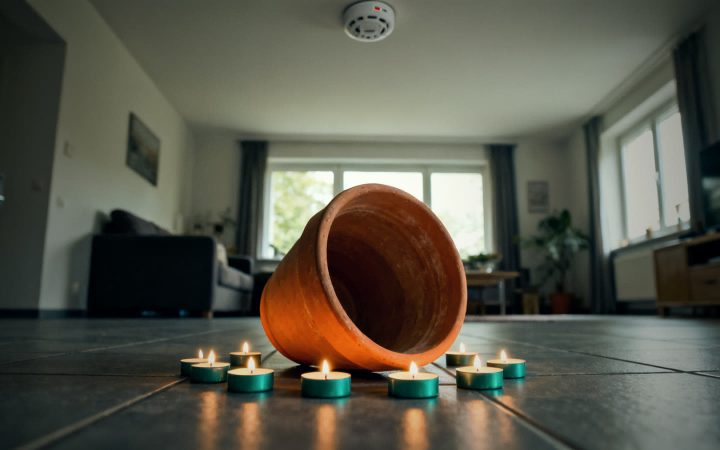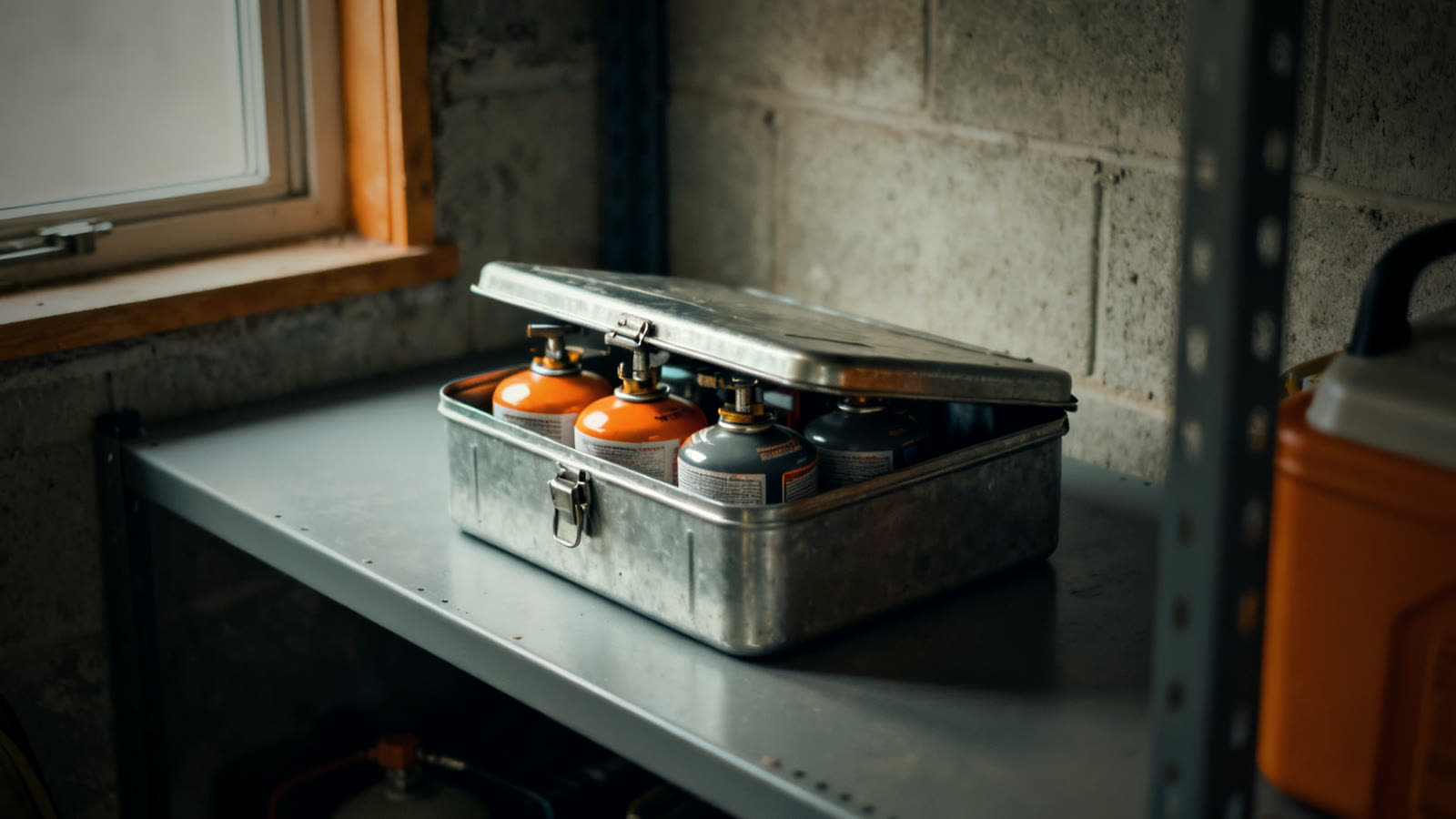
When it comes to storing gas cartridges in your apartment, there is a clear limit: you may keep a maximum of two cartridges, and they must be in different rooms – this applies to full and empty cartridges alike. This rule protects you in everyday life. It is not a bureaucratic detail but a real safety measure against fire and poisoning hazards.
Anyone interested in emergency preparedness usually owns more than just a camping stove. Gas cartridges, denatured alcohol, and kerosene are part of the basic equipment for many people, for example as part of cooking without electricity. But these fuels are not harmless items to leave in a cupboard. They react to heat, sparks, and poor ventilation – and the regulations on them are no coincidence, but lessons learned from real accidents.
Why fuels can’t just be stored anywhere
Liquefied gas is heavier than air. If it escapes from a leaking cartridge or cylinder, it collects at floor level and can ignite at sources of ignition such as light switches. That is exactly why poorly ventilated basement rooms are especially dangerous: the gas doesn’t disperse there, it accumulates.
Flammable liquids such as denatured alcohol and kerosene also follow their own rules, which are based on the Technical Rules for Hazardous Substances (TRGS) as well as the Technical Rule for Liquefied Gas (TRF), the occupational safety information ASI 8.04, and accident prevention regulation 79 of the DGUV (German Social Accident Insurance). They specify which quantities, locations, and containers are permitted.
Storing gas cartridges in your apartment: the permitted amount
In your apartment, you may keep no more than two gas cartridges – spread across two different rooms, not side by side in one cupboard. This applies regardless of whether the cartridges are still full or already empty, because empty cartridges often still contain residual gas.
Storage in well-ventilated rooms is permitted. The cartridges must be stored upright and kept away from heat sources such as radiators or stoves. A temperature range of 0 to 25 °C is recommended for storage – a normal living space usually meets this without any problem.
- Maximum of two cartridges, in separate rooms
- Store upright, not lying down
- Keep away from heaters, stoves, and other heat sources
- Well-ventilated room, not a closed cupboard without air circulation
- Keep within a temperature range of 0 to 25 °C
Storage is not permitted in bedrooms, stairwells, hallways, or passageways – in an emergency, these areas serve as escape routes, and flammable gas must never be allowed to accumulate there.
Storing fuel in the basement: why it’s prohibited for gas
If you’re thinking about storing fuel in the basement, you’ll quickly run into a clear restriction: gas cylinders and gas cartridges must not be stored in the basement. Basement rooms are below ground level and are usually poorly ventilated – exactly the combination that becomes dangerous in the event of a leak, because escaping gas cannot disperse there.
The storage ban also applies to escape routes of any kind. Even if the basement seems practical because it is cool and away from the living area, it is simply the wrong place for liquefied gas.
Storing Camping Gas Outdoors and in a Garden Shed
If you want to store more camping gas than is allowed inside your home, you need to move it outdoors. In a private household, up to 3,000 kg net fill weight of liquefied petroleum gas (LPG) may be stored outdoors – an amount that goes far beyond the needs of a normal household. Indoors, the limit remains two gas cylinders of up to 11 kg each, kept in separate rooms.
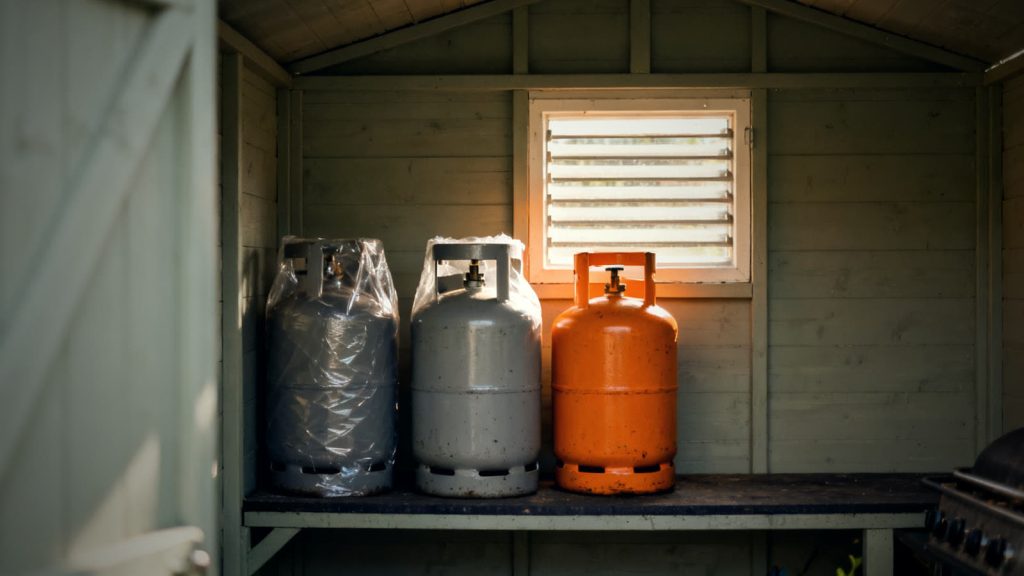
Cylinders and cartridges stored outdoors should stand upright in a shaded, dry place. They must be secured against tipping over and theft and kept at least 50 cm away from heat sources. A ventilated garden shed or a lockable outdoor cabinet is a better choice than a closed basement room.
Before any storage – whether indoors or outdoors – make it a routine to close the valve, unscrew the union nut, and seal the opening with a protective cap. This prevents residual gas from escaping unnoticed.
Storing Denatured Alcohol: Quantities and Locations
Denatured alcohol (methylated spirits) is a highly flammable liquid with a flash point below 21 °C (70 °F) and falls into hazard class A I. When storing denatured alcohol in your home, a tight limit therefore applies: a maximum of one liter per container. In the basement, the TRGS (German Technical Rules for Hazardous Substances) allows larger quantities – up to 20 liters, but only in shatterproof containers.
Regardless of the storage location, denatured alcohol must not be kept in bedrooms, stairwells, or hallways. If several flammable substances are stored at the same time, such as denatured alcohol next to kerosene, their quantities are added together when calculating the permitted total amount – so you can’t simply keep the maximum amount of each substance on hand at the same time.
Storing Kerosene and the Danger of Carbon Monoxide
Storing kerosene is one thing; using it safely is another. Incomplete combustion – for example, when there is too little oxygen in the room – can produce carbon monoxide, a colorless and odorless gas. It blocks oxygen transport in the body and is especially dangerous because you can neither smell nor see it.
Possible warning signs of carbon monoxide poisoning include headache, dizziness, nausea, confusion, and loss of consciousness. Portable kerosene or gas heaters without a closed exhaust system should therefore not be operated in tents, caravans, motorhomes, or enclosed awnings. You can find more about this risk in the article Carbon Monoxide: The Invisible Danger of Emergency Heaters.
How to Store Fuels Safely – Checklist
The individual rules can be summed up in one practical principle: keep as little as possible in your home, and store the rest in a ventilated, secured place outside.
- Know and observe the maximum quantities per room – separately for gas, denatured alcohol, and kerosene
- Never store in the basement, bedroom, stairwell, or hallway
- Keep containers upright, closed, and fitted with a protective cap
- Keep a safe distance from heat sources, at least the guideline values given above
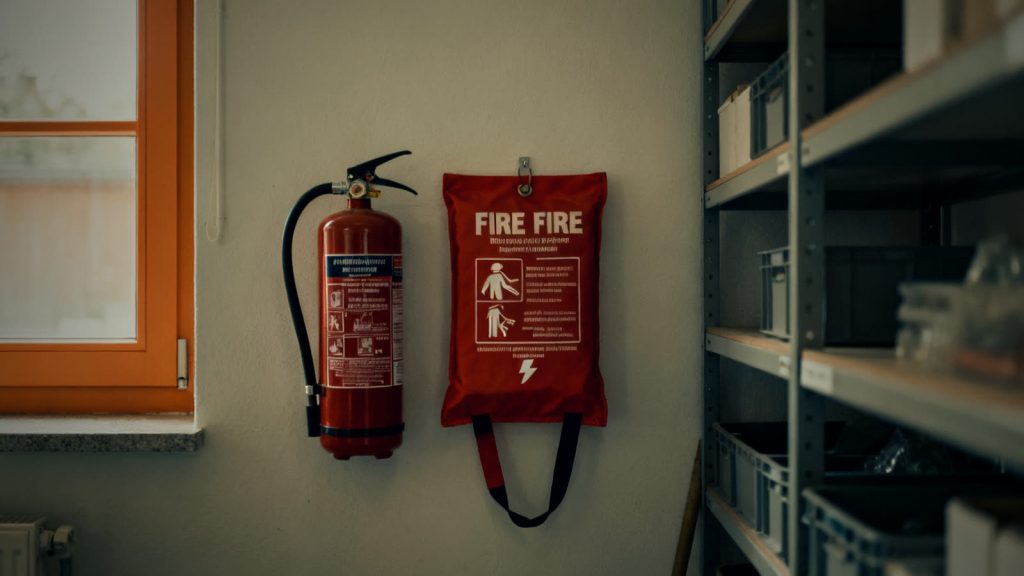
- Keep a fire extinguisher and fire blanket near the storage location
- Check your stock regularly and rotate it when needed
If you want to make your home safer against fire overall, you’ll find additional tips in the article Fire Safety at Home: Smoke Alarms, Fire Extinguishers, and Your Escape Route. Especially in small apartments with little storage space, it’s also worth reading the article Emergency Preparedness in a Small Rental Apartment to plan your storage locations sensibly.
Frequently Asked Questions
How many gas cartridges can I keep in my apartment?
A maximum of two, stored in two separate rooms. This applies to full and empty cartridges alike.
Can I store camping gas in the basement?
No. Gas cylinders and gas cartridges must not be stored in the basement or in escape routes, because leaking gas cannot disperse there.
How much denatured alcohol can I store at home?
In your apartment, a maximum of one liter per container. In the basement, the TRGS (Germany’s Technical Rules for Hazardous Substances) allows larger quantities in shatterproof containers, but the total amount is added together with other flammable substances.
Is kerosene dangerous indoors?
Incomplete combustion can produce carbon monoxide. Warning signs are headaches, dizziness, nausea, and confusion – so portable devices without a closed exhaust system do not belong in enclosed rooms, tents, or caravans.
Where is the best place to store fuels if I can’t use a basement?
A well-ventilated outdoor cabinet or a ventilated garden shed is a better choice than a closed basement room, as long as the containers are stored upright, secured, and kept away from heat sources.
Next Steps
First, check how many gas cartridges, how much denatured alcohol, and how much kerosene you currently have, and where exactly they are stored. Separate any quantities that exceed the permitted limits for your apartment and move them to a ventilated spot outdoors or into a suitable outdoor cabinet. Add a fire extinguisher and a fire blanket to the storage area, and make a note of when you last checked your supplies.
Sources and Further Information
- Proper Storage of Gas Cylinders & Gas Cartridges – Progas
- Accident Prevention Regulation and Technical Rules on Gas Cartridges – DGUV (German Social Accident Insurance)
- How Much Denatured Alcohol Can You Store? – isteshaltbar.de
- Kerosene Heaters and the Risk of Carbon Monoxide – Zibro Ofenshop
- Using a Kerosene Heater Safely While Camping – Camping-Experten
- Stockpiling – BBK (Germany’s Federal Office of Civil Protection and Disaster Assistance)
- Fire Safety – BBK (Germany’s Federal Office of Civil Protection and Disaster Assistance)
General information, no substitute for individual advice from authorities, emergency services or medical professionals. In an emergency in Europe: 112.