If you have a wood stove, tiled stove, or wood-burning cookstove, you have a real advantage in an emergency: a heat source that works without electricity or a gas grid. But that advantage depends entirely on your fuel. Wet wood burns poorly, clogs your stove and chimney with soot, fills the air with fine particulate matter, and gives off much less heat. A well-planned firewood supply therefore needs one thing above all: time.
Why dry firewood matters
According to the German Environment Agency (Umweltbundesamt), freshly cut wood is 45 to 60 percent water, depending on the species and the season. With good drying, that share drops to 15 to 20 percent. If you burn damp wood, the fire has to evaporate the water first. That energy is then missing as heat in your room. At the same time, the wood burns incompletely – producing more smoke, soot, and pollutants, including carbon monoxide. So damp wood isn’t just inefficient, it’s also a safety risk for your stove and chimney.
Where to get firewood
Buying
The easiest way is to buy from a local firewood dealer, forestry operation, or farmer. Check whether you’re getting ready-to-burn, already seasoned wood or fresh wood that you’ll still need to store for one to two years yourself. Ask about the moisture content, and if in doubt, measure it yourself.
Gathering or processing it yourself
Simply taking wood from the forest is not allowed in Germany. Every forest belongs to someone – the state, the municipality, or private owners. Even fallen deadwood on the ground may only be collected with the forest owner’s permission. Many forestry offices and municipalities issue wood-gathering permits or offer to let you process wood yourself after an instruction session. The rules differ from state to state, so the right move is to ask the responsible forestry office. For chainsaw work, forestry operations generally require proof of qualification.
What doesn’t belong in your stove
Only burn natural, untreated wood. Varnished, painted, impregnated, or coated wood, particleboard, pallets of unknown origin, reclaimed wood from renovations, or even trash do not belong in your stove. Burning them releases toxic substances, and it is not legally permitted.
Splitting firewood the right way
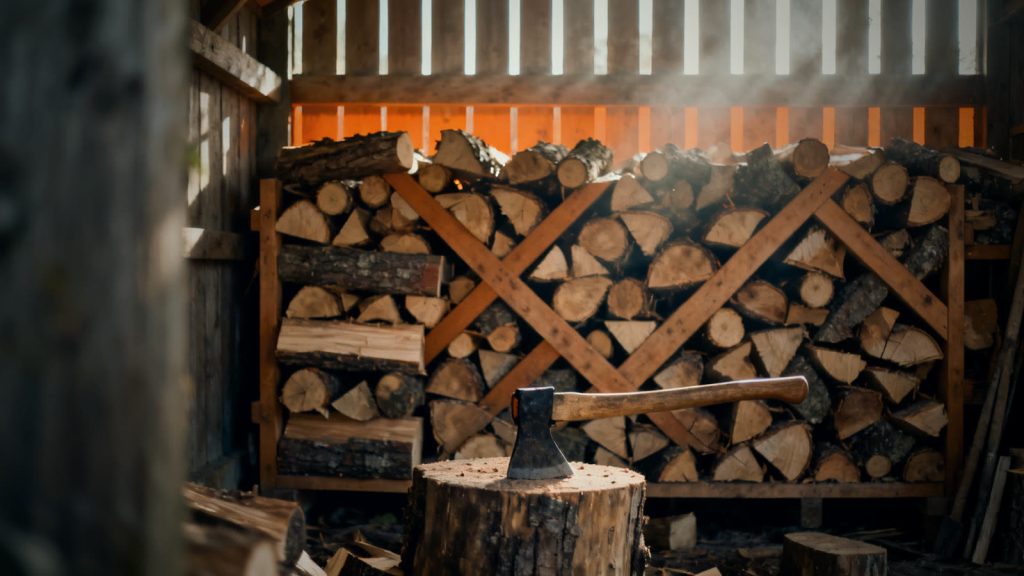
Wood dries much faster through the cut ends and split sides than through the bark. So split your wood to stove-ready size as soon as possible after felling. The right length depends on your stove – measure the firebox once. Always split thick pieces, otherwise they hardly dry out on the inside.
When splitting, keep these in mind: a secure stance, a sturdy chopping block, safety boots, gloves, and safety glasses. Keep children, pets, and onlookers at a distance. In basic training, we learned that a tool is only as safe as the person using it. A well-sharpened axe in steady hands is safer than a dull one that forces you to use brute strength.
Storing firewood the right way
The German Environment Agency (Umweltbundesamt) recommends stacking firewood in a sunny, airy spot protected from rain and snow, and letting it dry for one to two years. That leads to a few simple rules:
- Air from below: Don’t stack the wood directly on the ground. Use square timbers, stones, or a pallet instead.
- Roof on top, sides open: A cover or shelter protects against rain. The sides must stay open so the wind can carry the moisture away. A tarp that wraps the wood all the way around prevents it from drying.
- Distance from the wall: Leave a hand’s width of space between the stack and the wall of your house for air circulation.
- Choose the sunny side: South- or west-facing sides dry wood faster than shady north-facing ones.
- Don’t dry it in the basement: Fresh wood dries poorly in enclosed spaces and can promote mold. You can bring dry wood indoors a few days before you use it.
Measuring Moisture Content
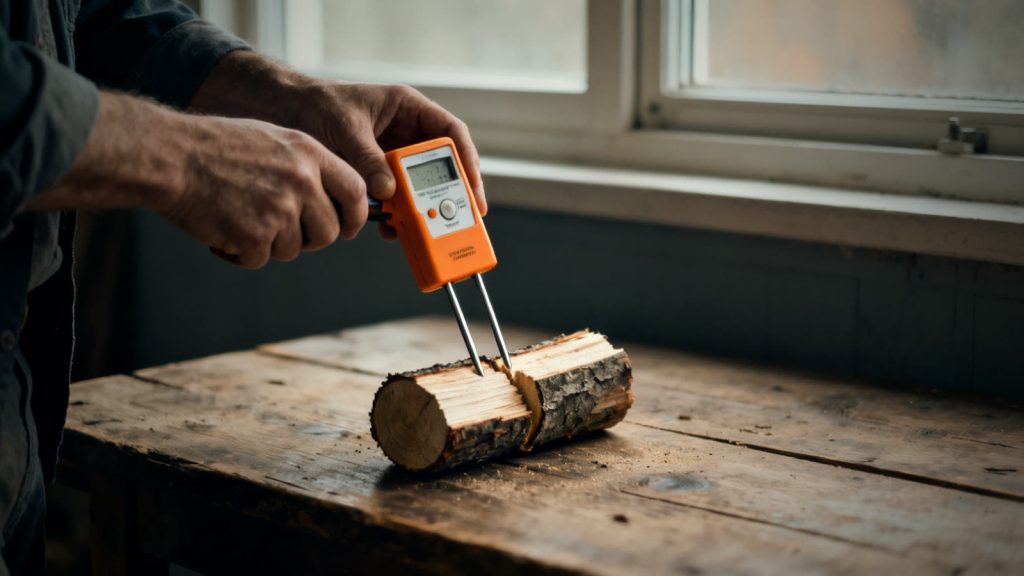
A simple wood moisture meter doesn’t cost much and gives you a clear answer. To measure, split a log fresh and take the reading in the middle of the freshly split face, not at the surface. Use the range that the German Environment Agency (Umweltbundesamt) gives for well-seasoned firewood as your guide. Check your device’s instructions as well, because some meters display wood moisture relative to dry mass, which gives slightly higher numbers than the water content. You can also recognize well-seasoned firewood without a meter: it is lighter, has cracks at the ends, and sounds bright and hollow when you knock two logs together.
How Much Firewood Should You Store?
That depends on your stove, living space, and insulation. For emergency preparedness, the goal isn’t to heat an entire house for weeks, but to keep one warm room heated. A good target is a supply that covers at least a few weeks of emergency use and is always seasoned one year ahead. Have your heating system inspected regularly by a chimney sweep, who can also tell you which types of wood and which quantities suit your stove.
In short: Only burn natural, dry wood. Store it split, in a well-ventilated and covered spot, and let it season for one to two years. Only gather wood in the forest with the permission of the forest owner.
Recommended Gear Compared
| Produktbild bei AmazonProven classicBrennenstuhl Feuchtigkeits-Detector MD | Produktbild bei AmazonPlenty of accessoriesTopTes TS-630 | Produktbild bei AmazonRechargeableRDINSCOS Holzfeuchtemessgerät (wiederaufladbar) | |
|---|---|---|---|
| Rating | at least 4.3 out of 5 starswith 500+ customer reviews (our selection criterion)See current reviews* | at least 4.3 out of 5 starswith 500+ customer reviews (our selection criterion)See current reviews* | at least 4.3 out of 5 starswith 500+ customer reviews (our selection criterion)See current reviews* |
| Features |
|
|
|
| Pros |
|
|
|
| Cons |
|
|
|
| View on Amazon* | View on Amazon* | View on Amazon* |
Selected by manufacturer data and customer reviews (at least 4.3 stars with 500+ reviews). We only show exact star ratings when they come from Amazon the same day. As of 04.10.2026. Not tested by us. Current prices and reviews are on Amazon. *Ad · paid link
Conclusion: our product picks
Wood Moisture Meters Compared
Anyone who just wants to check whether firewood is dry enough will be well served by the Brennenstuhl MD. The TopTes TS-630 offers more scales, a color display, and replacement probes. The RDINSCOS unit is the choice for anyone who wants to avoid storing batteries.
Links marked with * are advertising links. As an Amazon Associate I earn from qualifying purchases.
Sources and Further Information
- Umweltbundesamt (German Environment Agency) – Heating with Wood
- Umweltbundesamt – Wood Stoves: Pay Attention to Efficiency
- BfR (German Federal Institute for Risk Assessment) – Carbon Monoxide: The Invisible Danger When Heating with Wood
- BBK (Germany’s Federal Office of Civil Protection) – Preparing for and Handling a Power Outage
General information, no substitute for individual advice from authorities, emergency services or medical professionals. In an emergency in Europe: 112.