📌 Part of the guide: Packing a Go Bag: Checklist, Documents, and Family Plan
If you want to keep children occupied during a power outage, simple things help most: card and board games, drawing, stories, a blanket fort, and shadow puppet games with a flashlight. What’s important is that you’ve prepared some ideas and materials in advance and explain to the child briefly and honestly what’s happening. Then a dark evening quickly becomes quality family time.
Power Outage with Children: Planning Activities
Without power, children lose their familiar anchors: television, tablet, gaming console, often the lights too. For adults, it’s annoying; for children, it can be quite disruptive. That’s why meaningful activities serve two purposes. They beat boredom, and they give the day structure again—something the child can hold onto.
Germany’s Federal Office of Civil Protection and Disaster Assistance (BBK) points out that children show stress in different ways than adults do. Possible reactions to emergencies include difficulty concentrating, nightmares, anxiety, or irritability. Some children show no obvious reactions at first. So keep an eye on your child, even if they seem unaffected while playing.
According to the BBK, shared activities like drawing, writing, or playing help children express their feelings. So activity isn’t just a way to pass the time—it’s a calm way to deal with the situation. That’s exactly why it’s worth thinking about what you can do before you’re sitting in the dark.
What to Prepare Beforehand
Before you bring out a game, the basics need to be in place: light, warmth, food, and water. How to organize the first few hours overall is covered in our article Power Outage: How to Handle the First 24 Hours Right. Only then do you have a clear head for the children. That’s not a disadvantage: when you’re prepared, you seem calmer, and that calm rubs off.
Explaining the Power Outage to Children
Before you bring out a game, talk briefly about what’s happening. Children notice when something’s different. A short, honest explanation takes a lot of pressure off the situation. The BBK recommends listening carefully when your child has questions and answering them openly and honestly, in a straightforward, simple, and clear way.
For a power outage, it might sound like this: “The power’s out right now. That’s why the lights and TV aren’t working. This happens sometimes, and lots of people are working on it. We have flashlights and everything we need.” You don’t need to know more than you know. If you don’t know something, say that too.
Acknowledge Your Own Feelings
You can show that you’re a bit concerned yourself. According to the BBK, parents can explain to their child why they’re worried or sad. This way, the child understands that emergencies typically trigger uncertainty and that feeling this way is normal. What’s important is that you say it calmly and briefly without dwelling on details.
Reassuring Statements
The BBK recommends positive messages like “We’re taking care of you” and “We’re here for you.” They’re simple and they work. Don’t just say them once—repeat them often, even casually while playing. A child who feels secure is more willing to engage in activities.
- Explain briefly and in simple words what’s happening.
- Allow questions and answer them honestly.
- Take feelings seriously, including boredom and frustration.
- Show reliability: “We’re here for you.”
- Then offer a shared activity, like a game.
Games Without Power for Indoors
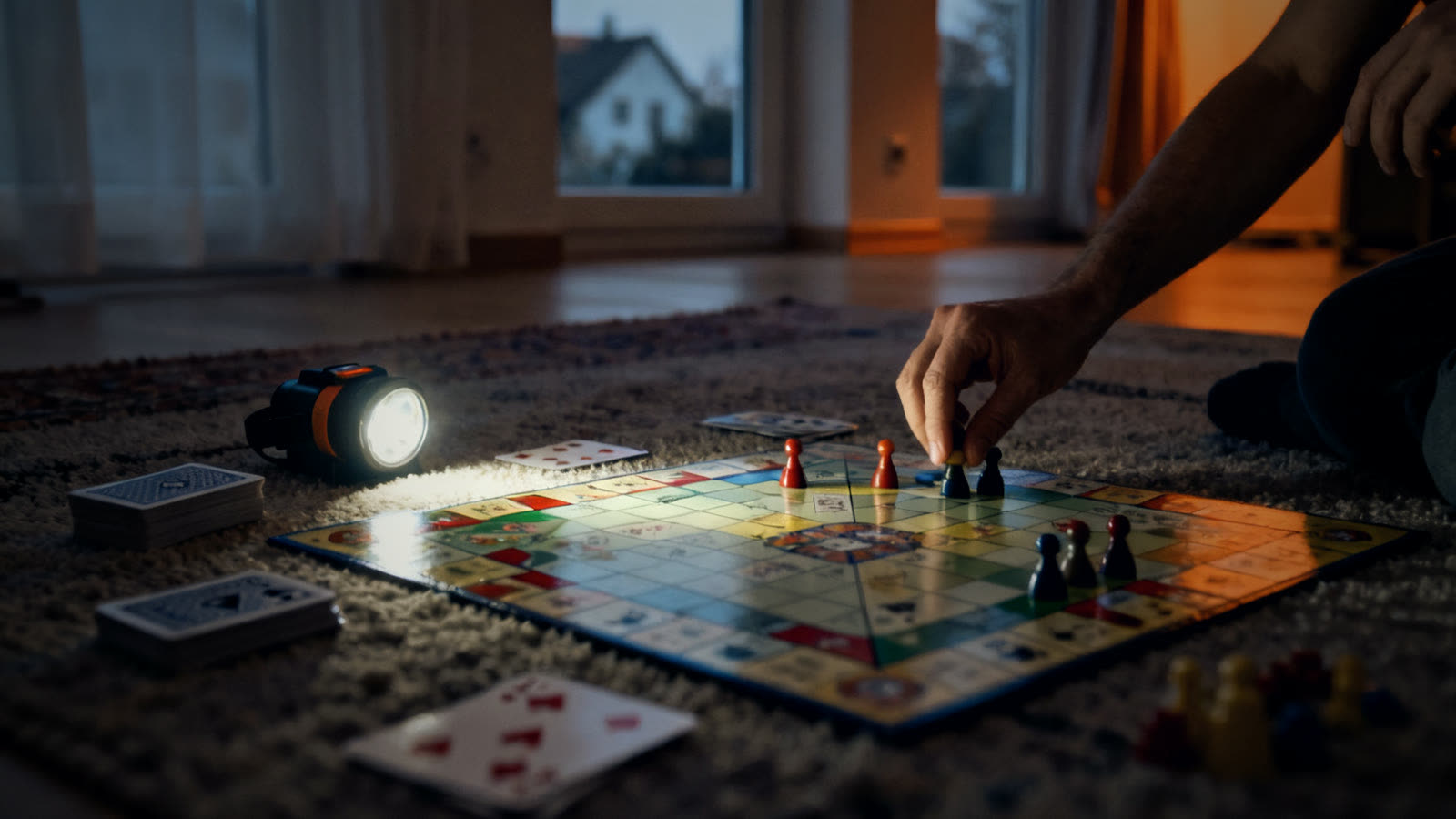
The simplest no-power games are often the best. They require minimal materials, are quick to explain, and work in low light. A headlamp or flashlight directed at the tabletop or ceiling provides enough light for card games and board games. To learn which lamps are suitable, read the article Choosing the Right Flashlight and Headlamp.
Card Games and Board Games
A card game is compact, lightweight, and lasts a long time. Depending on age, games such as Memory, Mau-Mau, Quartet, or Rummy work well. For younger children, games with simple rules work better. Board games and puzzles are ideal when the family sits together for several hours. It’s best to lay out a blanket or rug as a play surface so nothing slides away.
Ready.gov, the US disaster preparedness website, also specifically lists books, games, puzzles, and other activities for children in emergency kits. This shows that games are not an afterthought in emergency preparedness, but rather a natural and essential part of it.
Games Without Materials
Sometimes you don’t have games on hand. Then games that only require imagination can help:
- I Spy: works even in dim light when you shine a lamp on individual objects.
- Telephone Game: a classic for multiple children or the whole family.
- Animal or Profession Guessing: one child thinks of something, the others ask yes/no questions.
- Story Building: everyone takes turns adding a sentence.
- Charades: silent, movement-based, and possible anywhere.
- I’m Going on a Trip: trains memory and requires only voices.
Such games have an advantage: they can be extended or stopped as needed. If a child no longer feels like playing, that’s okay. Simply switch to a different activity instead of pushing.
Creative Activities Without Electricity
In addition to games with rules, children also need space for their own ideas. When keeping children entertained without electricity, the goal is not to fill every minute. It’s about having a few options for the child to choose from. Creative activities also have another advantage: they allow children to express their feelings without needing to talk about them.
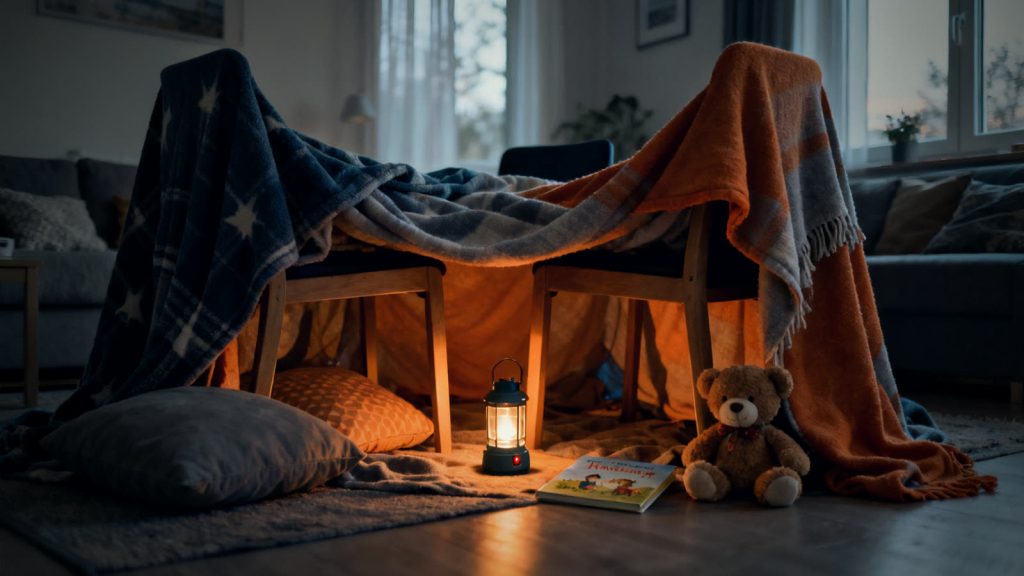
Building a Tent from Blankets
A tent in the living room is a highlight for many children. With chairs, blankets, clothespins, and pillows, a cozy hideout can be created in just a few minutes. Inside, you can read, be read to, play, and whisper. A tent can also be a retreat when the child needs some quiet time. Feel free to use a flashlight or a lamp with soft light, and make sure nothing hangs over heat sources.
When it’s cold, the hideout also helps retain warmth because less space needs to be heated. You’ll find more on this in our posts Keeping your home warm when the heating fails and Dressing in layers for cold.
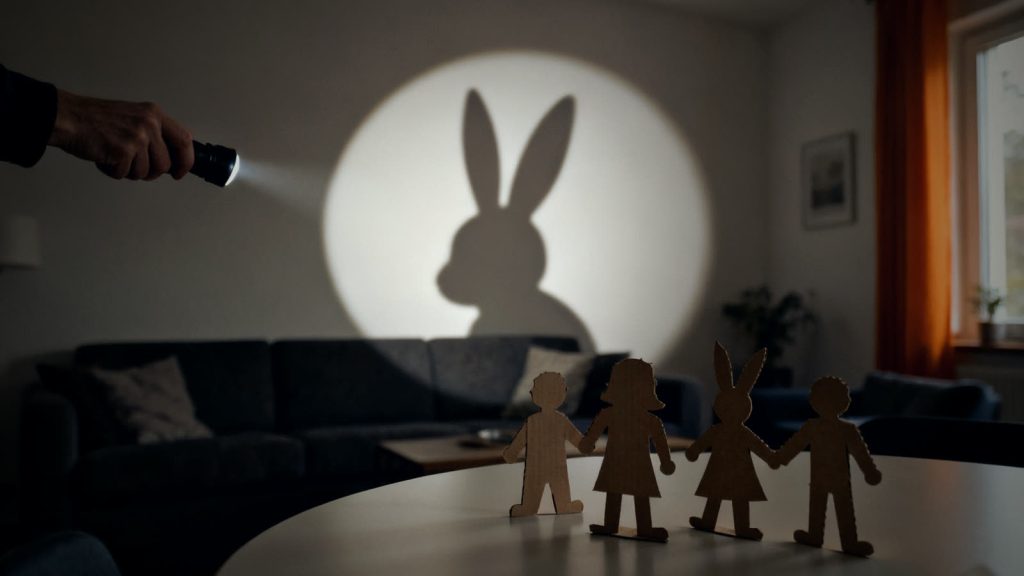
Shadow Puppets on the Wall
A flashlight and an empty wall are all you need. With your hands, you can create rabbits, birds, or dogs. Older children can cut figures out of cardboard and tell a story to go with them. If you hold the lamp closer or farther away, the shadows grow and shrink, which usually fascinates younger children. The game also works well with multiple children and is completely silent.
Drawing, Crafting, and Writing
The BBK (Germany’s Federal Office of Civil Protection) explicitly mentions drawing and writing as ways to express feelings. Have paper, colored pencils, and tape on hand. Ideas for the evening:
- Paint a picture of your “adventure without electricity.”
- Keep a small diary with drawings.
- Come up with your own story or comic.
- Fold paper into airplanes, paper boats, or figures.
- Draw a treasure map of your home and hide a treasure.
With the treasure map, you can also learn something: children practice navigation and spatial thinking. If you want to explore this further, check out the post Navigation without GPS: Using maps and compasses safely.
Helping as a Task
Children often want to feel needed. The BBK emphasizes that knowing what you and others can do in an emergency situation can reduce fear and worry. So give your child small, age-appropriate tasks: distributing lamps, fetching toys, setting the table, or helping with a cold dinner. You’ll find ideas for meals without a stove in Emergency supplies without cooking: What tastes good cold and is filling.
Family Games by Candlelight—But Safely
Candlelight creates a cozy atmosphere, and many families turn to it first during a power outage. With young children, however, you should be cautious. Open flames and curious hands don’t mix well. If you use candles, do so only under constant supervision, on a stable, non-flammable surface, out of reach of children, and never near curtains, blankets, or paper. Extinguish them before bed.
For games, flashlights, headlamps, and battery-powered lanterns are usually the better choice. They’re simpler to manage, and you can control the brightness more easily. Learn how to store batteries and rechargeable batteries so they work in an emergency in Storing Batteries and Rechargeable Batteries Correctly.
Game Ideas for a Quiet Evening
Family games by candlelight or lamplight have their own appeal, because everything becomes a bit quieter. Good options include:
- Reading aloud, including with different people taking different parts.
- Singing songs together or reciting nursery rhymes.
- Riddles and trivia questions you prepare ahead of time.
- A family quiz: “Who knows whom best?”
- A bedtime routine with a story and a familiar phrase.
A bedtime routine like this especially helps many children settle down, even under unusual circumstances. Stick with familiar routines as much as possible: brushing teeth, putting on pajamas, and a story. Learn how to maintain hygiene when water is unavailable in Hygiene Without Running Water.
When Spirits Drop
Even with the best ideas, there will be moments when a child whines, cries, or becomes angry. That’s normal. Acknowledge their feelings rather than dismissing them. A hug, a quiet space, or a glass of water often helps more than another game. If you’re feeling stressed yourself, the article Staying Calm in an Emergency may help.
Also watch for changes in the days that follow. According to the BBK (Germany’s Federal Office of Civil Protection), concentration difficulties, nightmares, or irritability can be possible reactions to crises, and they don’t always appear immediately. Stay in conversation and continue offering time together.
Frequently Asked Questions
How Can I Keep Children Occupied During a Power Outage When It’s Dark?
With games that require little light: card games and board games in the light of a headlamp or flashlight, reading aloud, telling stories, shadow play, or a tent made from blankets. Creative activities like drawing or painting work with a bit more light.
How Do I Explain a Power Outage to Children?
Factually, simply, and honestly, as recommended by the BBK (Germany’s Federal Office of Civil Protection). Tell them that the power is currently out, that certain devices don’t work because of it, and that you’re well prepared. Add phrases like “We’re looking out for you” and “We’re here for you,” and allow questions at any time.
What Toys and Activities Should Go in an Emergency Kit?
Ready.gov recommends books, games, puzzles, or other activities for children in an emergency kit. Practical items include card games, art supplies, a book, and a small game. Add lanterns and spare batteries. For emergencies on the go, also check out Emergency Bag for Children.
Are Candles a Good Light Source Around Children?
Not really as a main light source. Flashlights and headlamps are simpler and safer. If you do use candles, only under supervision, on a stable surface, and out of reach of children.
How Long Should I Plan Entertainment for Children?
That depends on the situation. The BBK (Germany’s Federal Office of Civil Protection) recommends being able to be self-sufficient for up to ten days, and a supply for at least three days is already very helpful. Therefore, plan your collection of games for several days with variety, not just for one evening.
Your Next Steps
Preparation doesn’t have to be complicated. With just a few simple steps, you’ll be well-prepared for the next power outage. The BBK (Germany’s Federal Office of Civil Protection and Disaster Assistance) emphasizes that being prepared helps reduce fears and worries. This applies equally to children and adults.
- Pack an entertainment box: Put cards, a board game, puzzles, a book, paper, and pencils in one designated place.
- Get lighting ready: Flashlights or headlamps plus spare batteries for each family member.
- Practice your explanation: Think of a few simple sentences you can use to explain the power outage.
- Involve your children: Let them choose their favorite games for the box.
- Try it out once: Plan an “evening without power” to practice. This turns the real situation into something familiar.
- Check yearly: Ready.gov recommends reviewing and updating your kit annually as your family’s needs change. Children grow, and games need to grow with them.
If you want to tackle emergency preparedness for your entire family, you’ll find more ideas in Emergency Preparedness for Families: Well-Prepared Together. The BBK also offers guides and checklists that cover the effects of power outages, plus an information library with a section “For Children and Educators”.
Sources and Further Information
General information, no substitute for individual advice from authorities, emergency services or medical professionals. In an emergency in Europe: 112.