📌 Part of the guide: Packing a Go Bag: Checklist, Documents, and Family Plan
If you are stuck in an elevator during a power outage, one thing matters most: stay calm, because you are safe inside the closed cabin and continuous ventilation provides you with enough air to breathe at all times. Never try to force the elevator doors open or climb out on your own. Instead, press and hold the emergency call button on the control panel for three to five seconds to reach the continuously staffed dispatch center via the backup-powered communication system.
Stuck in an Elevator During a Power Outage: What Should You Do in the First Few Minutes?
A sudden grid failure rarely gives any warning in everyday life. According to the Bundesamt für Bevölkerungsschutz und Katastrophenhilfe (BBK, Germany’s Federal Office of Civil Protection and Disaster Assistance), all electrically powered systems without their own backup power supply for the drive shut down immediately during a power outage. This includes standard passenger elevators in residential buildings, office buildings, shopping centers, and train stations. The elevator car brakes, comes to a stop, and the regular lighting goes out in an instant.
In that first moment, your body often reacts with a brief jolt of shock because the familiar motion stops abruptly and your surroundings are dark or only dimly lit. If you are stuck in an elevator and know what to do, you immediately regain control of the situation. Following a structured sequence of steps prevents rash reactions and ensures that the rescue process gets underway smoothly.
- Stay calm and get your bearings: Take a deep breath and stay where you are. In many cases, the elevator’s emergency lighting turns on automatically during a power outage, allowing you to see the control panel and your surroundings once your eyes have adjusted briefly.
- Reassure other passengers: If you are not alone in the elevator car, speak in a calm voice. Point out that the car is mechanically secured against falling and that fresh air continues to flow in at all times.
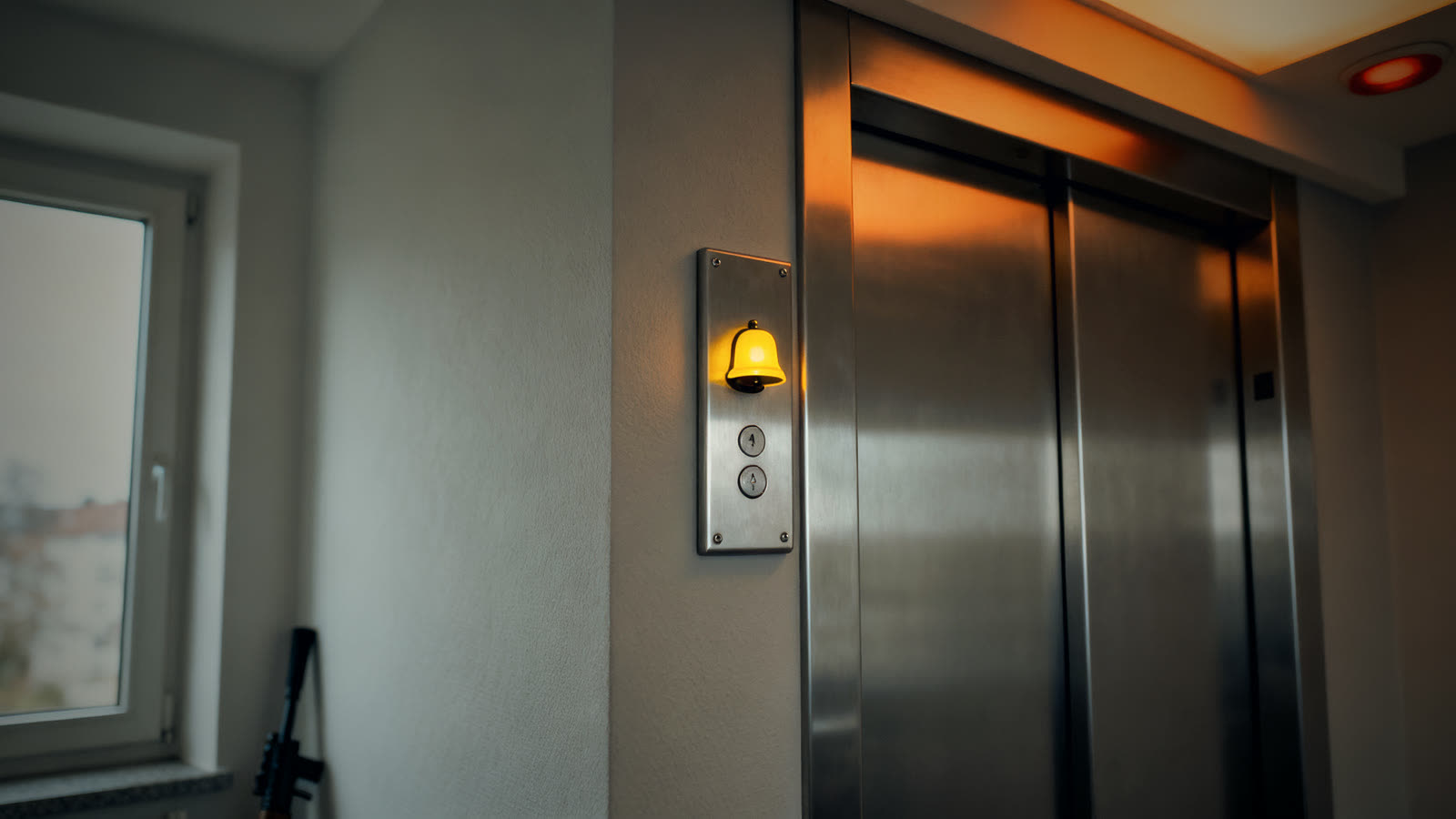
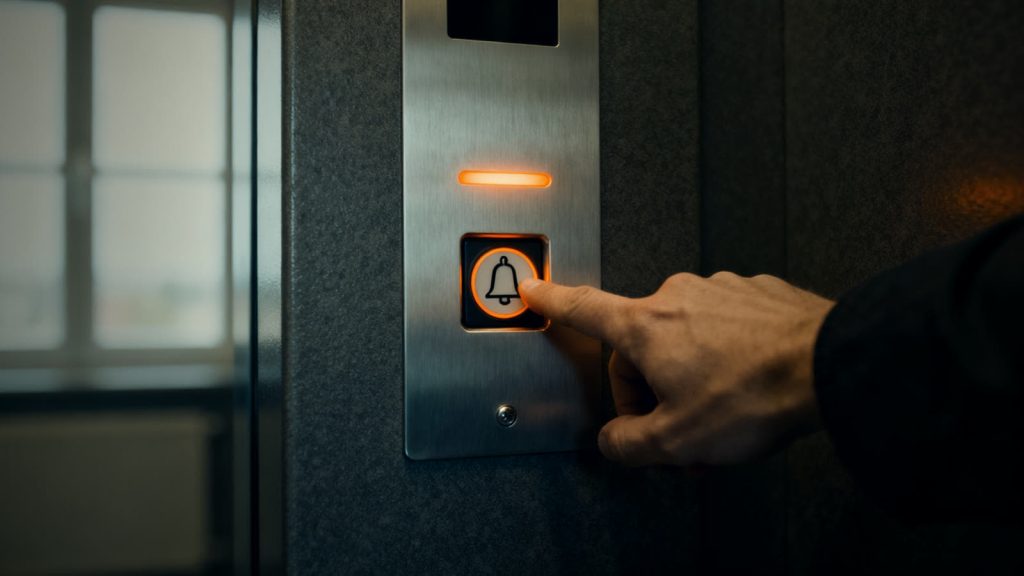
- Press and hold the emergency call button: Look on the control panel for the button with the yellow or red bell symbol. Press and hold this button continuously for at least three to five seconds to trigger the alarm.
- Wait for a voice connection and repeat if needed: After pressing the button, wait for the continuously staffed emergency call center to respond over the intercom. If there is no immediate response, be patient and repeat the process.
- Wait inside the closed elevator car: Briefly explain the situation to the control center, state the number of trapped passengers if possible, and then wait patiently for qualified technicians to arrive.
How to Properly Trigger the Elevator Emergency Call
A common mistake during an elevator stoppage is tapping the emergency call button only briefly, like a regular floor button. However, according to DEKRA (a German technical inspection organization) and Verbraucherportal Bayern (Bavaria’s official consumer portal), the emergency button on the control panel must be pressed and held for several seconds—typically three to five seconds. This delay is intentional by design so that no false alarm is triggered if passengers accidentally bump against the panel in everyday use.
Only after holding the button for several seconds does the system establish a connection to the 24/7 control center. Depending on the elevator system, you will hear an acoustic signal or a dialing sound while the connection is being made. If you do not get a response on the first try, this is sometimes because the connection takes a short time to establish. In that case, wait a moment and press and hold the button again for several seconds.
When an elevator stops, many people instinctively reach for their smartphone. Keep in mind, however, that according to the BBK, the mobile network during a widespread power outage only works for as long as the backup power supply of the respective cell towers lasts. In addition, the solid concrete and steel elevator shaft often heavily blocks the cellular signal, whereas the car’s built-in emergency call system has its own dedicated, directly connected communication unit.
Equally important is using official emergency numbers responsibly. The BBK explicitly points out that the emergency numbers 110 and 112 must not be tied up for general inquiries during a power outage. They are reserved exclusively for genuine emergencies and acute danger. You should know in advance what qualifies as such an emergency and how to properly place a 112 emergency call even with a weak signal.
Why the Closed Elevator Cab Is the Safest Place
If you have never been stuck in an elevator during a power outage, you may associate the situation with dramatic scenes from movies. In reality, however, passenger elevators in Germany are subject to strict technical safety regulations. Experts at DEKRA (a German technical inspection organization) explicitly emphasize that the closed elevator cab is the safest place for all passengers during a stoppage. As long as you remain inside the cab, you are protected from mechanical hazards in the shaft.
Plenty of Air to Breathe and Multiple Fall-Protection Systems
The widespread worry that a stalled elevator cab could quickly run out of oxygen is completely unfounded, according to Verbraucherportal Bayern (Bavaria’s official consumer portal). An elevator cab is not an airtight room. Both the cab itself and the entire elevator shaft are constantly ventilated, ensuring a continuous exchange of air. Even if several people are trapped in the elevator and rescue takes some time, there is no risk of suffocation.
Equally unfounded is the fear that the elevator could plunge down the shaft if the power suddenly goes out. According to DEKRA, elevators are equipped with multiple mechanical safeguards against falling. These braking systems engage purely mechanically and require no electrical power to hold the cab securely on the guide rails in the shaft. If the main power fails, the elevator remains stable in its current position.
In addition, DEKRA notes that passenger elevators are often equipped with elevator emergency lighting that turns on automatically during a power outage. This light is usually dimmer than the regular cab lighting, but it is more than enough to see the control panel with the emergency call button and stay oriented inside the space. If you learn to stay calm in an emergency and understand stress responses during moments like these, the wait will pass much more calmly.
Life-Threatening Danger of Self-Rescue: Never Force the Doors Open
The greatest real danger when an elevator stops does not come from the technology, but from unsafe behavior by trapped passengers. DEKRA strongly warns against trying to get out of the elevator on your own. Under no circumstances should you attempt to force open the cab doors or shaft doors, use objects as levers, or climb through a gap between floors into the stairwell.
The reason for this strict rule is vital: a stalled elevator can unexpectedly start moving again at any time—for example, if the power suddenly comes back on or technicians are working on the controls. Anyone caught in a half-open doorway or climbing between the cab and a landing floor at that moment faces an acute risk of being crushed as well as falling deep into the elevator shaft.
Always stay inside the cab with the doors closed until trained specialists or firefighters on site have secured the system against restarting. Leave the elevator only after emergency responders or service technicians unlock the door in a controlled manner from the outside and explicitly instruct you to step out. Patience is your most effective safety factor in this situation.
Technology and Regulations: How Elevator Emergency Calls and Rescue Work During a Power Outage
Why does an elevator emergency call still work when the entire apartment building or neighborhood loses power? While landline phones, routers, and many household appliances fail immediately during a power outage, passenger elevators in Germany are subject to strict special legal regulations. The goal of these rules is to ensure that no one gets trapped in an elevator car unnoticed and without contact to the outside world.
Two-Way Communication with Dedicated Backup Power
According to Verbraucherportal Bayern (Bavaria’s consumer information portal) and TÜV SÜD (a German technical inspection organization), every passenger elevator in Germany must be equipped with a permanently installed emergency call system. This is not just a simple alarm bell that only rings in the hallway, but a full two-way communication system. It establishes a direct, two-way voice connection to a continuously staffed emergency call center, allowing you to speak with the operators and hear their questions.
To ensure this system works reliably even during a complete power grid outage, according to TÜV SÜD and TÜV NORD (another German technical inspection organization), the two-way communication system is strictly required to have its own emergency power supply. If the building’s regular power fails, an integrated energy storage unit automatically takes over to power the intercom and the emergency call button. As a result, the connection to the continuously staffed call center remains functional independently of the building’s power supply.
The reliability of this safety technology is no coincidence—it is regularly inspected. As TÜV NORD explains, during periodic elevator inspections under the Betriebssicherheitsverordnung (BetrSichV, Germany’s Ordinance on Industrial Safety and Health) and the Technische Regeln für Betriebssicherheit (TRBS 3121, Germany’s Technical Rules for Operational Safety), certified inspectors specifically verify this point: they check whether a functioning two-way communication system to the emergency call center, complete with an intact emergency power supply, is in place.
The Individual Emergency Plan and the 30-Minute Guideline
What happens behind the scenes as soon as your emergency call reaches the dispatch center? According to the requirements cited by TÜV SÜD and TÜV NORD, the operator must maintain an individual emergency plan for every elevator installation. This plan contains all the critical information needed for a rapid rescue: the exact location of the elevator, its serial number, the contact details of the personnel responsible for emergency release, and the exact storage location of the emergency rescue instructions.
Using this information on file, the emergency call center immediately dispatches the responsible rescue service or an authorized technician nearby. Under current safety standards and TRBS 3121, trapped passengers are expected to be freed within a maximum of 30 minutes after placing the emergency call, whenever possible. During periodic inspections under BetrSichV, inspectors also verify that this passenger rescue emergency plan is properly in place.
Of course, a widespread power outage affecting many buildings at the same time can strain response times for service technicians and emergency responders in individual cases. Nevertheless, the clear registration of each elevator with its location and serial number ensures that no triggered elevator emergency call gets lost. Once you are freed from the elevator car, structured procedures help you take the right steps at home from the very beginning of a power outage.
Helping from the Outside and Fire Emergencies: What Applies Outside the Elevator Car
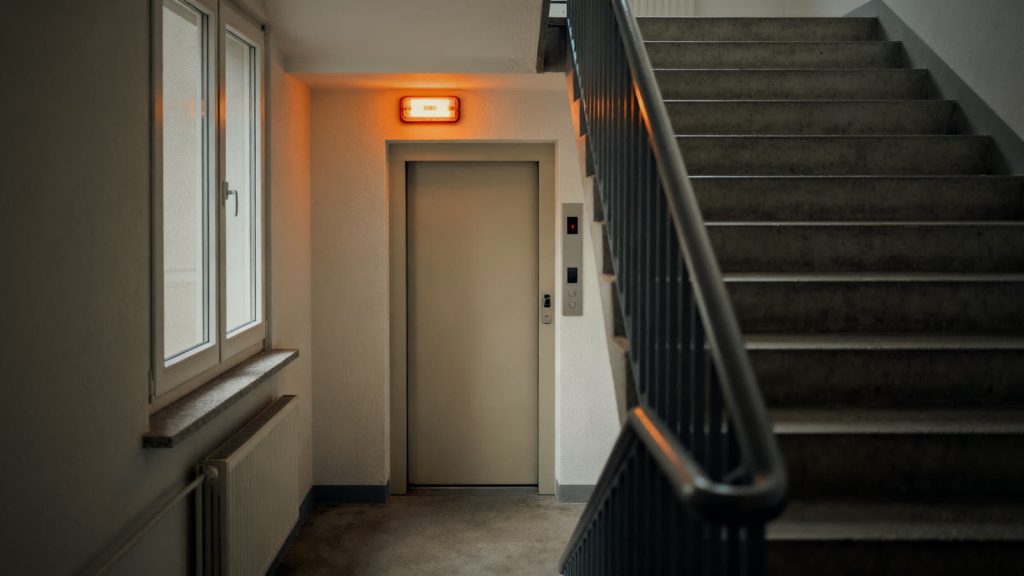
You aren’t always the one inside the elevator car when an elevator stops during a power outage. Often, as a resident, neighbor, or passerby in the stairwell, you notice that the elevator has stopped between two floors with people inside. For bystanders as well, there are clear rules of conduct that make the difference between safety and danger.
How Bystanders in the Stairwell Can Help Properly
Just like for those trapped inside, an absolute rule applies to helpers in the hallway according to DEKRA (a German technical inspection organization): bystanders must never try to force the elevator doors open on their own using tools or physical strength. Anyone who tampers with the shaft doors from the outside endangers both the people inside the car and themselves, because falling and crushing hazards arise as soon as the elevator starts moving again.
Instead, you can provide the best help through calm communication and focused coordination. Speak reassuringly to the trapped passengers through the closed door, and first ask whether they have already pressed and held the emergency call button inside the car for three to five seconds. Often, simply knowing that someone is standing outside the door and listening is enough to significantly reduce the tension for those inside.
If, in an exceptional case, the intercom connection inside the elevator has not yet been confirmed or additional assistance is needed, DEKRA recommends calling the maintenance company’s emergency number posted at the building’s main entrance. Also ask the trapped passengers whether everyone is doing okay health-wise. Only if there is a medical emergency or an acute danger inside the car should you immediately contact emergency services by calling 112.
Fire and Smoke: Why the Elevator Is Off-Limits
Special caution is required when a power outage is connected to a fire or smoke in the building—or when you have to evacuate the building during a fire alarm. DEKRA makes it clear: elevators must never be used in the event of a fire or smoke. First, the vertical elevator shaft acts like a chimney, allowing toxic fire gases to spread rapidly across all floors.
Second, the fire can cause a short circuit or power outage in the building’s electrical system at any time, leaving the elevator stuck in the middle of a smoke-filled shaft. That is why your safe escape route during a fire or smoke event is always via the stairwell. To learn how to prepare your home and keep escape routes clear, read our guide to home fire safety with smoke detectors, a fire extinguisher, and an escape route.
In many larger or newer buildings, special technology also helps prevent people from getting trapped during a fire. As the Berliner Feuerwehr (Berlin Fire Department) explains in its fact sheet on fire emergency recall, elevators equipped with this system automatically travel to a predetermined designated floor when a fire detector is triggered. This is usually the main entrance level with direct access to the outdoors. Once there, the elevator opens its doors and remains out of service so that no one else can get in and become trapped.
Frequently Asked Questions
Can You Suffocate in an Elevator During a Power Outage?
No, the fear of suffocating is unfounded according to Verbraucherportal Bayern (Bavaria’s official consumer information portal). Both the elevator car and the elevator shaft are permanently ventilated, ensuring a continuous exchange of air. Even without an active power supply, plenty of breathable air flows into the closed car at all times.
Does the Elevator Emergency Call System Work During a Power Outage?
Yes. Every passenger elevator in Germany is required to have a permanently installed two-way communication system with its own emergency backup power supply. When you press and hold the emergency call button with the bell symbol for three to five seconds, a two-way voice connection to a continuously staffed emergency call center is established—even during a complete power outage.
How Long Does It Take to Be Rescued from a Stuck Elevator?
Under applicable safety standards and the Technische Regeln für Betriebssicherheit (TRBS 3121, Germany’s Technical Rules for Operational Safety), trapped passengers are to be rescued within 30 minutes of placing the emergency call at the latest. To achieve this, every elevator operator must maintain an individual emergency rescue plan.
Can You Call 112 If You Are Stuck in an Elevator?
For a standard rescue, first use the emergency call button directly inside the elevator car, which connects you to the responsible emergency call center. According to the BBK (Germany’s Federal Office of Civil Protection), emergency numbers 110 and 112 must not be tied up for general inquiries during a power outage, and should be used exclusively for genuine emergencies, medical emergencies, and acute dangers.
Your Action Plan: Stay Prepared in Everyday Life
Getting stuck in an elevator during a power outage loses its fear factor once you understand the built-in safety reserves and know the right steps to take. You don’t need to fear a fall or a lack of air as long as you follow the most important basic rule and wait for professional help inside the closed cab. With just a few simple everyday habits, you can make sure you stay ready to respond at any time.
- Take a quick look at the control panel: Make it a routine habit to glance at the control panel when stepping into an elevator so you immediately know the location of the yellow or red emergency call button and the elevator’s identification details.
- Remember the three-to-five-second rule: Keep in mind that in an emergency, the emergency call button must be pressed and held for several seconds until the connection to the dispatch center is established, and patiently repeat the process if necessary.
- Carry a small light source on your keychain: Even though many cabs are equipped with emergency elevator lighting, a small flashlight gives you added security in everyday life. To find out what to look for when buying one, see our guide on how to choose the right flashlight and headlamp.
- Always take the stairs if you smell smoke: As a precaution, avoid the elevator and use the stairs instead during a fire alarm, if smoke is present, or during forecasted severe storms with an increased risk of a power outage.
It’s also a good idea to briefly go over these simple basic rules with your family or children. Anyone who knows in advance that the emergency call button still works during a power outage and that the closed cab provides a safe shelter will stay calm in an emergency and do the right thing from the very first moment.
Sources and Further Information
- Trapped in an Elevator – What to Do? – Verbraucherportal Bayern (Bavaria’s Consumer Portal)
- Never Try to Free Yourself from an Elevator! – DEKRA (German technical inspection organization)
- Elevator Inspections for System Operators – TÜV NORD (German technical inspection association)
- Hazard Technology | Emergency Technology – TÜV SÜD (German technical inspection association)
- Preparedness and Action During a Power Outage – BBK (Germany’s Federal Office of Civil Protection)
- Fact Sheet on Elevator Fire Emergency Operation – Berliner Feuerwehr (Berlin Fire Department)
General information, no substitute for individual advice from authorities, emergency services or medical professionals. In an emergency in Europe: 112.