📌 Part of the guide: Packing a Go Bag: Checklist, Documents, and Family Plan
If you get stuck in your car in a winter snow traffic jam, three measures will help you stay in control: immediately form a clear emergency corridor for snowplows and rescue vehicles, turn on your car radio for official situation updates, and ration your energy reserves carefully. During an extended standstill, do not leave the engine running continuously; instead, switch it off in between and run it only intermittently for a few minutes at a time to reheat the cabin. Always keep the exhaust pipe clear of snow so deadly carbon monoxide cannot enter the vehicle interior.
Stuck in Your Car in a Snow Traffic Jam: First Steps at a Standstill
When traffic comes to a halt on wintry roads, following a structured approach in the first few minutes determines how safely you will get through even long waiting times. If you find yourself caught in sudden snow chaos and wondering what to do in your car, start by positioning your vehicle properly. As long as your tires still have traction and snow has not piled up high around the wheels, it is much easier to steer the car toward the edge of the road.
According to the ADAC (Germany’s largest automobile association), on multi-lane roads an emergency corridor must be formed immediately and kept clear at all times as soon as traffic slows down or comes to a stop. This corridor always runs between the far-left lane and the lane directly next to it. In winter, this clear lane is crucial not only for emergency medical services and police, but especially for snow-clearing vehicles. Only when snowplows and salt trucks can get through unhindered can a winter roadblock clear up again.
Once your vehicle is safely positioned in its lane, you should secure a reliable channel for information. The Bundesamt für Bevölkerungsschutz und Katastrophenhilfe (BBK, Germany’s Federal Office of Civil Protection and Disaster Assistance) points out that a car radio continues to work reliably over long periods even in a stationary vehicle. Through it, you can receive official traffic reports and specific instructions from emergency responders during an emergency or extended traffic jam without draining your smartphone battery through constant mobile data checks.
It also helps to assess your situation objectively and stay calm and able to act in an emergency. A winter standstill on a highway or rural road rarely ends after just a few moments when heavy snowfall or vehicles stranded sideways block the route. The earlier you switch to conserving fuel, battery power, and body heat, the more calmly you will get through even a multi-hour interruption to your trip.
Running Your Engine in a Winter Traffic Jam: Managing Heat, Fuel, and Battery
One of the most common questions during a winter standstill is whether you should keep your engine running in a winter traffic jam to continuously heat the cabin. Because you cannot predict at the start of a road closure how long the route will remain blocked, running the engine nonstop is not a sensible option. Smart resource management protects you from running out of fuel or ending up with a dead starter battery toward the end of the wait.
Run the Engine in Intervals to Save Fuel
ADAC (Germany’s automobile association) recommends a clear approach for a prolonged traffic jam in cold weather: turn off the engine in between to save fuel. Only when the vehicle interior noticeably cools down should you start the engine periodically for a few minutes to restore basic warmth to the cabin. During the breaks between these heating intervals, appropriate clothing and a blanket help retain your body heat without unnecessarily draining your fuel reserve.
For this heating strategy to work in an emergency, you need an adequate buffer in your tank before you even hit traffic. According to ADAC, your fuel tank should always be kept at least one-third full in winter during longer trips or unsettled weather conditions. If you consistently observe this threshold and refuel early, you will have enough reserves during a winter traffic jam to heat the vehicle intermittently over an extended period.
Special Considerations and Charge Buffers for Electric Vehicles
If you drive an electric car, you also need to plan your energy reserves carefully in winter. As ADAC emphasizes, cold weather can reduce EV range by 10 to 30 percent. This is caused both by the additional energy required to heat the cabin and by the temperature-dependent state of the battery in low outside temperatures. That is why you should plan an appropriate charge buffer before any longer trip in winter.
If you are stuck in a winter traffic jam in an electric vehicle, the same principle of conservation applies. Reduce the heater output to a practical level and use blankets and warm clothing in the vehicle to keep energy drain from the drive battery low. If you have already factored the temperature-related 10 to 30 percent increase in consumption into your route and charging plans, you will not drop to critical charge levels, even during extended delays.
Protect Your Car Battery in Below-Freezing Temperatures
In addition to your fuel tank or drive battery, the standard car battery requires special attention in a winter traffic jam. Below-freezing temperatures already put a strain on the starter battery and reduce its performance. ADAC points out that frequent engine starts, along with running the heater blower, lights, and rear window defroster at the same time, place a heavy load on the car battery in freezing conditions. If too many power-hungry features run simultaneously, you risk a deeply discharged battery.
For this reason, consistently turn off all unnecessary electrical devices while stuck in traffic. In particular, the rear window defroster and a heater blower running on a high setting draw a lot of power without providing any lasting benefit in a stationary vehicle with the engine off. When it comes to lighting, make sure to use only the lights needed for safety so the battery reliably retains enough voltage to start the engine for the next heating intervals.
Exhaust Pipe, Snow, and Carbon Monoxide: Preventing Danger When Snowed In
When heavy precipitation continues and the wind drives snow against lines of stopped vehicles, a stationary car can gradually become snowed in. What initially looks from the inside like just an insulating layer of snow on the windows poses a serious hazard at the rear of the vehicle. The combination of exhaust pipe, snow, and carbon monoxide is one of the most important safety factors every driver needs to know and watch out for in winter.
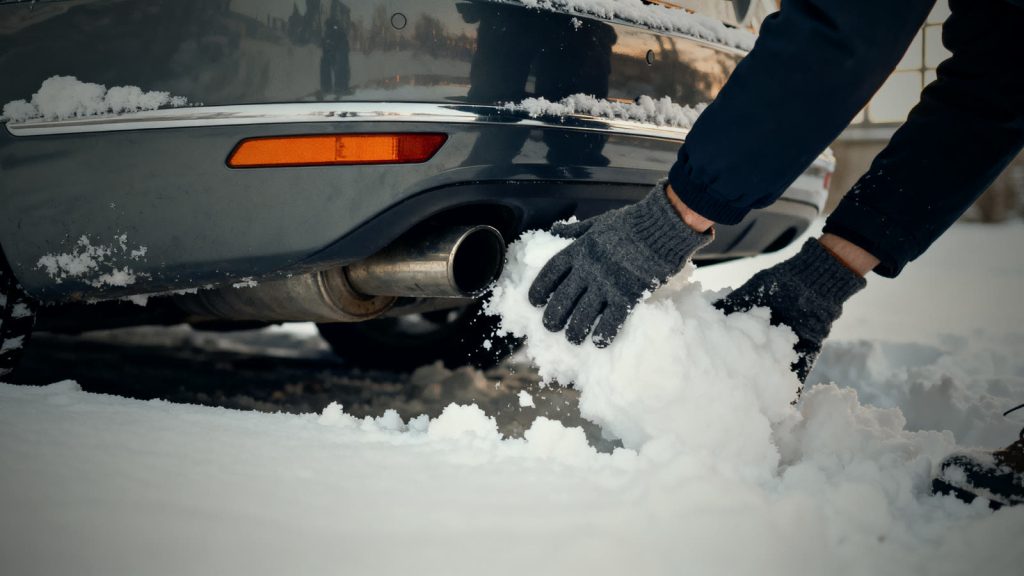
The ADAC (Germany’s largest automobile association) explicitly warns that the exhaust pipe must be kept clear of snow during heavy snowfall in a traffic jam. If a tailpipe blocked by snow obstructs the exhaust outlet, exhaust fumes can no longer vent freely into the open air while the engine is running. Instead, they build up underneath the vehicle and can cause deadly exhaust gases—especially carbon monoxide—to seep into the passenger cabin.
What makes this especially treacherous is how quickly snow can accumulate behind the vehicle. During heavy snowfall combined with strong winds, the Deutscher Wetterdienst (DWD, Germany’s national weather service) warns of snowdrifts that can make roads impassable. Such drifts often pack snow tightly under the rear bumper within a short time, even when there appears to be less snow on the open road beside you. You can learn more about the properties of this toxic gas in the article on carbon monoxide as an invisible hazard.
Therefore, regularly check the area around your exhaust pipe during continuous snowfall or strong winds. Clear the snow thoroughly away from the tailpipe so that exhaust gases can vent freely. Whenever you briefly step out of the car, always watch for surrounding traffic as well as emergency vehicles and snowplows in the emergency corridor, and stay right next to your own vehicle so you do not put yourself at risk in poor visibility.
Emergency Kit and Preparation for Safe Driving in Ice and Snow
How well you get through a multi-hour road closure if you get stranded in your car in snow traffic is decided before you even set off. With well-planned winter gear in your vehicle and a realistic assessment of weather and road conditions, you can eliminate most of the risk of a winter standstill. ADAC (the German Automobile Club), BBK (Germany’s Federal Office of Civil Protection), DWD (Germany’s National Meteorological Service), TÜV-Verband (the German Technical Inspection Association), and the police all provide clear, field-tested recommendations for this.
Recommended Winter Car Emergency Kit
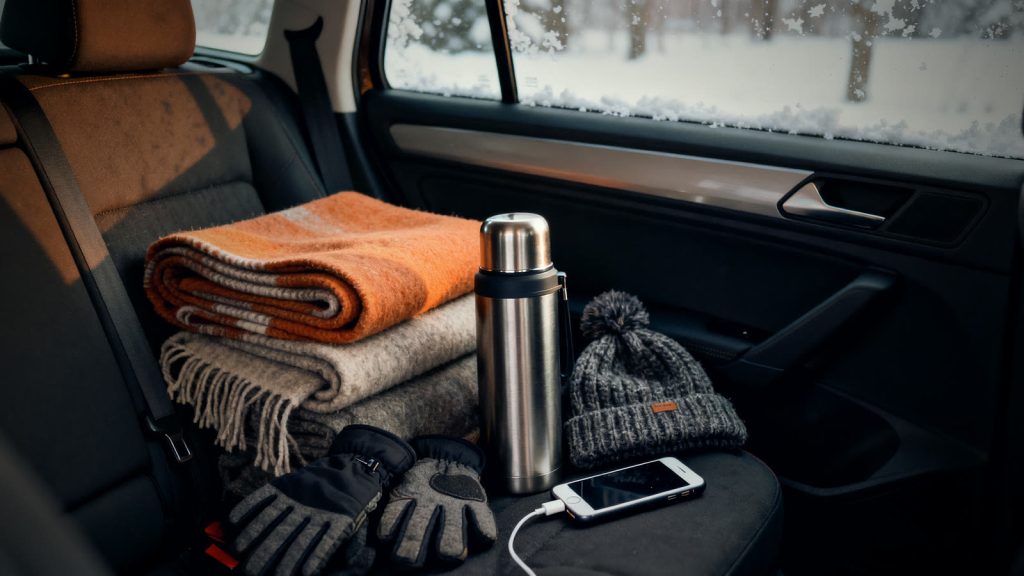
To help you stay warm, supplied, and reachable inside a stationary vehicle even with the engine turned off, ADAC recommends packing a dedicated winter emergency kit. When expanding your standard car emergency kit for the cold season, make sure the following items are always on board:
- Warm blanket and warm clothing: These help you retain your body heat during breaks in heating when the engine is turned off to save fuel. Dressing according to the layering principle in cold weather lets you flexibly combine multiple layers.
- Gloves and a hat: Your body loses heat particularly quickly through your head and hands. You will also need sturdy gloves whenever you have to step outside to clear snow from the exhaust pipe or windows.
- Hot drinks in a thermos and small snacks: Warm liquids warm you from the inside and, combined with energy-rich snacks, help prevent premature exhaustion during long waits.
- Charged smartphone with a charging cable or power bank: This keeps you able to make emergency calls and check live updates without draining your car’s starter battery while parked. Learn what to look for in portable power storage in our guide Portable Power Station or Power Bank for Emergencies.
Before heading out, store your blanket, hat, gloves, thermos, and power bank inside the cabin where you can reach them directly from your seat. If you are stuck on a highway in heavy snow, getting out to dig through luggage in the trunk for warm clothing is impractical and unnecessarily cold. Easy access inside the vehicle saves time and keeps the warmth you have already built up inside the cabin.
Check Weather Warnings from DWD and BBK Before Driving
The most effective way to avoid getting stuck in winter traffic starts before you even get into the car, by checking the weather. During heavy snowfall and icy conditions, BBK recommends closely monitoring weather forecasts from Deutscher Wetterdienst (DWD) as well as alerts through official channels such as the NINA warning app (Germany’s official emergency alert app). Find out how to make the most of the different alert channels in our overview on public emergency warnings via NINA and official channels.
As soon as heavy snowfall or extreme ice is forecast, BBK advises staying home whenever possible and avoiding non-essential driving. DWD also recommends avoiding unnecessary car trips at higher warning levels, especially when heavy snow and strong winds may cause snowdrifts. When you know the meaning of the DWD warning levels, you can postpone trips in time before roads become impassable.
Clear Your Vehicle Completely and Adjust Tires and Driving Style
If driving in winter conditions is unavoidable, your car must be made roadworthy before you start. According to TÜV-Verband, all windows, side mirrors, headlights, turn signals, license plates, and the entire roof must be completely cleared of snow and ice before setting off. Scraping a small peephole in the windshield is not enough, and snow blowing off the roof or sheets of ice sliding off can pose a serious hazard to vehicles behind you.
The requirements for vehicle equipment and driving behavior are just as clear: according to the “Polizei dein Partner” initiative (a German police safety campaign), winter or all-season tires bearing the Alpine symbol—the mountain pictogram with a snowflake—are mandatory in winter road conditions. In addition, you must leave a significantly greater following distance from the vehicle ahead, as braking distances on snow and ice multiply compared to dry pavement.
Expect sudden slick spots on the road even when the surface seemed clear just moments before. As DWD explains, the road surface cools down much faster on bridges, hillcrests, curves, and shaded forest stretches than on open sections of road. Sudden slippery snow or black ice is especially likely in these areas. Driving defensively at these hazard points helps prevent accidents, which in winter are often what cause multi-hour full road closures in the first place.
Frequently Asked Questions
Can you leave the engine running in a winter traffic jam?
If a traffic jam in cold weather lasts for an extended period, ADAC (Germany’s automobile association) recommends not leaving the engine running continuously, but instead turning it off periodically to save fuel. Whenever the vehicle interior cools down, start the engine for a few minutes at regular intervals to warm the cabin back up. It is important that the tailpipe is clear of snow before every start and that unnecessary electrical features remain turned off.
Why is a snow-blocked tailpipe life-threatening in a traffic jam?
If dense snow blocks the exhaust tailpipe, engine exhaust gases can no longer escape freely outdoors while the engine is running. ADAC warns that in this situation, deadly exhaust fumes—above all invisible and odorless carbon monoxide—can flow into the vehicle interior. Therefore, during heavy snowfall in a traffic jam, the tailpipe must be checked regularly and cleared completely.
How much fuel reserve or battery charge do you need in winter?
ADAC recommends keeping your fuel tank at least one-third full during winter on longer trips or in unsettled weather so you have enough reserve for heating in a traffic jam. In electric vehicles, cold weather can reduce driving range by 10 to 30 percent due to heating and temperature-dependent battery performance, so you should plan for a corresponding charging buffer before setting off.
What winter emergency kit should you always keep in your car?
The winter emergency kit recommended by ADAC includes a warm blanket, warm clothing, gloves, and a hat. This kit is rounded out by warm drinks in a thermos, small snacks, and a charged smartphone with a matching charging cable or a charged power bank. All essential items needed to stay warm right away should be kept within easy reach inside the cabin.
Conclusion: Your Action Steps for Winter Driving
With good preparation and clear procedures, even an extended standstill on winter roads loses its dread. By consistently following these action steps before and during your winter drives, you reliably protect yourself and your passengers from cold, energy depletion, and exhaust hazards:
- Check weather conditions in advance: Before setting off, monitor forecasts from DWD (Germany’s National Meteorological Service) as well as alerts via NINA (Germany’s official emergency warning app), and avoid non-essential trips whenever possible if heavy snowfall, snowdrifts, or extreme ice are forecast.
- Prepare your vehicle and reserves: Check that you have the required tires with the Alpine symbol, keep the fuel tank at least one-third full (or plan for a 10 to 30 percent range reduction as a charging buffer in an electric vehicle), and completely clear snow and ice from all windows, mirrors, lights, license plates, and the entire car roof.
- Pack winter gear within easy reach: Place a warm blanket, warm clothing, a hat, gloves, a filled thermos, small snacks, and a charged smartphone with a charging cable or power bank directly inside the vehicle cabin.
- In a traffic jam, immediately form an emergency corridor and stay informed: As soon as traffic slows to a crawl, form a clear emergency corridor between the far-left lane and the adjacent lane for snowplows and emergency vehicles, and turn on your car radio for official announcements.
- Heat in controlled intervals and keep the tailpipe clear: Turn off unnecessary electrical features such as the rear window defroster, run the engine only intermittently for a few minutes at a time to reheat the cabin, and be sure to keep the tailpipe clear of snow to eliminate any risk of carbon monoxide.
It is best to check the gear in your vehicle before the next onset of winter weather and add any missing items so you can respond to any weather conditions calmly and prepared.
Sources and Further Information
- Preparedness and Action in Cold Weather and Snowfall – Bundesamt für Bevölkerungsschutz und Katastrophenhilfe (BBK, Germany’s Federal Office of Civil Protection)
- Current Warnings / Weather Warning Report and Safety Advice – Deutscher Wetterdienst (DWD)
- Winter Driving: Staying Safe in Ice and Snow – ADAC
- Driving Safely Through Winter – TÜV-Verband (German Association of Technical Inspection Agencies)
- 5 Tips for Road Safety in Winter – Polizei dein Partner (German police prevention portal)
General information, no substitute for individual advice from authorities, emergency services or medical professionals. In an emergency in Europe: 112.