The best preparedness plan won’t help much if you can’t remember where you put your supplies at the critical moment. And that’s exactly what happens to many people in emergencies: your mind suddenly goes blank, your hands shake, and everything seems important at once. That’s not a sign of weakness, but a completely normal physical reaction. The good news: you can learn to deal with it.
What happens in your body
When danger strikes suddenly, your body switches into an ancient alarm mode. Stress hormones are released, your heart rate and breathing speed up, and your muscles tense. Throughout human history, this made sense: flee quickly or fight back. But for the tasks of a modern crisis – making an emergency call, thinking clearly, setting priorities – this mode is only of limited help.
Typical symptoms include:
- Tunnel vision: You only perceive a small part of your surroundings.
- Reduced fine motor skills: Putting a key in a lock or dialing a number becomes difficult.
- Distorted sense of time: Minutes feel like seconds, or the other way around.
- Racing thoughts or a feeling of being frozen in place.
If you know this can happen, you’ll be less alarmed by it. That alone gives you back a bit of control.
Preparation reduces stress
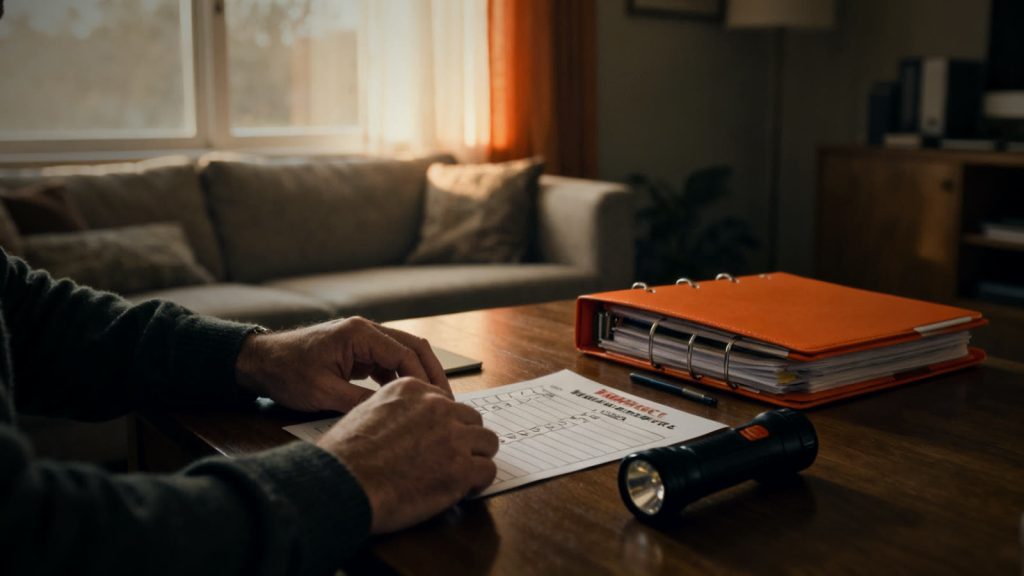
In basic training, we repeat procedures until they work without thinking. The reason is simple: under stress, the brain falls back on what it has practiced. What you’ve never practiced is hard to recall in an emergency. For your household, this means:
- Fixed places for your flashlight, first aid kit, document folder, and go bag – and everyone in the household knows where they are.
- Simple checklists on paper, such as “power outage,” “leaving home,” or “emergency call.” A list does the thinking for you when you can’t.
- A practice run once a year: spend an evening without electricity or walk the route to your family meeting point together once.
Preparation is therefore not only about material supplies, but also about mental readiness. Every habit that’s second nature is one less problem on your mind.
Tools for the moment
1. Breathe deliberately
Breathing is one of the few levers you can directly control. A simple method is box breathing: inhale for four seconds, hold for four seconds, exhale for four seconds, hold for four seconds. A few rounds are often enough to think more clearly again. If holding your breath is uncomfortable, simply focus on exhaling for longer than you inhale.
2. Stop – think – act
Before you run off, take a few seconds. A proven sequence is:
- Stop: Pause briefly, and don’t react in a panic.
- Assess the situation: What happened? Who is in danger? Am I safe myself?
- Prioritize: What matters most right now? Usually: your own safety, calling 112, providing help.
- Act: One step at a time.
3. Think out loud and speak clearly
Tell yourself what you’re going to do next: “I’m getting the flashlight now.” This helps organize your thoughts. If other people are present, address them directly and give clear, short tasks: “You call 112. You get the first aid kit.” General appeals like “Can someone help?” often go unanswered.
4. Small tasks for everyone
People feel better when they can do something. Give children a manageable task too, such as holding the flashlight or calming the pet. This shifts attention away from fear and toward something concrete.
Limit How Much News You Take In
In a crisis, rumors and false reports spread quickly. Get your information from reliable sources – the NINA warning app, public broadcasters, government agency websites – and check them at set intervals rather than every few minutes. Constantly watching the news keeps you in alarm mode without making you any better informed.
After the Event
Distressing experiences often linger. Trouble sleeping, irritability, recurring images, or a feeling of emptiness in the days afterward are common reactions to an extraordinary event. Talk about it with people you trust, and make sure you get rest, regular meals, and some physical activity.
If the strain continues or severely limits your daily life, get support – from your family doctor’s office or through psychosocial counseling services. The TelefonSeelsorge (Germany’s free crisis helpline) is available around the clock at no cost at 0800 111 0 111, 0800 111 0 222, or 116 123. After large-scale emergencies, Psychosocial Emergency Care teams are often on site as well, such as emergency chaplains and crisis intervention teams.
Take care of yourself too if you were there for others. People who keep functioning and helping others during a crisis often don’t notice their own exhaustion until it’s all over. That isn’t a failure – it’s a signal that it’s time for rest, sleep, and a conversation.
In short: Stress in an emergency is normal and predictable. Practiced routines, fixed locations, and checklists take some of the load off your mind. Breathe deliberately, pause for a moment, and then act step by step.
Suitable Gear Compared
| Produktbild bei AmazonBudget entry pointSolarbaby Notfall-Solarradio | Produktbild bei AmazonSolid middle groundActa Berg Kurbelradio | Produktbild bei AmazonLargest reserveROCAM Kurbelradio 12.000 mAh | |
|---|---|---|---|
| Rating | at least 4.3 out of 5 starswith 500+ customer reviews (our selection criterion)See current reviews* | at least 4.3 out of 5 starswith 500+ customer reviews (our selection criterion)See current reviews* | at least 4.3 out of 5 starswith 500+ customer reviews (our selection criterion)See current reviews* |
| Features |
|
|
|
| Pros |
|
|
|
| Cons |
|
|
|
| View on Amazon* | View on Amazon* | View on Amazon* |
Selected by manufacturer data and customer reviews (at least 4.3 stars with 500+ reviews). We only show exact star ratings when they come from Amazon the same day. As of 04.10.2026. Not tested by us. Current prices and reviews are on Amazon. *Ad · paid link
Conclusion: our product picks
Crank Radios Compared
For most households, the Acta Berg offers the best compromise between battery reserve and size. If you want to recharge your phone over several days, go for the ROCAM with 12,000 mAh. For a small emergency backpack, the Solarbaby is enough.
Links marked with * are advertising links. As an Amazon Associate I earn from qualifying purchases.
Sources and Further Information
General information, no substitute for individual advice from authorities, emergency services or medical professionals. In an emergency in Europe: 112.