When the cell network goes down or gets overloaded, it suddenly becomes hard to stay in contact with people nearby: your partner helping a neighbor, your kids in the yard, or your family two streets away. This is exactly where simple handheld radios can help. In Germany, you can use two radio services without a license, without registration, and without fees: PMR446 and Freenet. We’ll explain what each one can do, where their limits are, and how to use them effectively.
Why radios are useful in an emergency
Radios communicate directly with each other, from device to device. They don’t need a cell tower, a network, or a contract. As long as the batteries are charged and the distance is within range, they work. That makes them a useful addition when you need to coordinate over short distances – for example in an apartment building, at a campground, in a community garden area, or around your neighborhood.
In basic training, every recruit learns radio discipline first: speak briefly, speak clearly, listen. That applies in everyday civilian life too, and it saves battery as well.
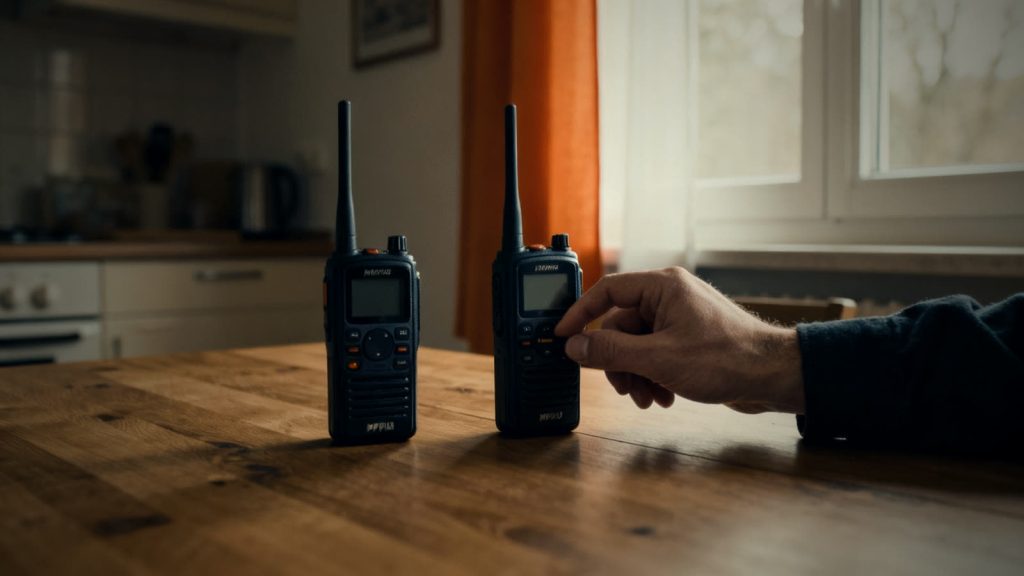
PMR446: the European license-free two-way radio
PMR446 uses frequencies around 446 MHz and is permitted without registration in Germany and many other European countries. The Bundesnetzagentur (Germany’s Federal Network Agency) has regulated its use in a general authorization. The key points:
- The maximum transmit power is 500 mW (ERP).
- Only devices with a permanently attached antenna may be used.
- The devices are intended for direct device-to-device operation, not as a repeater or as part of a fixed network.
- There is no protection from interference: everyone shares the channels, and you have to expect other users.
Analog PMR446 radios have 16 channels available. Older models often only support the first eight. If you mix radios from different manufacturers, make sure they all use the same channel and the same settings.
Freenet: the German alternative around 149 MHz
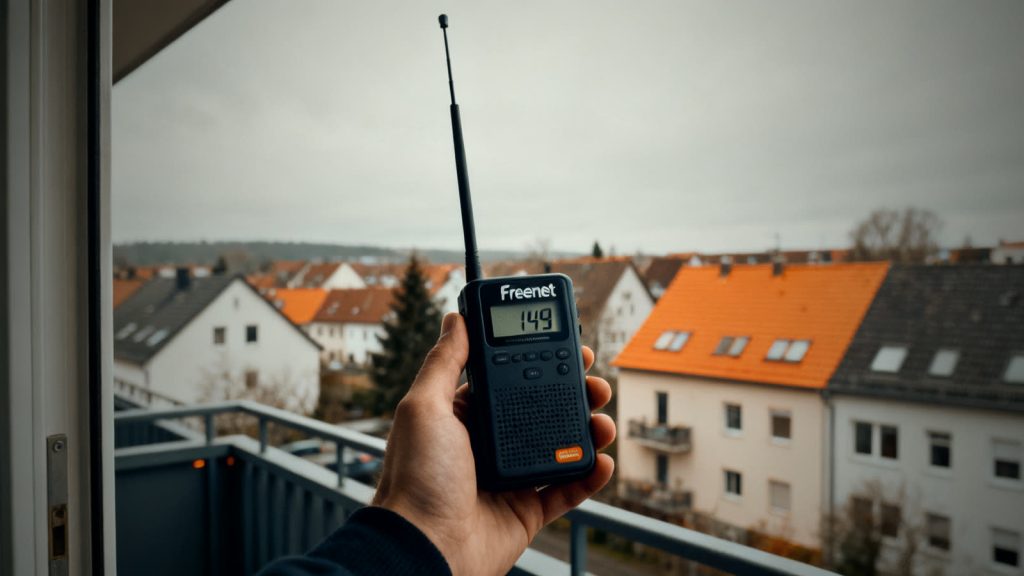
Freenet is a German-only radio service in the range around 149 MHz, and it is also free of registration and fees. The Bundesnetzagentur updated the rules for it in 2025. Since then, operation has been expressly limited to handheld radios for voice communication, meaning portable devices with their own power supply that one person can operate with one hand. Fixed stations, vehicle-mounted radios, and forwarding to the internet via so-called gateways are not allowed.
Freenet radios are less common in stores than PMR radios and only work in Germany. When buying, make sure the device is approved for Freenet. For most households, PMR446 is the easier choice because there is a wider selection and the radios can also be used in other European countries.
Realistic range
The packaging often promises impressive ranges of ten kilometers or more. Those figures only hold under ideal conditions, such as from one mountaintop to another with a clear line of sight. In practice, buildings, reinforced concrete, trees, and terrain greatly weaken the signal. In a built-up area, you should expect anywhere from a few hundred meters to a few kilometers. That’s why you should test the range yourself, right where you plan to use the radios: from the basement to your apartment, from your place to your parents’ place, from your home to your meeting point.
What two-way radios can’t do
- They don’t replace an emergency call. With PMR or Freenet radios, you can’t reach the fire department or emergency medical services. In an emergency, you still call 112, and if that doesn’t work, go to the nearest police station or hospital.
- They aren’t secure against eavesdropping. Anyone with a compatible radio can listen in. So-called privacy codes (CTCSS or DCS) only filter what you hear – they don’t encrypt anything. So don’t say anything over the radio that shouldn’t be public knowledge, such as when your home is empty.
- They don’t have a long range. They aren’t built for connecting to another city.
If you want more range, you’ll end up with amateur radio (ham radio). For that, you need to pass an exam and get a call sign from the Bundesnetzagentur (Germany’s Federal Network Agency). It’s a fascinating hobby, but a topic of its own.
How to use two-way radios effectively
- Set your channel: Agree on a main channel and a backup channel. Write both down on your emergency contact list.
- Agree on times: If you don’t want to keep your radio on all the time, set fixed times to listen, for example every hour on the hour for five minutes. This saves battery power.
- Secure your power supply: Choose radios that also run on regular AA or AAA batteries. That way, you can fall back on your battery stockpile when the rechargeable battery is empty.
- Practice: Try out the radios in everyday life, for example while hiking or camping. If you know how to use them, you’ll make fewer mistakes under stress.
- Involve the kids: Kids love two-way radios. Use that to practice the rules in a playful way: press the button first, then talk, and say “Over” at the end.
In short: PMR446 and Freenet radios require no registration in Germany and keep you in touch over short distances when the cell network goes down. Expect realistic ranges of a few hundred meters to a few kilometers, and test them on location. Radio is not encrypted and never replaces the 112 emergency call.
Compare the right gear
| Produktbild bei AmazonBattery-PoweredMotorola Talkabout T42 (3er-Set) | Produktbild bei AmazonRechargeable with HeadsetRetevis RT24 (Paar) | Produktbild bei AmazonFor GroupsJUCJET BF-88E (6 Stück) | |
|---|---|---|---|
| Rating | at least 4.3 out of 5 starswith 500+ customer reviews (our selection criterion)See current reviews* | at least 4.3 out of 5 starswith 500+ customer reviews (our selection criterion)See current reviews* | at least 4.3 out of 5 starswith 500+ customer reviews (our selection criterion)See current reviews* |
| Features |
|
|
|
| Pros |
|
|
|
| Cons |
|
|
|
| View on Amazon* | View on Amazon* | View on Amazon* |
Selected by manufacturer data and customer reviews (at least 4.3 stars with 500+ reviews). We only show exact star ratings when they come from Amazon the same day. As of 04.10.2026. Not tested by us. Current prices and reviews are on Amazon. *Ad · paid link
Conclusion: our product picks
PMR446 Radios Compared
For emergency stockpiling, the Motorola T42 is a strong choice because it runs on storable AAA batteries. Those traveling in pairs who prefer charging should go with the Retevis RT24 with headset, while families or neighborhoods are better served by the JUCJET 6-pack. All range figures are manufacturer specifications under ideal conditions—significantly less indoors and in urban areas.
Links marked with * are advertising links. As an Amazon Associate I earn from qualifying purchases.
Sources and further information
General information, no substitute for individual advice from authorities, emergency services or medical professionals. In an emergency in Europe: 112.