When you’re out in the open and the weather turns, shelter quickly becomes your top priority. Moisture and wind draw heat from your body – often faster than you’d expect, even at temperatures well above freezing. A tarp, a lightweight waterproof sheet with grommets and tie-out points, is one of the most versatile pieces of gear you can carry. It belongs in your go bag, in your car, and on every longer trip.
What a tarp is good for – and what it isn’t
A tarp is not a tent. It has no floor, no walls all the way around, and no mosquito netting. In return, it is light, quick to set up, and adapts to almost any terrain. It works as rain protection during a break, as a windbreak, as an emergency shelter for a night, or as an extra roof over a makeshift camp. At home, too, it can help, for example as a temporary cover after storm damage.
Important to keep in mind: wild camping is not permitted in many parts of Germany; the rules vary by federal state and protected area. For practice, it’s best to use your own yard, designated trekking sites, or land where you have the owner’s permission. In a real emergency, protecting life and limb comes first.
Size and material
For one person, a tarp of about 3 × 3 meters has proven its worth. It’s large enough for different setups and covers you along with your backpack. Smaller tarps save weight but leave less room to work with in driving rain. Common materials are coated polyester or nylon (light, quick to dry) and polycotton blends (heavier, but more breathable and more resistant to sparks from a fire).
To set it up, you’ll also need:
- a sturdy ridgeline (about 5–10 meters of cord),
- several shorter guy lines,
- a few tent stakes – or branches, stones, and roots as a substitute.
Choosing the right spot
A good spot is half the battle. Pay attention to these points:
- No hollows: Rainwater and cold air collect there.
- No rotten trees or dead branches above you – they can fall in the wind.
- Not right next to streams or rivers, which can swell quickly when it rains.
- Mind the wind direction: The closed side should face into the wind.
Three tarp setups you should know
1. The lean-to
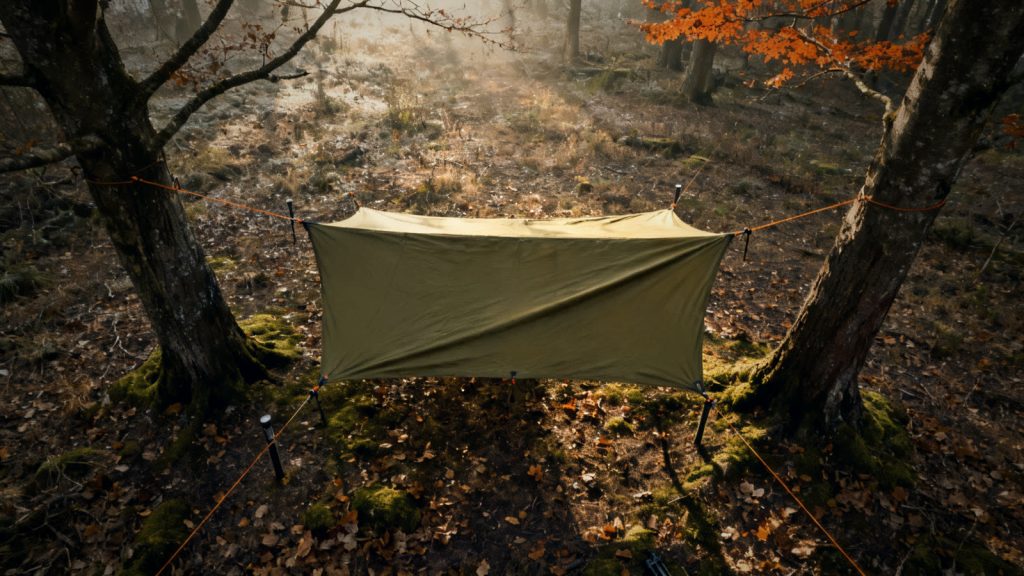
The simplest setup: Run the ridgeline between two trees, drape one edge of the tarp over it, and pull the other edge down at an angle to the ground. The open side faces away from the wind. Good for short breaks and mild weather.
2. The A-frame
The tarp hangs centered over the ridgeline, and both sides are staked out to the ground. This creates a roof like that of a tent. In rain, it offers much better protection than the lean-to. The lower you pitch it, the better it blocks wind – but the less room you’ll have, too.
3. The diamond
One corner is fastened high on a tree or pole, the opposite corner low to the ground, and the two side corners are staked out. This setup goes up quickly and is very wind-stable for one person.
Underestimated: Cold from Below
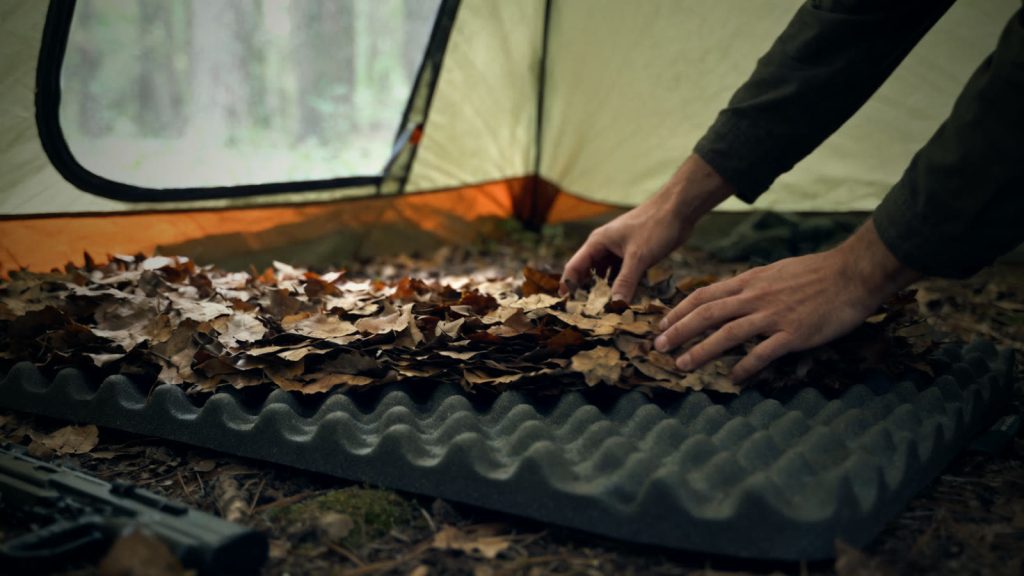
When people think about an emergency shelter, they often think only of the roof. Just as important is insulation from the ground. The ground continuously draws heat away from your body through direct contact, especially when it is damp. That’s why a sleeping pad should always be part of your kit. If you don’t have one, a thick layer of dry leaves, brushwood, or your backpack and clothing under you can help in a pinch. An emergency blanket can also block wind and reflect heat back toward you, but it is no substitute for insulation from the ground.
Also watch for the signs of early hypothermia: severe shivering, clumsiness, confusion. If you notice them, here’s what matters: get out of the wind and wet, change into dry clothing, insulate, and drink something warm if possible. If you notice serious symptoms, call the emergency number 112 immediately.
Fire and Tarp
Flying sparks can damage synthetic fabric in seconds. Keep open flames at a distance and follow wildfire rules – in Germany, open fires in and near forests are generally prohibited. You can find more in our article on starting a fire.
Practice Before It Counts
In basic training, you learn quickly: a shelter that takes ten minutes in daylight and dry weather takes twice as long in the dark, in the rain, and with cold fingers. That’s why you should set up your tarp several times in your yard or in a legal area. Tie the guy lines to the grommets in advance so that only a few steps are needed in a real emergency. A few basic knots, such as the clove hitch or the trucker’s hitch, make setup much easier.
In short: A 3 × 3 meter tarp with prepared guy lines is a lightweight, versatile emergency shelter. Choose your site carefully and always insulate yourself from below as well. Practice the setup several times – then you can do it even in rain and darkness.
Matching Gear Compared
| Produktbild bei AmazonLightestVOSOIR Tarp 3×3 / 3×5 m | Produktbild bei AmazonAll-RounderUnigear Tarp | Produktbild bei AmazonWith CarabinersRYACO Tarp | |
|---|---|---|---|
| Rating | at least 4.3 out of 5 starswith 500+ customer reviews (our selection criterion)See current reviews* | at least 4.3 out of 5 starswith 500+ customer reviews (our selection criterion)See current reviews* | at least 4.3 out of 5 starswith 500+ customer reviews (our selection criterion)See current reviews* |
| Features |
|
|
|
| Pros |
|
|
|
| Cons |
|
|
|
| View on Amazon* | View on Amazon* | View on Amazon* |
Selected by manufacturer data and customer reviews (at least 4.3 stars with 500+ reviews). We only show exact star ratings when they come from Amazon the same day. As of 04.10.2026. Not tested by us. Current prices and reviews are on Amazon. *Ad · paid link
Conclusion: our product picks
Tarps Compared
As a versatile weather shield for the garden, camping, and emergency shelter, the Unigear in four sizes is the most flexible choice. Anyone counting every gram in their backpack should go with the VOSOIR. The RYACO scores points with rip-stop fabric and carabiners for attaching it to a backpack.
Links marked with * are advertising links. As an Amazon Associate I earn from qualifying purchases.
Sources and Further Information
General information, no substitute for individual advice from authorities, emergency services or medical professionals. In an emergency in Europe: 112.