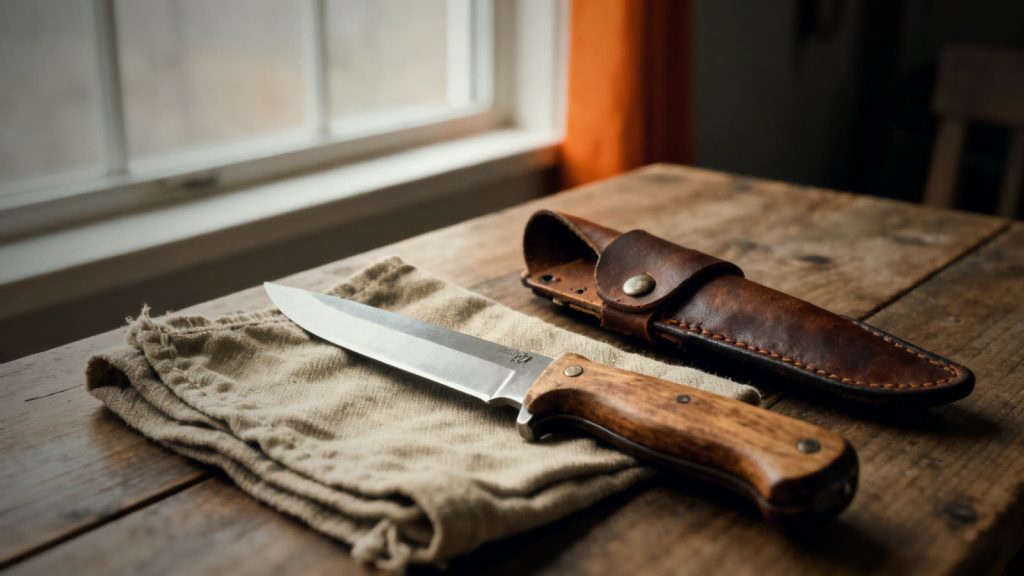
A knife is one of the oldest and most useful tools there is. In everyday life, you use it to open packaging. In an emergency, you cut cord, make feather sticks for kindling, prepare food, or trim a tarp line. For emergency preparedness, you don’t need a macho “survival knife” with a sawback and a compass in the handle. What matters is a solid, sharp tool that feels good in your hand and that you can use safely.
Fixed blade or folding knife?
Both designs have their place:
- Fixed-blade knives are sturdy, easy to clean, and have no mechanism that can fail. For woodworking at camp, they are the first choice.
- Pocket knives and folding knives are compact and practical for everyday carry. A good pocket knife with a blade, saw, can opener, and bottle opener covers many tasks around the house and on the go.
Many experienced outdoorsmen use both: a small fixed-blade knife for the backpack and a pocket knife for everyday carry.
What to look for
Blade length
A blade of about 8 to 11 centimeters is enough for almost every task. Longer blades are harder to control, clumsier for fine carving, and more problematic legally (see below).
Steel
- Stainless steel is low-maintenance and works well in wet conditions and for food preparation.
- Carbon steel is easy to resharpen and often holds a very good edge, but it can rust and needs some care (dry it, oil it lightly).
Grind and spine
A so-called Scandi grind is easy to resharpen and ideal for woodworking. A blade spine ground at a right angle is handy for striking sparks with a ferro rod.
Handle and sheath
The handle should stay secure in your hand even when it’s wet or when you’re wearing gloves. A sturdy sheath that holds the knife securely protects you and your gear.
Working safely
In basic military training, there was one fundamental rule for handling tools that still applies today: always cut away from your body, and watch your “blood circle,” the area your blade can reach with your arm fully extended. No one else has any business being inside it.
- A sharp knife is safer than a dull one because you need less force and it slips less often.
- When you carve, work while seated, with your elbows resting on your knees.
- Don’t misuse a knife as a pry bar or screwdriver.
- Only let children carve under supervision and after they’ve been shown how.
- Keep a few bandages and a compress handy, because small cuts happen.
Care and Sharpening
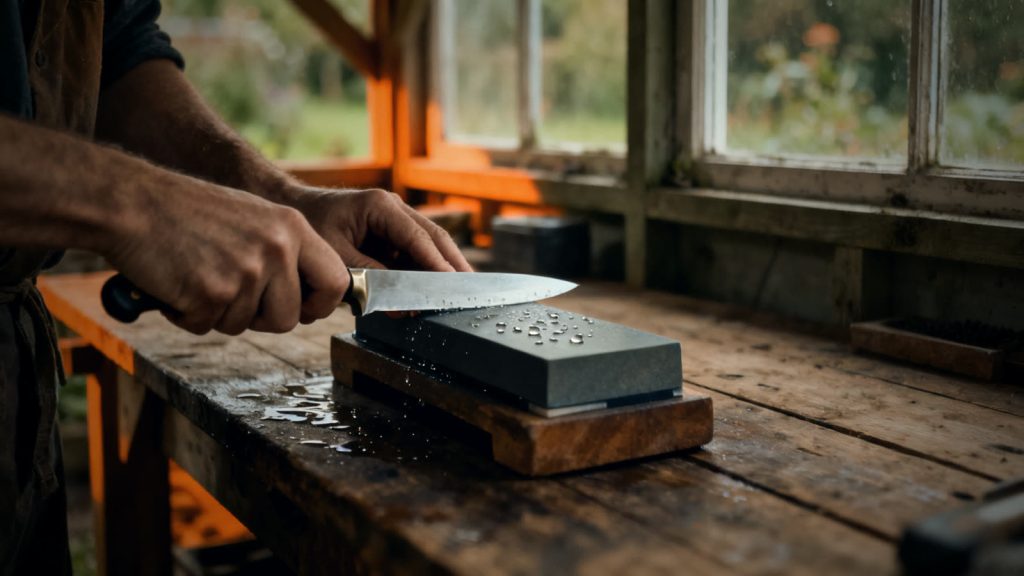
Wipe and dry your knife after use, and apply a light coat of oil to carbon steel from time to time. A combination sharpening stone or a handy pocket sharpener is enough for touch-ups. What matters is keeping the angle consistent. Practice sharpening at home, not for the first time out in the field.
A tip for checking your edge: a sharp knife cuts a sheet of paper cleanly, without tearing or snagging. If it no longer does, it’s time to sharpen. Folding knives need a little more attention: clean dirt out of the pivot from time to time and add a drop of acid-free oil so the mechanism keeps moving smoothly. Wooden handles appreciate a little linseed oil now and then. Store knives dry and not for long periods in a damp leather sheath, because even stainless steel can develop stains in there.
A Quick Overview of the Legal Situation in Germany
Note: This is not legal advice, just general guidance. If in doubt, check with the responsible authority or a professional.
In general, adults are allowed to own common outdoor and pocket knives. There are restrictions on carrying a knife in public, meaning when you have it on you and within easy reach:
- Under Section 42a of the German Weapons Act (Waffengesetz), it is prohibited to carry knives with a blade that can be locked open with one hand (one-handed knives) and fixed-blade knives with a blade length over 12 centimeters – unless there is a legitimate reason, such as professional use, traditional customs, sport, or another generally recognized purpose.
- Transport in a closed container is permitted.
- Since 2024, additional, more extensive knife bans have applied, for example at public festivals and other public events, as well as in designated weapon and knife prohibition zones – in some cases regardless of blade length.
In practice, this means: your outdoor knife belongs in your backpack when you’re heading out on a trip, a drill, or to your emergency camp site – not in your jacket pocket on the way to the movies or a town festival. A knife is a tool, not a weapon.
Our Recommendation for Preparedness
For your go bag: a small fixed-blade knife with a blade under 12 centimeters and a secure sheath. For your pocket and around the house: a classic pocket knife without a one-handed opening mechanism. That way you’re well equipped and stay on the safe side.
In short: A simple, sharp knife with a blade of 8 to 11 centimeters covers almost every task. Safe cutting technique and regular maintenance matter more than fancy extras. Restrictions apply when carrying a knife in public – if in doubt, keep the knife packed away in your backpack.
Matching Gear Compared
| Produktbild bei AmazonLight & SimpleSwiss+Tech Outdoor Messer | Produktbild bei AmazonRugged One-Piece BuildOdenwolf W1 | Produktbild bei AmazonBushcraft SetGREIFS BushMaster | |
|---|---|---|---|
| Rating | at least 4.3 out of 5 starswith 500+ customer reviews (our selection criterion)See current reviews* | at least 4.3 out of 5 starswith 500+ customer reviews (our selection criterion)See current reviews* | at least 4.3 out of 5 starswith 500+ customer reviews (our selection criterion)See current reviews* |
| Features |
|
|
|
| Pros |
|
|
|
| Cons |
|
|
|
| View on Amazon* | View on Amazon* | View on Amazon* |
Selected by manufacturer data and customer reviews (at least 4.3 stars with 500+ reviews). We only show exact star ratings when they come from Amazon the same day. As of 04.10.2026. Not tested by us. Current prices and reviews are on Amazon. *Ad · paid link
Conclusion: our product picks
Fixed-Blade Outdoor Knives Compared
For woodworking and fire-starting, the GREIFS BushMaster with its included fire starter is the most complete package. The Odenwolf W1 is the rugged alternative without accessories, while the Swiss+Tech is the lightweight, slim choice. Mind the legal situation: under Section 42a of the German Weapons Act (WaffG), carrying fixed-blade knives with a blade over 12 cm (4.7 in) in public without a legitimate reason is prohibited – additional knife bans apply at events and in designated weapons-ban zones.
Links marked with * are advertising links. As an Amazon Associate I earn from qualifying purchases.
Sources and Further Information
General information, no substitute for individual advice from authorities, emergency services or medical professionals. In an emergency in Europe: 112.