A rope is only as useful as the knot you tie it with. Whether you’re pitching a tarp, pulling a tarp over a damaged roof, securing luggage on a car roof, or rigging a clothesline in the living room because the dryer won’t run during a power outage, a few good knots make your life easier. You don’t need to be a sailor or a climber. Five knots are enough for the majority of everyday and emergency situations.
Important note up front: This article is not a substitute for training in climbing, fall protection, or rescue. Knots that people hang from belong in the hands of trained professionals using certified equipment.
A Few Terms
- Standing part: the long, loaded section of the rope.
- Working end: the short end you use to tie the knot.
- Bight: a loop in which the rope does not cross itself.
- Loop: a loop in which the rope crosses itself.
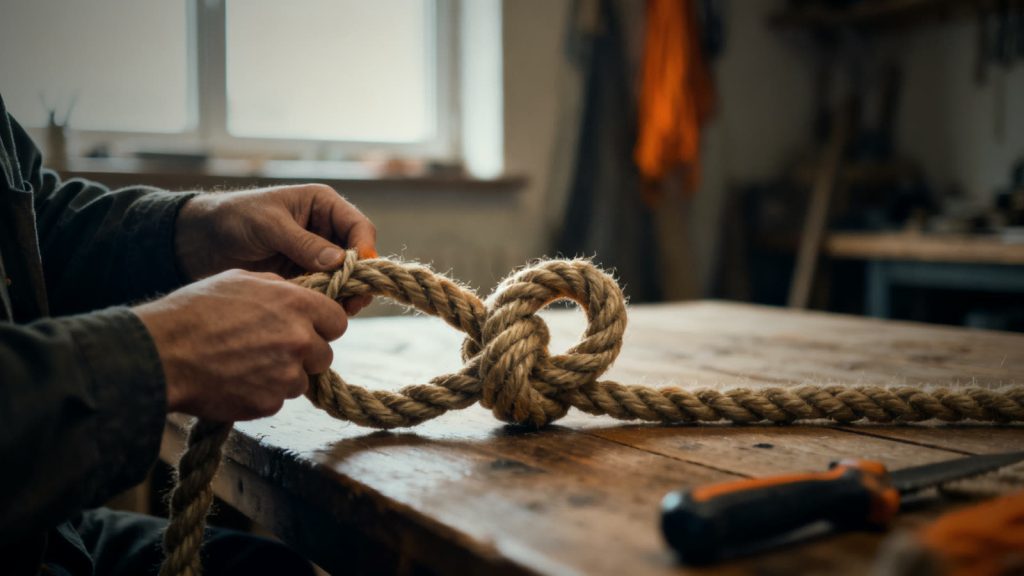
1. Figure-Eight Knot – the Stopper
What it’s for: Keeps the end of a rope from slipping through an eyelet or your hand. It is also the basis for many other knots.
How to tie it: Form a loop with the working end, pass the end once around the standing part, and then down through the loop from above. Pull it tight – the result is a figure eight lying on its side.
Advantage: It is usually easy to untie even after being loaded.
2. Bowline – the Fixed Loop
What it’s for: A loop that doesn’t tighten under load. Ideal for putting a rope around a tree, post, or ring, for example for the ridgeline of a tarp.
How to tie it: Make a small loop in the standing part (the “rabbit hole”). Pass the working end up through the loop from below (“the rabbit comes out of the hole”), around behind the standing part (“runs around the tree”), and back down through the loop (“jumps back into the hole”). Pull it tight by pulling the standing part against the loop.
Caution: A bowline can work loose if it is moved back and forth while unloaded. Leave the working end long enough, or secure it additionally with a stopper knot.
3. Clove Hitch – Quick to Secure
What it’s for: Quickly fastening a rope to a post, branch, or pole, for example for guying out or as the start of a lashing.
How to tie it: Wrap the rope once around the post, cross it over the standing part, wrap it around a second time, and tuck the end under the last wrap. From the front, you see two parallel wraps with a cross over them.
Caution: With a changing direction of pull or on smooth poles, the clove hitch can slip. For permanent attachments, secure it with two additional half hitches.
4. Trucker’s Hitch – Tension with Power
What it’s for: Pulling a rope really taut, for example for a ridgeline, a clothesline, or to tie down a tarp and cargo.
How to tie it (simplified):
- Tie a fixed loop that doesn’t tighten into the standing part, such as a slipknot or a loop made with a figure-eight knot.
- Pass the working end around the anchor point (tree, hook, eyelet).
- Thread the end back through the loop – this creates a simple redirect like a pulley.
- Pull hard on the end until the line is taut.
- Secure the tension with two half hitches below the loop.
Caution: The redirect generates a lot of force. Don’t overdo it, so that eyelets, tarps, or thin branches don’t tear.
5. Square Knot (Reef Knot) – for Tying Things Together
What it’s for: Joining two ends of the same cord to bundle something: a package, a bundle of firewood, or a triangular bandage sling in first aid.
How to tie it: Left over right and through, then right over left and through. A correct square knot lies flat and symmetrical. If it sits crooked, you’ve tied a “granny knot,” which comes undone easily.
Warning: The square knot is not suitable for joining two ropes that carry a load, especially if they differ in thickness or are slippery. It can then come loose without you noticing.
Choosing the Right Cord
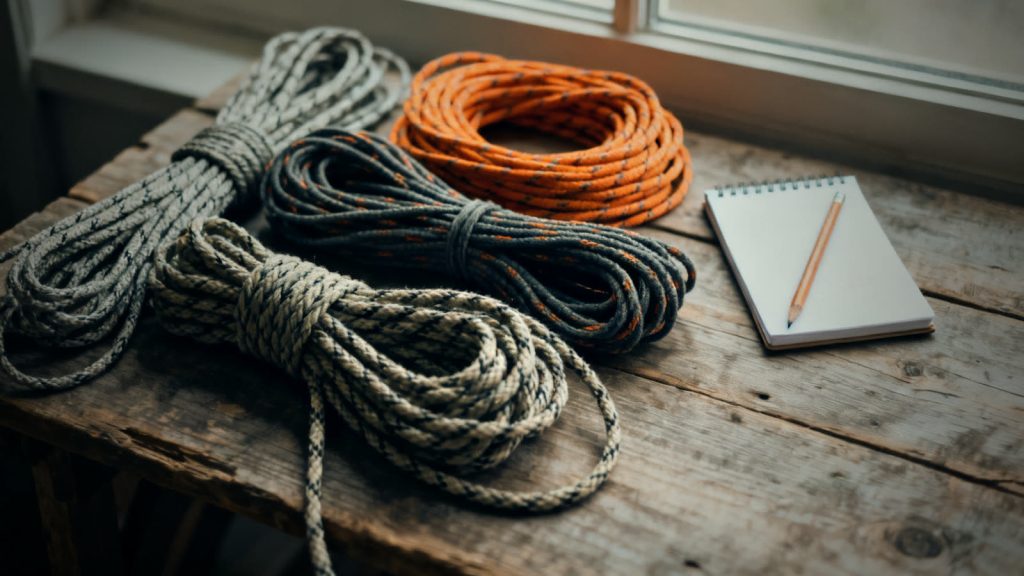
For emergency preparedness and outdoor use, cord with a diameter of about 3 to 4 millimeters has proven its worth: thick enough to grip, thin enough to carry. Store a few bundles of 5 to 10 meters in your go bag, in your car, and at home. You can carefully melt the ends of synthetic cords with a lighter so they don’t fray.
How to Make the Knots Stick
What you learn in basic training sticks because it’s repeated constantly. Do the same: hang a piece of cord at your desk or next to the couch and tie each knot a few times a week – even with your eyes closed or behind your back. After a few weeks, you’ll be able to tie them with cold fingers in the dark.
In short: The figure-eight knot, bowline, clove hitch, trucker’s hitch, and square knot cover most everyday and emergency tasks. Know not only the technique but also the limits of each knot. Regular practice turns them into routine.
Matching Gear Compared
| Produktbild bei AmazonAll-rounderTECEUM Paracord 550 Typ III | Produktbild bei AmazonFor Crafting & BraidingGanzoo Paracord 550 Typ III | Produktbild bei AmazonOn a SpoolGO!elements Paracord 550 Typ III | |
|---|---|---|---|
| Rating | at least 4.3 out of 5 starswith 500+ customer reviews (our selection criterion)See current reviews* | at least 4.3 out of 5 starswith 500+ customer reviews (our selection criterion)See current reviews* | at least 4.3 out of 5 starswith 500+ customer reviews (our selection criterion)See current reviews* |
| Features |
|
|
|
| Pros |
|
|
|
| Cons |
|
|
|
| View on Amazon* | View on Amazon* | View on Amazon* |
Selected by manufacturer data and customer reviews (at least 4.3 stars with 500+ reviews). We only show exact star ratings when they come from Amazon the same day. As of 04.10.2026. Not tested by us. Current prices and reviews are on Amazon. *Ad · paid link
Conclusion: our product picks
Paracord 550 Compared
As a stockpile for tents, tarps, and repairs, the TECEUM is the most flexible choice with lengths up to 305 m (1,000 ft). Anyone wanting to braid bracelets or handles should reach for the Ganzoo. For a backpack, the spooled GO!elements is the handiest option. Important: paracord is not a climbing or belay rope.
Links marked with * are advertising links. As an Amazon Associate I earn from qualifying purchases.
Sources and Further Information
General information, no substitute for individual advice from authorities, emergency services or medical professionals. In an emergency in Europe: 112.