Severe weather is a regular part of the year in Germany: autumn and winter storms, summer thunderstorms with hail and heavy rain. Most of them pass without major consequences. Some, however, cause considerable damage, and the greatest danger to people often comes from flying debris and falling trees. If you take warnings seriously and know a few basic rules, you will almost always get through safely.
How to read weather warnings
The Deutscher Wetterdienst (DWD) (Germany’s National Meteorological Service) is responsible for official weather warnings in Germany. It uses four warning levels, each marked by a color:
- Level 1 – Yellow: Weather warning. Hazards may occur, for example from thunderstorms or wind gusts.
- Level 2 – Orange: Warning of significant weather. Local damage is possible.
- Level 3 – Red: Severe weather warning. The weather is dangerous, and widespread damage is possible.
- Level 4 – Violet: Warning of extreme severe weather. There is a danger to life, and large-scale destruction is possible.
You can receive warnings through the DWD’s WarnWetter app, through the NINA warning app (Germany’s official emergency alert app), and via radio and television. In the apps, set your home location and, if needed, your workplace. From Red upward, you should seriously reconsider your plans; at Violet, stay in a safe building if at all possible.
Before the storm: secure your house, balcony and yard
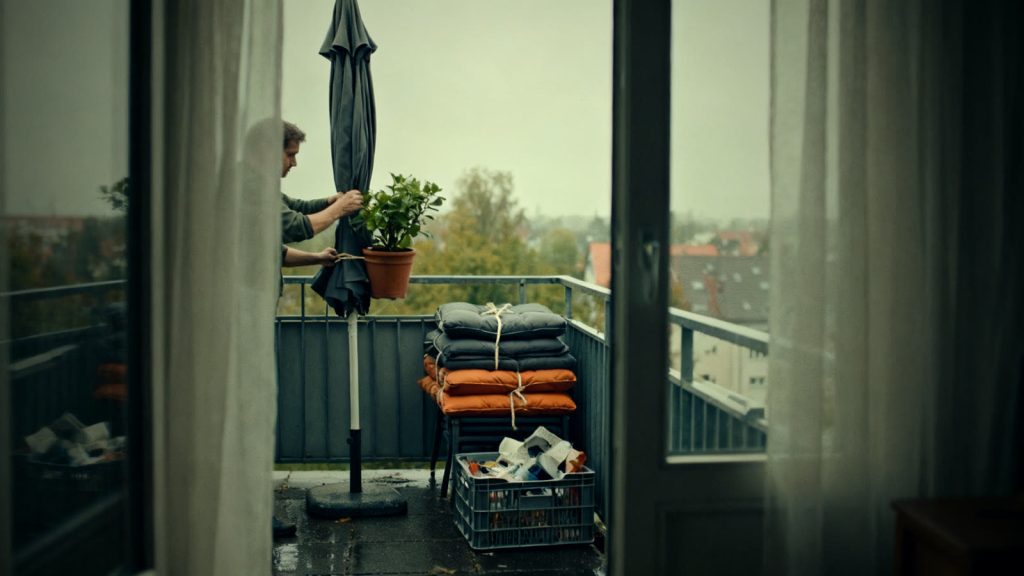
As soon as a storm warning is issued, take fifteen minutes for a walk-around. In basic training, we strap down our gear before every march so nothing gets lost along the way – the same principle applies at home: secure or put away anything the wind could carry off.
- Secure or bring in patio furniture, umbrellas, flower boxes, trampolines and trash cans
- Retract awnings, close windows and doors, lower roller shutters
- Avoid parking your car under trees or scaffolding, or next to loose roof parts, if possible
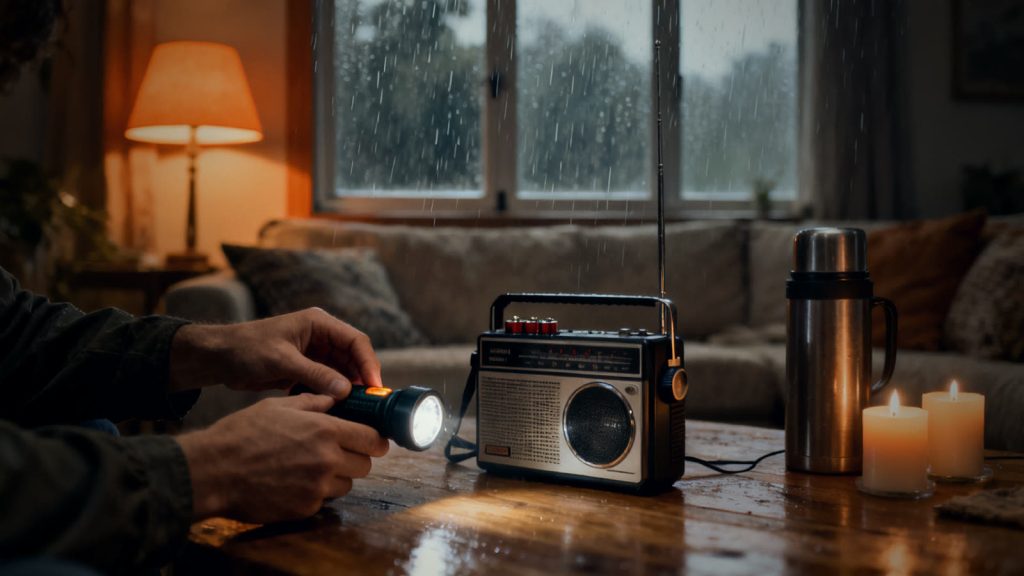
- Keep flashlights, a power bank and a battery-powered radio within easy reach
- If there is a risk of lightning, unplug sensitive electronics or run them through a surge protector
The BBK (Germany’s Federal Office of Civil Protection and Disaster Assistance) also advises documenting your belongings with photos in advance. This makes filing an insurance claim much easier.
During the storm: stay indoors
You are usually safest inside. Stay away from windows and glass surfaces. In very strong storms or hail, the BBK recommends going to an interior room on the ground floor – but you should avoid basement rooms. Don’t go outside to “rescue” something – no patio chair is worth an injury.
Pets often react anxiously to storms and thunder. Bring them inside, stay calm and close to them, and give them a sheltered place to retreat to.
During the Storm: When You’re Out and About
If the storm catches you outdoors:
- Take shelter in a building. In a severe storm, avoid large halls with wide, free-spanning roofs.
- Avoid forests, tree-lined roads, and parks. Branches and entire trees can fall without warning, even hours after the storm has passed.
- Keep your distance from scaffolding, construction sites, poles, and building facades where parts could come loose.
- In a car: Slow down significantly, watch for crosswinds on bridges and in gaps in wooded areas, and if possible, pull over in a safe spot away from trees.
Special Case: Thunderstorms
During a thunderstorm, additional rules apply, as summarized by the BBK (Germany’s Federal Office of Civil Protection and Disaster Assistance):
- Avoid open terrain, hilltops, isolated trees, towers, and poles
- Stay at least 50 meters away from overhead power lines
- If no building is within reach: crouch down with your feet close together, ideally in a hollow
- You’re well protected inside a car during a thunderstorm – stay inside and don’t touch any bare metal parts
- Get out of the water and don’t hold up objects with metal parts, such as umbrellas
After the Storm
When the wind dies down, the situation isn’t automatically safe. Keep the following in mind:
- Downed power lines: Never touch them and keep a wide distance. Report them by calling the emergency number 112 or contacting your grid operator.
- Forests and parks: Don’t re-enter them until they’ve been officially reopened. Partially broken branches can fall for a long time.
- Document the damage: Take photos of everything before you clean up, and report the damage to your insurance company.
- Roof and facade: Don’t climb up yourself if parts are loose – leave this to professional contractors or, in case of immediate danger, the fire department.
- Neighborhood: Check on people who might need help.
Call the emergency number 112 if anyone is injured or there is immediate danger. For fallen trees on roads or loose roof parts that don’t pose an immediate threat to life, the fire department is also responsible in many municipalities – but don’t overload the lines with minor issues.
Also plan for the possibility that a storm damages power lines and causes a power outage lasting several hours or longer. A supply of drinking water and food, light that doesn’t need an outlet, and a hand-crank or battery-powered radio keep a stormy evening from turning into a problem.
In short: Pay attention to the DWD (German Weather Service) warning levels from yellow to purple and plan accordingly. Secure anything that could fly away beforehand, and stay indoors and away from windows during a storm. After the storm: keep your distance from power lines and trees, document first, then clean up.
Recommended Gear Compared
| Produktbild bei AmazonBudget entry pointSolarbaby Notfall-Solarradio | Produktbild bei AmazonSolid middle groundActa Berg Kurbelradio | Produktbild bei AmazonLargest reserveROCAM Kurbelradio 12.000 mAh | |
|---|---|---|---|
| Rating | at least 4.3 out of 5 starswith 500+ customer reviews (our selection criterion)See current reviews* | at least 4.3 out of 5 starswith 500+ customer reviews (our selection criterion)See current reviews* | at least 4.3 out of 5 starswith 500+ customer reviews (our selection criterion)See current reviews* |
| Features |
|
|
|
| Pros |
|
|
|
| Cons |
|
|
|
| View on Amazon* | View on Amazon* | View on Amazon* |
Selected by manufacturer data and customer reviews (at least 4.3 stars with 500+ reviews). We only show exact star ratings when they come from Amazon the same day. As of 04.10.2026. Not tested by us. Current prices and reviews are on Amazon. *Ad · paid link
| Produktbild bei AmazonSmall & affordableINIU Power Bank 20.000 mAh 22,5 W | Produktbild bei AmazonAll-rounderAnker Zolo 20.000 mAh 30 W | Produktbild bei AmazonAlso for laptopsAnker Powerbank 20.000 mAh 87 W | |
|---|---|---|---|
| Rating | at least 4.3 out of 5 starswith 500+ customer reviews (our selection criterion)See current reviews* | at least 4.3 out of 5 starswith 500+ customer reviews (our selection criterion)See current reviews* | at least 4.3 out of 5 starswith 500+ customer reviews (our selection criterion)See current reviews* |
| Features |
|
|
|
| Pros |
|
|
|
| Cons |
|
|
|
| View on Amazon* | View on Amazon* | View on Amazon* |
Selected by manufacturer data and customer reviews (at least 4.3 stars with 500+ reviews). We only show exact star ratings when they come from Amazon the same day. As of 04.10.2026. Not tested by us. Current prices and reviews are on Amazon. *Ad · paid link
Conclusion: our product picks
Crank Radios Compared
For most households, the Acta Berg offers the best compromise between battery reserve and size. If you want to recharge your phone over several days, go for the ROCAM with 12,000 mAh. For a small emergency backpack, the Solarbaby is enough.
Power Banks (20,000 mAh) Compared
For charging your phone in an emergency, the Anker Zolo is enough – with a built-in cable, nothing gets lost. If you need to power a laptop, you'll need the 87 W version. The INIU is the most compact choice for emergency bags and jacket pockets.
Links marked with * are advertising links. As an Amazon Associate I earn from qualifying purchases.
Sources and Further Information
General information, no substitute for individual advice from authorities, emergency services or medical professionals. In an emergency in Europe: 112.