Once kids are part of the household, preparedness changes. It’s no longer just about water and canned food, but also diapers, favorite stuffed animals, medications, the route to school, and the question: who picks up whom when the cell network goes down? The good news: families are usually great organizers in everyday life anyway. With a few targeted steps, you can turn that into a solid emergency plan – one that helps kids feel safer, not more anxious.
Your emergency supplies: think of every family member
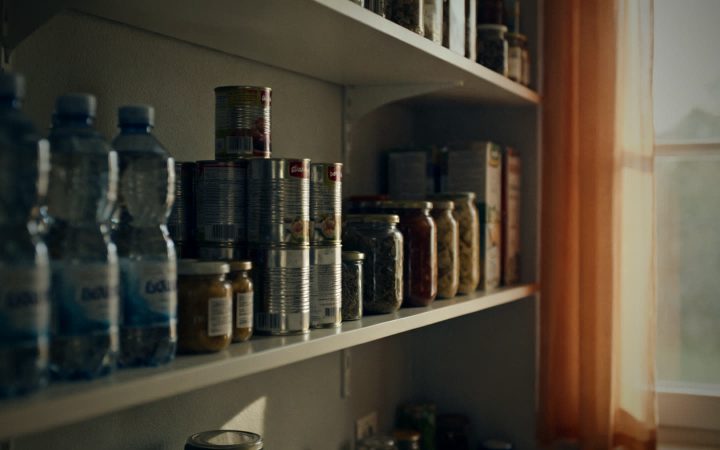
The BBK (Germany’s Federal Office of Civil Protection and Disaster Assistance) recommends building up a supply for ten days if possible; even three days is a good start. Per person, the BBK calculates at least 1.5 liters of drinking fluids per day, plus about 0.5 liters for cooking. For a family of four, that quickly adds up to 80 liters over ten days – so plan realistically for the storage space.
With kids, there are a few extra things to consider:
- Baby food: Keep a sufficient stock of the infant formula you already use. To prepare it, you’ll need clean water and a way to heat it – talk through the details with your pediatrician or midwife.
- Hygiene: Diapers, wet wipes, and diaper rash cream for at least the length of your supply period.
- Favorite foods: Kids often eat poorly in stressful situations. Familiar snacks and favorite meals with a long shelf life help enormously.
- Take allergies and food intolerances into account when shopping.
- Medications: Talk to your pediatrician’s office or pharmacy in good time about long-term medications and fever reducers for children.
A handy tool is the supply calculator at ernaehrungsvorsorge.de, which you can use to work out quantities for your household.
Keeping kids busy is preparedness too
A power outage without a tablet, TV, and Wi-Fi can feel long to kids. Pack a small “boredom box”: card games, art supplies, books, a puzzle, a headlamp for the fort under the table. It may sound minor, but it brings calm – and calm is an advantage in any crisis.
Share the tasks
Preparedness doesn’t have to rest on one person. Divide up the responsibilities: who takes care of the water supply, who handles flashlights and batteries, who looks after the document folder? Older kids and teens can take on tasks of their own, like checking expiration dates twice a year or charging the power banks. This takes some of the load off the adults and gives kids the good feeling of being needed. A recurring date in the family calendar keeps your preparations from being forgotten.
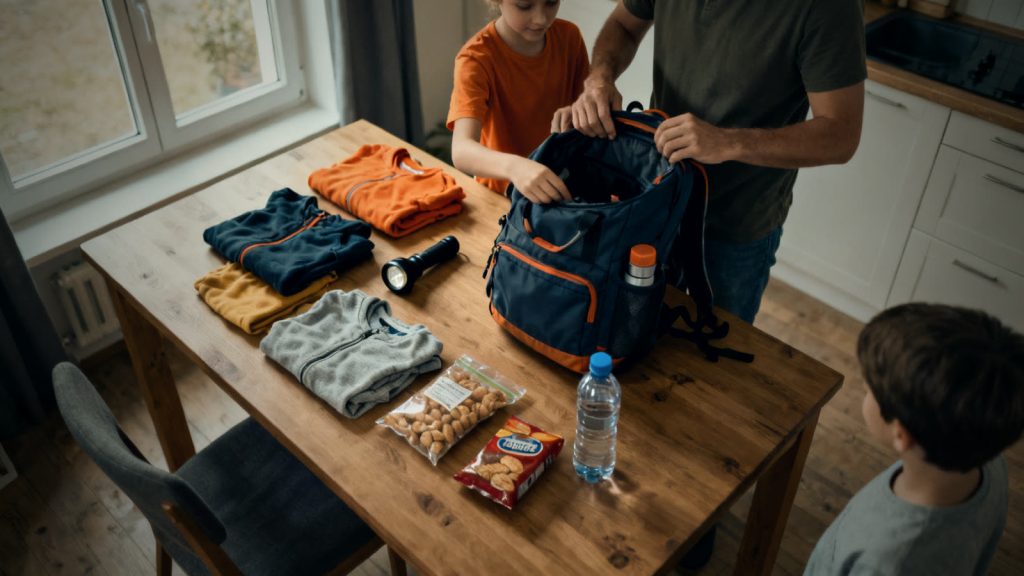
A go bag for every child
In case you have to leave your home quickly, the BBK recommends one go bag per person that fits into a backpack. Kids from about preschool age can carry a small backpack of their own: a change of clothes, a favorite stuffed animal, a water bottle, a snack, a small light. For small children, the BBK also recommends a neck pouch or an SOS capsule with their name, date of birth, and address. Add a phone number for the parents.
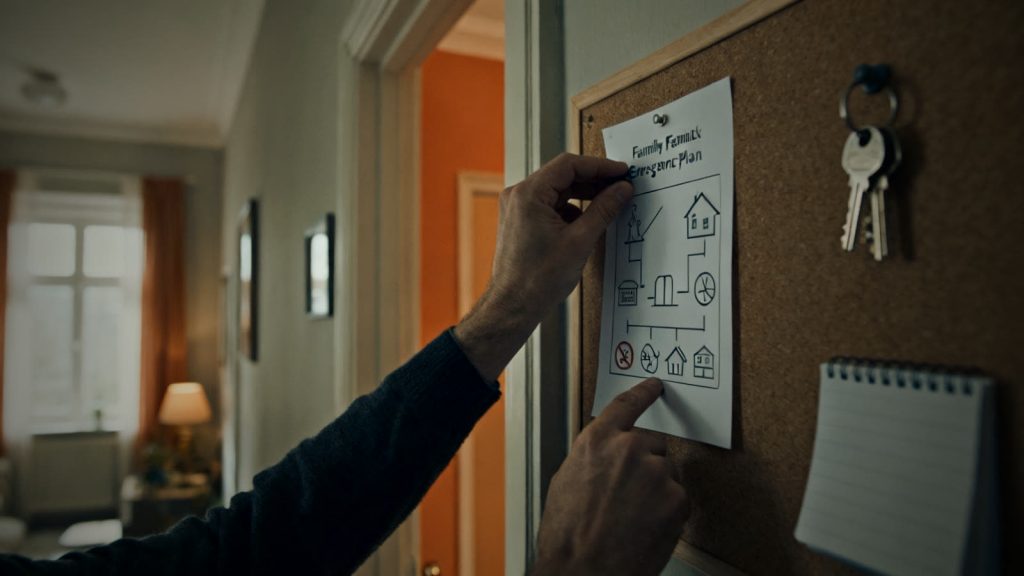
Agreements: the most important part
In a real emergency, you probably won’t all be together: one parent is at work, one child is at school, another is at daycare. That’s why you should:
- Keep a paper contact list: Print out important phone numbers and put a copy in every backpack and school bag. Kids should memorize at least one number.
- Set meeting points: one near your home (for example, at a neighbor’s place) and one outside your neighborhood (for example, at the grandparents’ home).
- Clarify pickup rules: Who is allowed to pick up the kids from school and daycare? Find out how the facility handles emergencies.
- Choose an out-of-area contact: One person in a different region whom everyone checks in with. During regional disruptions, connections to that person sometimes work better.
Talking to kids about crises
Kids notice when adults are worried. Staying silent rarely helps. In its current guide, the BBK (Germany’s Federal Office of Civil Protection and Disaster Assistance) offers advice on how to deal with fears and worries, including those of children. A few principles that have proven helpful:
- Explain things honestly and at an age-appropriate level, without painting a vivid picture of the details.
- Allow questions and take them seriously. “I don’t know, but I’ll take care of it” is a good answer.
- Make preparedness a shared project: let kids pack their own backpack, test flashlights, and walk the route to the meeting point.
- Limit exposure to upsetting news.
In basic training, we learned that under stress, people fall back on what they have practiced beforehand. Kids are no different. A playful “power outage night” with candle substitutes, a hand-crank radio, and a board game sticks better than any explanation.
Safety at home
- Never leave candles burning unattended. With kids, battery-powered lamps are the better choice.
- Never use grills, gas heaters, or camping stoves indoors without proper exhaust venting: carbon monoxide is invisible and deadly.
- Store food supplies, fuel, and medications out of children’s reach.
- Kids know how to dial the emergency number 112 and what to say.
- Install the NINA warning app (Germany’s official emergency alert app) on your family’s smartphones.
In short: Plan your emergency supplies and go bag for every family member, with baby food, medications, and favorite items in mind. Clear agreements on contacts, meeting points, and pickup are at least as important as your supplies. Involve your kids in a playful way. It gives them a sense of security instead of fear.
Matching gear compared
| Produktbild bei AmazonFor home useFLEXEO Erste-Hilfe-Koffer DIN 13157:2021 | Produktbild bei AmazonHome alternativeWERKSTEIN Erste-Hilfe-Kasten DIN 13157:2021 | Produktbild bei AmazonFor on the goFLEXEO Erste-Hilfe-Tasche „Discovery“ | |
|---|---|---|---|
| Rating | at least 4.3 out of 5 starswith 500+ customer reviews (our selection criterion)See current reviews* | at least 4.3 out of 5 starswith 500+ customer reviews (our selection criterion)See current reviews* | at least 4.3 out of 5 starswith 500+ customer reviews (our selection criterion)See current reviews* |
| Features |
|
|
|
| Pros |
|
|
|
| Cons |
|
|
|
| View on Amazon* | View on Amazon* | View on Amazon* |
Selected by manufacturer data and customer reviews (at least 4.3 stars with 500+ reviews). We only show exact star ratings when they come from Amazon the same day. As of 04.10.2026. Not tested by us. Current prices and reviews are on Amazon. *Ad · paid link
| Produktbild bei AmazonBudget entry pointSolarbaby Notfall-Solarradio | Produktbild bei AmazonSolid middle groundActa Berg Kurbelradio | Produktbild bei AmazonLargest reserveROCAM Kurbelradio 12.000 mAh | |
|---|---|---|---|
| Rating | at least 4.3 out of 5 starswith 500+ customer reviews (our selection criterion)See current reviews* | at least 4.3 out of 5 starswith 500+ customer reviews (our selection criterion)See current reviews* | at least 4.3 out of 5 starswith 500+ customer reviews (our selection criterion)See current reviews* |
| Features |
|
|
|
| Pros |
|
|
|
| Cons |
|
|
|
| View on Amazon* | View on Amazon* | View on Amazon* |
Selected by manufacturer data and customer reviews (at least 4.3 stars with 500+ reviews). We only show exact star ratings when they come from Amazon the same day. As of 04.10.2026. Not tested by us. Current prices and reviews are on Amazon. *Ad · paid link
Conclusion: our product picks
First Aid Kits Compared
For home use, a kit meeting DIN 13157 belongs on the wall – both models meet the current standard. For emergency bags and outings, the FLEXEO bag is a good addition. A first aid course doesn't replace the supplies – in an emergency, always call 112.
Crank Radios Compared
For most households, the Acta Berg offers the best compromise between battery reserve and size. If you want to recharge your phone over several days, go for the ROCAM with 12,000 mAh. For a small emergency backpack, the Solarbaby is enough.
Links marked with * are advertising links. As an Amazon Associate I earn from qualifying purchases.
Sources and further information
General information, no substitute for individual advice from authorities, emergency services or medical professionals. In an emergency in Europe: 112.